

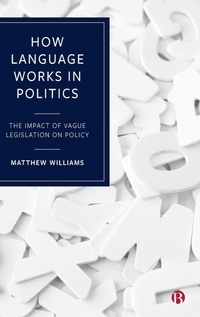
How Language Works in Politics
The Impact of Vague Legislation on Policy
1st Edition
Published on 26. June 2018
Book
Hardback
256 pages
978-1-5292-0020-1 (ISBN)
Description
There were more colons used in legislation in 2015 than there were words enacted in 1900. Using analysis from machine readings of all legislation enacted between 1900 and 2015, this book discusses the social impact of increasingly elastic legislative language on the contemporary workings of the British constitution.
The hot-button debates of our time - from immigration to European integration, to the creeping power of judges - have, at their core, battles over what policy instructions are authoritative.
The book encourages readers to connect the dots of British statecraft, and to understand how, exactly, public demands are transferred into laws that are then implemented with greater and lesser degrees of success. Crucially, it shows that vague legislation has a tremendous impact on policy delivery, disproportionately affecting the weakest, in areas including immigration, homelessness and anti-discrimination.
The hot-button debates of our time - from immigration to European integration, to the creeping power of judges - have, at their core, battles over what policy instructions are authoritative.
The book encourages readers to connect the dots of British statecraft, and to understand how, exactly, public demands are transferred into laws that are then implemented with greater and lesser degrees of success. Crucially, it shows that vague legislation has a tremendous impact on policy delivery, disproportionately affecting the weakest, in areas including immigration, homelessness and anti-discrimination.
Reviews / Votes
"... impressive and extremely thought-provoking... The book contains much data that throws a new light on the various debates in which it is situated." Local Government Studies "provides a valuable window into the world of legislation and its consequences. A go-to book for all those involved in drafting, amending, interpreting and researching legislation." Louise Thompson, University of SurreyMore details
Edition
First Edition
Language
English
Place of publication
Bristol
United Kingdom
Target group
Professional and scholarly
Illustrations
Not illustrated
Dimensions
Height: 240 mm
Width: 161 mm
Thickness: 21 mm
Weight
622 gr
ISBN-13
978-1-5292-0020-1 (9781529200201)
Copyright in bibliographic data and cover images is held by Nielsen Book Services Limited or by the publishers or by their respective licensors: all rights reserved.
Schweitzer Classification
Other editions
Additional editions
E-Book
06/2018
1st Edition
Bristol University Press
€47.99
Available for download
Previous edition
Book
Policy Press
€112.85
Shipment within 15-20 days
Person
Matthew Williams is Access and Career Development Fellow, Jesus College, University of Oxford. His research focusses on the sometimes difficult relationships between judges and politicians - where the rule of law meets the power of politics. He has sought to explain the increasing intervention by judges into sensitive public policy domains, such as immigration, anti-discrimination and homelessness.
Content
Part One - Language and Politics in the UK;
1 Introduction - How Language Works in Politics;
2 Past - How Has Parliament's Use of Language Changed?
3 Present - Why Has Parliament's Use of Language Changed?
Part Two - The Social Impact of Parliament's Use of Language;
4 Immigration - How Parliament's Language Affects Central Government Powers;
5 Homelessness - How Parliament's Language Affects Local Government Duties;
6 Anti-discrimination and Equality - How Parliament's Language Affects Individual Rights;
Part Three - Fixing the Code;
7 Constitutional Language - Lessons from Beyond Westminster
8 Filling Gaps - The Human Rights Act 1998
Conclusions.
1 Introduction - How Language Works in Politics;
2 Past - How Has Parliament's Use of Language Changed?
3 Present - Why Has Parliament's Use of Language Changed?
Part Two - The Social Impact of Parliament's Use of Language;
4 Immigration - How Parliament's Language Affects Central Government Powers;
5 Homelessness - How Parliament's Language Affects Local Government Duties;
6 Anti-discrimination and Equality - How Parliament's Language Affects Individual Rights;
Part Three - Fixing the Code;
7 Constitutional Language - Lessons from Beyond Westminster
8 Filling Gaps - The Human Rights Act 1998
Conclusions.