

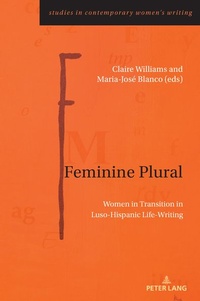
Feminine Plural
Women in Transition in Luso-Hispanic Life-Writing
Published on 5. May 2026
Book
Paperback/Softback
420 pages
978-1-78997-610-6 (ISBN)
Description
'Feminine Plural shows that a revolution is taking place in literature written in Portuguese and Spanish. After many years of being silenced by dictatorships, colonial injustice, and systemic problems of access to education, women from the Iberian Peninsula and Latin America are not only making their voices heard, but also, in the process, creating previously unseen literary forms in order to be able to tell their previously untold stories. I had not known how important it was to examine recent life-writing by women in my own language until I had this book in my hands. And if I needed proof that a personal story is more than a small cog in the mechanics of the world, this is it.' - Susana Moreira Marques, writer
'For several decades now, women's autobiographical writing has been flourishing. Many women writers narrate their personal experience, marked out by their condition of womanhood, by experiences such as their relationship with their mothers, migration, adoption, racism, motherhood, the rural world, infertility, sexuality, exile . In this well-documented and entertaining book, two great experts in Luso-Hispanic women's literature, Maria-José Blanco and Claire Williams, introduce and guide the reader through this vast new field of writing.' - Laura Freixas, writer
In the short period since our volume Feminine Singular came out, life-writing by women in the Luso-Hispanic world has proliferated, justifying another book of essays on the topic. Not only are more women choosing to write (about) themselves, they are doing so in innovative ways that cross conventional generic boundaries. They openly discuss previously taboo subjects, speak out against injustice and provoke changes in policy and attitudes. Furthermore, they embrace plurality, by recognising the achievements of their foremothers and celebrating their peers; expressing themselves through fragmentation and collage; and, ultimately, working and reading and writing together.
These essays introduce an Anglophone readership to some of the most exciting and audacious Luso-Hispanic women writing and making art today. They bring together a mixture of personal essays and short fiction, alongside more traditional literary critical research, to show what women's life-writing can do.
More details
Series
Edition
New edition
Language
English
Place of publication
Oxford
United Kingdom
Target group
Professional and scholarly
Edition type
New edition
Product notice
Paperback (trade)
Illustrations
26 Illustrations
Dimensions
Height: 229 mm
Width: 152 mm
Thickness: 25 mm
Weight
656 gr
ISBN-13
978-1-78997-610-6 (9781789976106)
Schweitzer Classification
Persons
Claire Williams is Professor of Brazilian Literature and Culture at the University of Oxford and a Fellow of St Peter's College.
Maria-José Blanco teaches twentieth-century Spanish literature at King's College London.
Content
List of Figures and Tables - Preface - Acknowledgments - Introduction - Speaking Up and Speaking Out: The Expanding Field of Women's Life-Writing in the Luso-Hispanic World, Maria-Jose Blanco and Claire Williams - 1. Life-Writing in the Hispanic World, Maria-Jose Blanco - 2. Life-Writing in the Lusophone World, Claire Williams - PART I: Writers and Artists at Work - 3. Clavicle, an Excerpt, Marta Sanz - 4. 'Holy Land', Djaimilia Pereira de Almeida - 5. 'What is an Autora?' and 'Being Latin@', Two Cronicas from Viajar Sola, Liliana Chavez Diaz - 6. How to Deal with Being Brazilian - Some Brief Thoughts on Sense of Place, Representation and the Stories I Can Tell, Carol Bensimon - 7. On Transitions and Belonging: Multiple Narratives of Contemporary Brazilian Art Diasporas, Cibelle, Pauline Batista, Rubiane Maia, Sylvia Morgado, Tete de Alencar, Marcia Thompson - PART II: Pushing the (Generic) Boundaries - 8. From the Love Boat to Noah's Ark: The Unpublished Log-Book of Maria Ondina Braga, Isabel Cristina Mateus - 9. Ilse Losa's 'Chronic' Border and Boundary Crossing, Rosa Churcher Clarke - 10. And the Writer Became a Grandmother: Josefina Aldecoa and Rosa Regas, Maria-Jose Blanco - 11. Brazilian History Through Women's Eyes: Ana Arruda Callado's Feminist Biographies, Claire Williams - 12. Painful maternity: Illness and Mother-Daughter Relationships in Sangre en el ojo by Lina Meruane and Madre mia by Florencia del Campo, Beatriz Velayos Amo - 13. Post-Traumatic Transitions: Writing Women's Lives in Dulce Chacon's La voz dormida, Hannie Lawlor - 14. From Puberty and Democracy to Menopause and Recession: Representations of Female Identity in the Works of Marta Sanz, Marta Simo-Comas - 15. Narrating Crossings: Mother / Daughter, Morocco / Spain, Catherine Bourland Ross - PART III: 'Art Spaces and Border Crossings' - 16. 'Eu sou porque somos': Women's Resistance and Collaboration in Latin American Cultural Practices, Maria B. Batlle and Georgina Robinson - 17. The Transition(s) of Poetry into Arts, Languages and Gentes in Weiyami: Mulheres que Fazem Sol, Anelia Montechiari Pietrani - 18. In the House of Celestina: Paula Rego and the Ageing Female?? Body, Maria Luisa Coelho - 19. 'Todos ellos estan equivocados': Challenging Borders between Disciplines: Humour, Science and Anthropology in Remedios Varo's De Homo Rodans, Nadia Albaladejo Garcia - 20. A Curvy Revolution: Celebrating the Female Body in #Curvy by Covadonga D'lom and Flavita Banana, Diana Aramburu - Notes on the Contributors - Index