

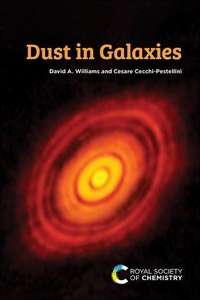
Dust in Galaxies
Published on 12. December 2019
Book
Paperback/Softback
247 pages
978-1-78801-505-9 (ISBN)
Description
Without interstellar dust, the Universe as we see it today would not exist. Yet at first we considered this vital ingredient merely an irritating fog that prevented a clear view of the stars and nebulae in the Milky Way and other galaxies. We now know that interstellar dust has essential roles in the physics and chemistry of the formation of stars and planetary systems, the creation of the building blocks of life, and in the movement of those molecules to new planets. This is the story in this book.
After introducing the materials this interstellar dust is made of, the authors explain the range of sizes and shapes of the dust grains in the Milky Way galaxy and the life cycle of dust, starting from the origins of dust grains in stellar explosions through to their turbulent destruction. Later on we see the variety of processes in interstellar space involving dust and the events there that cause the dust to change in ways that astronomers and astrobiologists can use to indirectly observe those events.
This book is written for a general audience, concentrating on ideas rather than detailed mathematics and chemical formulae, and is the first time interstellar dust has been discussed at an accessible level.
After introducing the materials this interstellar dust is made of, the authors explain the range of sizes and shapes of the dust grains in the Milky Way galaxy and the life cycle of dust, starting from the origins of dust grains in stellar explosions through to their turbulent destruction. Later on we see the variety of processes in interstellar space involving dust and the events there that cause the dust to change in ways that astronomers and astrobiologists can use to indirectly observe those events.
This book is written for a general audience, concentrating on ideas rather than detailed mathematics and chemical formulae, and is the first time interstellar dust has been discussed at an accessible level.
More details
Language
English
Place of publication
Cambridge
United Kingdom
Target group
College/higher education
Professional and scholarly
Product notice
Unsewn / adhesive bound
Dimensions
Height: 230 mm
Width: 154 mm
Thickness: 30 mm
Weight
375 gr
ISBN-13
978-1-78801-505-9 (9781788015059)
DOI
10.1039/9781839168307
Copyright in bibliographic data and cover images is held by Nielsen Book Services Limited or by the publishers or by their respective licensors: all rights reserved.
Schweitzer Classification
Other editions
Additional editions
David A. Williams | Cesare Cecchi-Pestellini
Dust in Galaxies
E-Book
12/2019
1st Edition
Royal Society of Chemistry
€34.49
Available for download
Persons
Content
Interstellar Dust in Galaxies;
What are Dust Grains made of? How to find their Chemical Composition;
What is the Structure of Interstellar Dust Grains? How to find their Physical Composition;
Some Old Stars are "Smoking Like Candles": Is this where Interstellar Dust Grains Come from?;
What happens to Stardust in Interstellar Space?;
Doing Chemistry in the Dark: How Interstellar Dust leads to Molecular Complexity in the Interstellar Gas;
Catalytic Chemistry in Space? Reactions on Bare Dust Grains;
Chemistry in the Freezer: Making Complex Molecules from Simple Interstellar Ices;
Making Stars and Planets from Interstellar Gas and Dust;
Where and How does Life Begin?;
What have we Learned About Dust in Space?
What are Dust Grains made of? How to find their Chemical Composition;
What is the Structure of Interstellar Dust Grains? How to find their Physical Composition;
Some Old Stars are "Smoking Like Candles": Is this where Interstellar Dust Grains Come from?;
What happens to Stardust in Interstellar Space?;
Doing Chemistry in the Dark: How Interstellar Dust leads to Molecular Complexity in the Interstellar Gas;
Catalytic Chemistry in Space? Reactions on Bare Dust Grains;
Chemistry in the Freezer: Making Complex Molecules from Simple Interstellar Ices;
Making Stars and Planets from Interstellar Gas and Dust;
Where and How does Life Begin?;
What have we Learned About Dust in Space?