

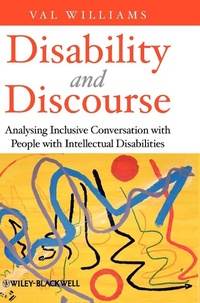
Disability and Discourse
Analysing Inclusive Conversation with People with Intellectual Disabilities
1st Edition
Published on 28. January 2011
Book
Hardback
272 pages
978-0-470-68266-1 (ISBN)
Description
Disability and Discourse applies and explains Conversation Analysis (CA), an established methodology for studying communication, to explore what happens during the everyday encounters of people with intellectual disabilities and the other people with whom they interact.
Explores conversations and encounters from the lives of people with intellectual disabilities
Introduces the established methodology of Conversation Analysis, making it accessible and useful to a wide range of students, researchers and practitioners
Adopts a discursive approach which looks at how people with intellectual disabilities use talk in real-life situations, while showing how such talk can be supported and developed
Follows people into the meetings and discussions that take place in self-advocacy and research contexts
Offers insights into how people with learning disabilities can have a voice in their own affairs, in policy-making, and in research
Explores conversations and encounters from the lives of people with intellectual disabilities
Introduces the established methodology of Conversation Analysis, making it accessible and useful to a wide range of students, researchers and practitioners
Adopts a discursive approach which looks at how people with intellectual disabilities use talk in real-life situations, while showing how such talk can be supported and developed
Follows people into the meetings and discussions that take place in self-advocacy and research contexts
Offers insights into how people with learning disabilities can have a voice in their own affairs, in policy-making, and in research
Reviews / Votes
"This thought-provoking text is aimed at practitioners, those who engage in everyday conversation with individuals with intellectual disabilities and researchers who employ conversation analysis (CA). This book reminds us that these individuals and their support workers can benefit from engaging in more mindful and reflective practice with regard to everyday discourse." (British Journal of Learning Disabilities, 7 August 2013)More details
Language
English
Place of publication
New York
United States
Target group
College/higher education
Professional and scholarly
Product notice
sewn/stitched
Paper over boards
Dimensions
Height: 250 mm
Width: 175 mm
Thickness: 19 mm
Weight
656 gr
ISBN-13
978-0-470-68266-1 (9780470682661)
Copyright in bibliographic data and cover images is held by Nielsen Book Services Limited or by the publishers or by their respective licensors: all rights reserved.
Schweitzer Classification
Other editions
Additional editions
Val Williams
Disability and Discourse
Analysing Inclusive Conversation with People with Intellectual Disabilities
E-Book
03/2011
1st Edition
Wiley
€34.99
Available for download

Val Williams
Disability and Discourse
Analysing Inclusive Conversation with People with Intellectual Disabilities
Book
01/2011
Wiley
€42.08
Article exhausted; check different version
Val Williams
Disability and Discourse
Analysing Inclusive Conversation with People with Intellectual Disabilities
E-Book
12/2010
1st Edition
Wiley
€34.99
Available for download
Person
Val Williams is a Senior Research Fellow at the Norah Fry Research Centre, University of Bristol, UK - a leading centre for research into services for people with intellectual disabilities based on a social model of disability. Her work concerns the barriers faced by adults with learning disabilities, with particular emphasis on inclusive research and analysis of naturally-occurring communication.
Content
About the Author. Preface.
Acknowledgements.
1 Starting Points.
2 Some Building Blocks for Analysis.
Part 1 Individual Voices.
3 Challenging Disempowering Patterns of Talk.
4 Supporting Someone to be Competent.
5 Opening up Conversation.
6 Equalising Talk and Friendliness.
7 Doing Autonomy: 'It's entirely up to you'.
8 Public Encounters.
Part 2 Collective Voice.
9 Self-Advocacy Talk: The personal to the political.
10 Supporting People to Speak up in Group Situations.
11 Being Interviewers with the Label of 'Intellectual Disability'.
12 Behind the Scenes in Inclusive Research: 'We are the artists of our lives'.
13 Talk about Labelling and Identity.
14 Reflections on Doing Analysis.
15 Reflections on Change.
Appendix Transcription Conventions.
References.
Index.
Acknowledgements.
1 Starting Points.
2 Some Building Blocks for Analysis.
Part 1 Individual Voices.
3 Challenging Disempowering Patterns of Talk.
4 Supporting Someone to be Competent.
5 Opening up Conversation.
6 Equalising Talk and Friendliness.
7 Doing Autonomy: 'It's entirely up to you'.
8 Public Encounters.
Part 2 Collective Voice.
9 Self-Advocacy Talk: The personal to the political.
10 Supporting People to Speak up in Group Situations.
11 Being Interviewers with the Label of 'Intellectual Disability'.
12 Behind the Scenes in Inclusive Research: 'We are the artists of our lives'.
13 Talk about Labelling and Identity.
14 Reflections on Doing Analysis.
15 Reflections on Change.
Appendix Transcription Conventions.
References.
Index.