

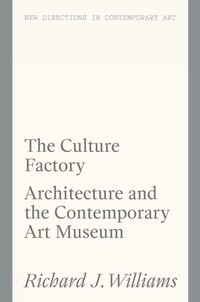
The Culture Factory
Architecture and the Contemporary Art Museum
Published on 15. October 2021
Book
Paperback/Softback
144 pages
978-1-84822-397-4 (ISBN)
Description
The Culture Factory: Architecture and the Contemporary Art Museum explores the key battlegrounds in the design of the contemporary-art museum, describing the intersection of art, aesthetics and politics at the highest levels, and the commitment of states, cities and wealthy individuals to the display of art. Global in scope, the book examines key examples from Europe and the Americas to contemporary China. It describes museum building as the projection of political power, but also as a desire to acquire power. So it is a book about ambitious peripheries as much as the traditional centres: Dundee and Bilbao as well as New York and Paris.
It is commonplace to assume that the contemporary-art museum has become ever more spectacular, and the place of art ever more subservient within it. This book argues that a tendency to spectacle coexists with another equally powerful tendency, to make art museums that celebrate the artistic process, typically attempting to recreate the feeling of the artist's studio. That tendency is strongly represented in the designs for the Centre Georges Pompidou, completed in 1977, and arguably in the many contemporary art museums which have adapted former industrial buildings.
Richard J. Williams's stimulating text includes many historical examples to illustrate how we got to where we are now, from the Centre Pompidou in Paris, to the Guggenheim museums in New York and Bilbao, London's Tate Modern, Oscar Niemeyer's work in Brazil and beyond, and the 798 Art District in Beijing.
It is commonplace to assume that the contemporary-art museum has become ever more spectacular, and the place of art ever more subservient within it. This book argues that a tendency to spectacle coexists with another equally powerful tendency, to make art museums that celebrate the artistic process, typically attempting to recreate the feeling of the artist's studio. That tendency is strongly represented in the designs for the Centre Georges Pompidou, completed in 1977, and arguably in the many contemporary art museums which have adapted former industrial buildings.
Richard J. Williams's stimulating text includes many historical examples to illustrate how we got to where we are now, from the Centre Pompidou in Paris, to the Guggenheim museums in New York and Bilbao, London's Tate Modern, Oscar Niemeyer's work in Brazil and beyond, and the 798 Art District in Beijing.
Reviews / Votes
'Richard J. Williams's brief but enjoyable The Culture Factory critically explores how art museums went from places of art appreciation to spaces of consumption, media, money, and entertainment over the last fifty years.' - A Weekly Dose of Architecture Books 'The Culture Factory takes the reader on an engaging tour of many of the most significant examples of museum architecture from the mid-twentieth to the early twenty-first century, to demonstrate its role in the emergence of art as merely "one point on a continuum of consumption" [...] in the contemporary experience economy.' - Burlington ContemporaryMore details
Series
Language
English
Place of publication
London
United Kingdom
Illustrations
Illustrations; 20 Illustrations, black and white
Dimensions
Height: 133 mm
Width: 201 mm
Thickness: 13 mm
Weight
218 gr
ISBN-13
978-1-84822-397-4 (9781848223974)
Copyright in bibliographic data and cover images is held by Nielsen Book Services Limited or by the publishers or by their respective licensors: all rights reserved.
Schweitzer Classification
Other editions
Additional editions
E-Book
10/2021
Lund Humphries Publishers Ltd
€30.49
Available for download
Person
Richard J. Williams is Professor of Contemporary Visual Cultures at the University of Edinburgh. Among his most recent books are Sex and Buildings (2013), Why Cities Look the Way They Do (2019) and Reyner Banham Revisited (2021).
Content
Series Editor's Foreword; Acknowledgements; Chapter One: How Did we Get Here?; Chapter Two: Making Sense of Industrial Space; Chapter Three: Museums and Architectural Icons; Chapter Four: Landscapes in the Vicinity of Art; Notes; Further Reading; Index