

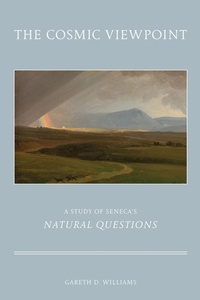
The Cosmic Viewpoint
A Study of Seneca's Natural Questions
Published on 12. May 2016
Book
Paperback/Softback
410 pages
978-0-19-049098-0 (ISBN)
Description
Seneca's Natural Questions is an eight-book disquisition on the nature of meteorological phenomena, ranging inter alia from rainbows to earthquakes, from comets to the winds, from the causes of snow and hail to the reasons why the Nile floods in summer. Much of this material had been treated in the earlier Greco-Roman meteorological tradition, but what notoriously sets Seneca's writing apart is his insertion of extended moralizing sections within his technical discourse. How, if at all, are these outbursts against the luxury and vice that are apparently rampant in Seneca's first-century CE Rome to be reconciled with his main meteorological agenda?
In grappling with this familiar question, The Cosmic Viewpoint argues that Seneca is no blinkered or arid meteorological investigator, but a creative explorer into nature's workings who offers a highly idiosyncratic blend of physico-moral investigation across his eight books. At one level, his inquiry into nature impinges on human conduct and morality in its implicit propagation of the familiar Stoic ideal of living in accordance with nature: the moral deviants whom Seneca condemns in the course of the work offer egregious examples of living contrary to nature's balanced way. At a deeper level, however, The Cosmic Viewpoint stresses the literary qualities and complexities that are essential to Seneca's literary art of science: his technical enquiries initiate a form of engagement with nature which distances the reader from the ordinary involvements and fragmentations of everyday life, instead centering our existence in the cosmic whole. From a figurative standpoint, Seneca's meteorological theme raises our gaze from a terrestrial level of existence to a more intuitive plane where literal vision gives way to "higher" conjecture and intuition: in striving to understand meteorological phenomena, we progress in an elevating direction--a conceptual climb that renders the Natural Questions no mere store of technical learning, but a work that actively promotes a change of perspective in its readership.
In grappling with this familiar question, The Cosmic Viewpoint argues that Seneca is no blinkered or arid meteorological investigator, but a creative explorer into nature's workings who offers a highly idiosyncratic blend of physico-moral investigation across his eight books. At one level, his inquiry into nature impinges on human conduct and morality in its implicit propagation of the familiar Stoic ideal of living in accordance with nature: the moral deviants whom Seneca condemns in the course of the work offer egregious examples of living contrary to nature's balanced way. At a deeper level, however, The Cosmic Viewpoint stresses the literary qualities and complexities that are essential to Seneca's literary art of science: his technical enquiries initiate a form of engagement with nature which distances the reader from the ordinary involvements and fragmentations of everyday life, instead centering our existence in the cosmic whole. From a figurative standpoint, Seneca's meteorological theme raises our gaze from a terrestrial level of existence to a more intuitive plane where literal vision gives way to "higher" conjecture and intuition: in striving to understand meteorological phenomena, we progress in an elevating direction--a conceptual climb that renders the Natural Questions no mere store of technical learning, but a work that actively promotes a change of perspective in its readership.
Reviews / Votes
Williams's exemplary, learned study of Natural Questions, Seneca's rarely read treatise on meteorology complements Harry Hine's translation of this work (2010).... Although the author offers a wealth of insight into Seneca's use of sources, Williams's acumen as a close reader carefully attuned to the rhetorical and literary dimensions of Natural Questions stands out. Highly recommended. * CHOICE * Sorting styles of reasoning, The Cosmic Viewpoint pilots through joined-up power-thinking from Rome's sharpest, pushiest, writer. Now we can read Seneca on the ecosphere: how-and-why we should try our damnedest to figure out how planet Earth works. * J.G. Henderson, Cambridge University* In this subtle and perceptive study, Gareth Williams shows how in the Natural Questions Seneca transformed the genre of meteorological writing in a highly creative way, offering a holistic Stoic vision of the cosmos, where in wrestling to understand the physical world we must also wrestle with our human nature. * Harry Hine, University of St. Andrews
* Offers an extremely convincing articulation of [Naturales Quaestiones's] moral prefaces and interludes with the strictly technical sections of the book. * Philosophy in Review *
More details
Language
English
Place of publication
New York
United States
Target group
College/higher education
Dimensions
Height: 234 mm
Width: 156 mm
Thickness: 24 mm
Weight
692 gr
ISBN-13
978-0-19-049098-0 (9780190490980)
Copyright in bibliographic data and cover images is held by Nielsen Book Services Limited or by the publishers or by their respective licensors: all rights reserved.
Schweitzer Classification
Other editions
Additional editions
Book
04/2012
Oxford University Press Inc
€101.40
Shipment within 15-20 days
Person
Gareth D. Williams is Violin Family Professor of Classics at Columbia University. His most recent book, co-edited with Katharina Volk, is Roman Reflections.
Content
Abbreviations
Introduction
I. Interiority and Cosmic Consciousness in the Natural Questions
II. Seneca's Moralizing Interludes
III. The Cataclysm and the Nile
IV. The Rhetoric of Science
V. Seneca on Winds
VI. Earthquakes, Consolation, and the Senecan Sublime
VII. Seneca on Comets and Ancient Cometary Theory
VIII. Seneca on Lightning and Divination
Epilogue
Bibliography
Index of Passages
General Index
Index of Latin Words
Index of Greek Words
Introduction
I. Interiority and Cosmic Consciousness in the Natural Questions
II. Seneca's Moralizing Interludes
III. The Cataclysm and the Nile
IV. The Rhetoric of Science
V. Seneca on Winds
VI. Earthquakes, Consolation, and the Senecan Sublime
VII. Seneca on Comets and Ancient Cometary Theory
VIII. Seneca on Lightning and Divination
Epilogue
Bibliography
Index of Passages
General Index
Index of Latin Words
Index of Greek Words