

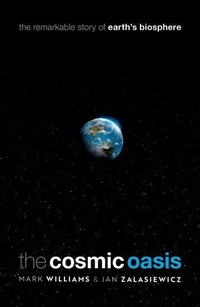
The Cosmic Oasis
The Remarkable Story of Earth's Biosphere
Published on 23. June 2022
Book
Hardback
288 pages
978-0-19-884587-4 (ISBN)
Description
Alone in the known universe the Earth glows bright with life, a unique cosmic oasis of biodiversity which is now under threat from our own actions.
The Earth is a unique as a living planet, a cosmic oasis drifting in the vastness of barren space. It is strikingly and obviously different from our nearest heavenly neighbours, the Moon, Venus and Mars, in its thin skin of biology, extending from the surface for a few kilometres into the crust, and for a few tens of kilometres into the air. But how did this remarkable abundance and diversity of life arise? How has life survived over the enormous time frame of Earth's history? And does it continue to flourish now, especially with the growing pressure for space from humans?
The Cosmic Oasis examines life on Earth, from our earliest interactions with animals and plants to our absolute domination of biology. It follows our developing understanding of life's origins, its remarkable complexity, and its interactions with the air, oceans and land. It also shows how patterns of diversity across the surface of the planet evolved, and how humans are now homogenising these, degrading both biodiversity and the space in which life can exist. Within this overall trend of loss there are some remarkable examples of survival, from the beneficial relationships between the gelada monkeys and wolves of the Ethiopian highlands, and the people and brown howler monkeys of Porte Allegre in Brazil, to interactions between you and your gut microbiome. Thoughout, the authors ask what these interactions can teach us about building a better relationship with nature, and consider how we might become stewards, rather than destructive exploiters, of the life around us.
The Earth is a unique as a living planet, a cosmic oasis drifting in the vastness of barren space. It is strikingly and obviously different from our nearest heavenly neighbours, the Moon, Venus and Mars, in its thin skin of biology, extending from the surface for a few kilometres into the crust, and for a few tens of kilometres into the air. But how did this remarkable abundance and diversity of life arise? How has life survived over the enormous time frame of Earth's history? And does it continue to flourish now, especially with the growing pressure for space from humans?
The Cosmic Oasis examines life on Earth, from our earliest interactions with animals and plants to our absolute domination of biology. It follows our developing understanding of life's origins, its remarkable complexity, and its interactions with the air, oceans and land. It also shows how patterns of diversity across the surface of the planet evolved, and how humans are now homogenising these, degrading both biodiversity and the space in which life can exist. Within this overall trend of loss there are some remarkable examples of survival, from the beneficial relationships between the gelada monkeys and wolves of the Ethiopian highlands, and the people and brown howler monkeys of Porte Allegre in Brazil, to interactions between you and your gut microbiome. Thoughout, the authors ask what these interactions can teach us about building a better relationship with nature, and consider how we might become stewards, rather than destructive exploiters, of the life around us.
Reviews / Votes
This book tells an interesting story about our understanding of the natural world. A straightforward discussion of interesting facts about nature, liberally punctuated with historical background and comment, it is easy and enjoyable to read. * Choice * easy and enjoyable to read * M. S. Zavada, CHOICE Reviews * captivating and informative * Jonathan Cowie, The Science Fact & Science Fiction Concatenation *More details
Language
English
Place of publication
Oxford
United Kingdom
Illustrations
8 black and white images
Dimensions
Height: 236 mm
Width: 160 mm
Thickness: 27 mm
Weight
486 gr
ISBN-13
978-0-19-884587-4 (9780198845874)
Copyright in bibliographic data and cover images is held by Nielsen Book Services Limited or by the publishers or by their respective licensors: all rights reserved.
Schweitzer Classification
Other editions
Additional editions
E-Book
05/2022
1st Edition
OUP eBook
€18.49
Available for download
E-Book
05/2022
1st Edition
OUP eBook
€18.49
Available for download
Persons
Mark Williams is a Professor of Palaeobiology at the University of Leicester, a sometime British Geological Survey palaeontologist, and a former scientist with the British Antarctic Survey. He has a strong interest in how the fossil record reflects changes in our planet through time. He teaches many aspects of geology and palaeontology and has published many papers in scientific journals.
Jan Zalasiewicz is Emeritus Professor of Palaeobiology at the University of Leicester, before that working at the British Geological Survey. A field geologist, palaeontologist, and stratigrapher, he is a researcher into fossil ecosystems and environments across over half a billion years of geological time. He has published over a hundred papers in scientific journals.
Together they are the authors of The Goldilocks Planet, (2012); Ocean Worlds (2014); and Skeletons (2018).
Jan Zalasiewicz is Emeritus Professor of Palaeobiology at the University of Leicester, before that working at the British Geological Survey. A field geologist, palaeontologist, and stratigrapher, he is a researcher into fossil ecosystems and environments across over half a billion years of geological time. He has published over a hundred papers in scientific journals.
Together they are the authors of The Goldilocks Planet, (2012); Ocean Worlds (2014); and Skeletons (2018).
Content
1: Earthrise
2: A spadeful of Earth
3: The planet in a garden
4: The lost worlds of the giants
5: A bonfire like no other
6: The bite in your hamburger
7: Mirror to the world
8: No country for wild apes
Index
2: A spadeful of Earth
3: The planet in a garden
4: The lost worlds of the giants
5: A bonfire like no other
6: The bite in your hamburger
7: Mirror to the world
8: No country for wild apes
Index