

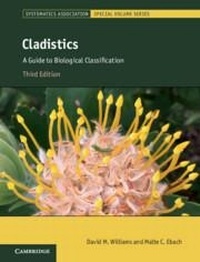
Cladistics
A Guide to Biological Classification
3rd Edition
Will be published approx. on 6. August 2020
Book
Hardback
452 pages
978-1-107-00810-6 (ISBN)
Description
This new edition of a foundational text presents a contemporary review of cladistics, as applied to biological classification. It provides a comprehensive account of the past fifty years of discussion on the relationship between classification, phylogeny and evolution. It covers cladistics in the era of molecular data, detailing new advances and ideas that have emerged over the last twenty-five years. Written in an accessible style by internationally renowned authors in the field, readers are straightforwardly guided through fundamental principles and terminology. Simple worked examples and easy-to-understand diagrams also help readers navigate complex problems that have perplexed scientists for centuries. This practical guide is an essential addition for advanced undergraduates, postgraduates and researchers in taxonomy, systematics, comparative biology, evolutionary biology and molecular biology.
Reviews / Votes
'The authors ... are well situated to consider and elaborate on cladistic philosophy and applications in biological and evolutionary studies. This volume ... will provide a solid background in the general study of classification, the major considerations for determining taxon relationships, a bit of history, and solid discussion on the use and theory of cladistics with various examples and citations for reference.' S. T. Meiers, ChoiceMore details
Series
Edition
3rd Revised edition
Language
English
Place of publication
Cambridge
United Kingdom
Target group
College/higher education
Professional and scholarly
Edition type
Revised edition
Product notice
sewn/stitched
Cloth over boards
Illustrations
Worked examples or Exercises; 83 Halftones, black and white
Dimensions
Height: 249 mm
Width: 189 mm
Thickness: 24 mm
Weight
1089 gr
ISBN-13
978-1-107-00810-6 (9781107008106)
Copyright in bibliographic data and cover images is held by Nielsen Book Services Limited or by the publishers or by their respective licensors: all rights reserved.
Schweitzer Classification
Other editions
Additional editions
E-Book
08/2020
Cambridge University Press
€34.49
Available for download
Book
08/2020
3rd Edition
Cambridge University Press
€65.00
Shipment within 15-20 days
E-Book
07/2020
3rd Edition
Cambridge University Press
€48.99
Available for download
Persons
David M. Williams is a researcher at the Natural History Museum, London, specializing in diatom (Bacillariophyta) taxonomy and biogeography. He is the current president of the Systematics Association, London. He has written over 240 scientific papers and ten books. Malte C. Ebach is Senior Lecturer in Biogeography at the University of New South Wales, Sydney. He has published extensively on the history, theory and methodology of biological systematics, taxonomy and biogeography. He is Associate Editor for the Journal of Biogeography, Australian Systematic Botany and Editor of the CRC Biogeography Book Series.
Content
Part I. The Interrelationships of Organisms: 1. What this book is about; 2. Classification; Part II. Systematics: Exposing Myths: 3. Relationship diagrams; 4. Essentialism and typology; 5. Monothetic and polythetic taxa; 6. Non-taxa or the absence of -phyly: paraphyly and aphyly; Part III. The Cladistic Programme: 7. Parameters of classification: ordo ab chao; Part IV. How to Study Classification: 8. Modern artificial methods and raw data; 9. How to study classification: consensus techniques and general classifications; 10. How to study classification - 'total evidence' vs 'consensus', character congruence vs taxonomic congruence, simultaneous analysis vs partitioned data; 11. How to study classification: natural methods I - consensus revisited; 12. How to study classification: natural methods II - beyond method, the philosophy of three-item analysis; Part V. Beyond Classification: 13. Beyond classification: how to study phylogeny; 14. The separation of classification and phylogenetics; 15. Further myths and misunderstandings.