

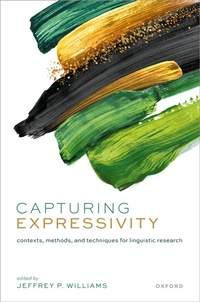
Capturing Expressivity
Contexts, Methods, and Techniques for Linguistic Research
Published on 25. March 2025
Book
Hardback
256 pages
978-0-19-285893-1 (ISBN)
Description
This volume investigates the methods and techniques used to investigate expressivity, a term used to describe linguistic phenomena that serve an expressive function and deliver sensory information about an event, entity, or other culturally-determined category through a set of grammatical resources. The study of expressivity has gradually grown in stature over the last decade in particular; while there are much earlier accounts of expressivity, particularly within descriptive traditions of African, East Asian, and European linguistics, modern linguistic theory has been rather slow to incorporate information regarding these forms and processes into contemporary dialogue. In many earlier grammars, discussion of expressive elements such as ideophones and mimetics was relegated to footnotes at best. This is no longer the case in modern linguistic documentation and description, necessitating new fieldwork methods and analytical tools. The chapters in this book represent a new stage in the history of the study of expressivity: they explore a variety of different expressive items from a wide range of languages, focusing on the question of how to 'capture' expressivity in language and culture.
More details
Language
English
Place of publication
Oxford
United Kingdom
Target group
College/higher education
Product notice
sewn/stitched
Cloth over boards
Dimensions
Height: 240 mm
Width: 165 mm
Thickness: 23 mm
Weight
599 gr
ISBN-13
978-0-19-285893-1 (9780192858931)
Copyright in bibliographic data and cover images is held by Nielsen Book Services Limited or by the publishers or by their respective licensors: all rights reserved.
Schweitzer Classification
Person
Jeffrey P. Williams is Professor of Ethnology and Linguistics at Texas Tech University, having previously held positions at the University of Sydney, Vanderbilt University, and Cleveland State University. His research is wide ranging and covers topics such as language contact, English dialectology, expressivity in grammar, neurolinguistics, and language documentation and endangerment.
Content
1: Jeffrey P. Williams: Introduction
Part I. Contexts
2: Christa Kilian-Hatz: Ideophones: How the world speaks to us
3: Hakan Lundstroem and Jan-Olof Svantesson: Expressives in Kuanmu singing
Part II. Methods
4: Iraide Ibarretxe-Antunano: Eliciting ideophones in the field: The IdEus-Psylex stimuli collection
5: Bonnie McLean and Mark Dingemanse: Diversifying the toolkit for documentary research on ideophones
6: Nicolau Dols and Pere Garau: Detecting and analysing expressives in a language corpus
7: Janis Nuckolls and Tod Swanson: Empathy and indirect methods for fieldwork with ideophones in Pastaza and Upper Napo Kichwa
8: Olivier Le Guen and Rodrigo Petatillo Chan: Documenting stealth lexicon: Field methods to collect the use of ideophones in Yucatec Maya
9: Kimi Akita: Studying Japanese mimetics
Part III. Techniques
10: Harshit Parmar and Jeffrey P. Williams: Is there an aesthetic component of language?
11: Nathan Badenoch: Learning to learn expressives: Finding cultural salience in linguistic fieldwork
Part I. Contexts
2: Christa Kilian-Hatz: Ideophones: How the world speaks to us
3: Hakan Lundstroem and Jan-Olof Svantesson: Expressives in Kuanmu singing
Part II. Methods
4: Iraide Ibarretxe-Antunano: Eliciting ideophones in the field: The IdEus-Psylex stimuli collection
5: Bonnie McLean and Mark Dingemanse: Diversifying the toolkit for documentary research on ideophones
6: Nicolau Dols and Pere Garau: Detecting and analysing expressives in a language corpus
7: Janis Nuckolls and Tod Swanson: Empathy and indirect methods for fieldwork with ideophones in Pastaza and Upper Napo Kichwa
8: Olivier Le Guen and Rodrigo Petatillo Chan: Documenting stealth lexicon: Field methods to collect the use of ideophones in Yucatec Maya
9: Kimi Akita: Studying Japanese mimetics
Part III. Techniques
10: Harshit Parmar and Jeffrey P. Williams: Is there an aesthetic component of language?
11: Nathan Badenoch: Learning to learn expressives: Finding cultural salience in linguistic fieldwork