

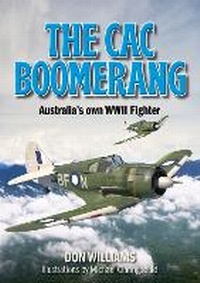
The CAC Boomerang
Australia's own WWII Fighter
Published on 6. November 2024
Book
Paperback/Softback
104 pages
978-0-9756423-2-0 (ISBN)
Description
The CAC Boomerang has a unique place in Australian aviation history, being the nation's only home designed and produced fighter.
The design was born in dark days at the start of the Pacific War when the RAAF possessed not a single modern fighter and the southwards onslaught of Japanese forces seemed unstoppable. The single seat Boomerang owed its origins to the Wirraway two seat general purpose aircraft produced by the Commonwealth Aircraft Corporation in Melbourne. Because of existing Wirraway production, a Boomerang prototype flew less than six months after the design was conceived - a remarkable achievement.
Lacking the performance of contemporaries such as America's P-39 and P-40 and Japan's Zero, the Boomerang's subsequent history is chequered. It served with three RAAF home defence squadrons in the fighter interceptor role but had only fleeting, unsuccessful, contact with enemy aircraft. However, the Boomerang found its true niche as an army cooperation aircraft, and the type gave very useful service with Nos. 4 and 5 Squadrons in New Guinea and Bougainville.
With hindsight the Boomerang provided an insurance policy if other fighters could not be obtained from the US and Britain. In that role it was successful, and its production maintained a skilled wartime workforce at the CAC factory.
This is the first stand-alone history of the Boomerang. The author Don Williams examines this unique aircraft and its origins, service and the men that flew it.
The design was born in dark days at the start of the Pacific War when the RAAF possessed not a single modern fighter and the southwards onslaught of Japanese forces seemed unstoppable. The single seat Boomerang owed its origins to the Wirraway two seat general purpose aircraft produced by the Commonwealth Aircraft Corporation in Melbourne. Because of existing Wirraway production, a Boomerang prototype flew less than six months after the design was conceived - a remarkable achievement.
Lacking the performance of contemporaries such as America's P-39 and P-40 and Japan's Zero, the Boomerang's subsequent history is chequered. It served with three RAAF home defence squadrons in the fighter interceptor role but had only fleeting, unsuccessful, contact with enemy aircraft. However, the Boomerang found its true niche as an army cooperation aircraft, and the type gave very useful service with Nos. 4 and 5 Squadrons in New Guinea and Bougainville.
With hindsight the Boomerang provided an insurance policy if other fighters could not be obtained from the US and Britain. In that role it was successful, and its production maintained a skilled wartime workforce at the CAC factory.
This is the first stand-alone history of the Boomerang. The author Don Williams examines this unique aircraft and its origins, service and the men that flew it.
More details
Language
English
Place of publication
Kent Town
Australia
Product notice
Paperback (trade)
Unsewn / adhesive bound
Illustrations
fully illustrated;colour
Dimensions
Height: 243 mm
Width: 172 mm
Thickness: 7 mm
Weight
312 gr
ISBN-13
978-0-9756423-2-0 (9780975642320)
Copyright in bibliographic data and cover images is held by Nielsen Book Services Limited or by the publishers or by their respective licensors: all rights reserved.
Schweitzer Classification
Person
In recent years Don Williams has stuided the role of Royal Australian Air Force in the Pacific War. He was surprised to find that no book telling the complete story of Australia's own wartime emergency fighter, the Commonwealth Aircraft Corporation Boomerang, had been published. Don decided to fill this gap by writing a book dedicated to the Boomerang. He is also a keen amateur photographer and is pleased that some of his photographs are included in the book.
Sound research and writing were foundations of Don's career as a policy analyst and these skills were further honed when he completed a mature age PhD.
Sound research and writing were foundations of Don's career as a policy analyst and these skills were further honed when he completed a mature age PhD.
Content
Abbreviations
& Glossary
About the Author
Acknowledgements
Introduction
Maps
Chapter 1 -
Strategic Leadership of Australia's Air War in WWII
Chapter 2 - Why
Australia Needed an Emergency Fighter in WWII
Chapter 3 - A
Battle Won: Approval to Produce an Australian Interceptor Fighter
Chapter 4 - Tests
and Further Orders
Chapter 5 - The
Production Battle: Early Victories and Later Losses
Chapter 6 - The
CAC Boomerang Described
Chapter 7 - The
Boomerang Goes to War: RAAF Service
Chapter 8 - No. 4
Squadron
Chapter 9 - No. 5
Squadron and Other Units
Chapter 10 -
Prominent Boomerang Pilots
Chapter 11 -
Assessing the Boomerang
Appendix: Summary
of Boomerang Air Combat Engagements
Sources
Index of Names
& Glossary
About the Author
Acknowledgements
Introduction
Maps
Chapter 1 -
Strategic Leadership of Australia's Air War in WWII
Chapter 2 - Why
Australia Needed an Emergency Fighter in WWII
Chapter 3 - A
Battle Won: Approval to Produce an Australian Interceptor Fighter
Chapter 4 - Tests
and Further Orders
Chapter 5 - The
Production Battle: Early Victories and Later Losses
Chapter 6 - The
CAC Boomerang Described
Chapter 7 - The
Boomerang Goes to War: RAAF Service
Chapter 8 - No. 4
Squadron
Chapter 9 - No. 5
Squadron and Other Units
Chapter 10 -
Prominent Boomerang Pilots
Chapter 11 -
Assessing the Boomerang
Appendix: Summary
of Boomerang Air Combat Engagements
Sources
Index of Names