

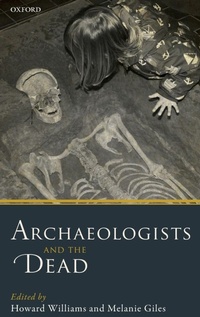
Archaeologists and the Dead
Mortuary Archaeology in Contemporary Society
Published on 23. June 2016
Book
Hardback
496 pages
978-0-19-875353-7 (ISBN)
Description
This volume addresses the relationship between archaeologists and the dead, through the many dimensions of their relationships: in the field (through practical and legal issues); in the lab (through their analysis and interpretation); and in their written, visual and exhibitionary practice - disseminated to a variety of academic and public audiences.
Written from a variety of perspectives, its authors address the experience, effect, ethical considerations, and cultural politics of working with mortuary archaeology. Whilst some papers reflect institutional or organisational approaches, others are more personal in their view: creating exciting and frank insights into contemporary issues which have hitherto often remained 'unspoken' amongst the discipline. Reframing funerary archaeologists as 'death-workers' of a kind, the contributors
reflect on their own experience to provide both guidance and inspiration to future practitioners, arguing strongly that we have a central role to play in engaging the public with themes of mortality and commemoration, through the lens of the past. Spurred by the recent debates in the UK, papers from
Scandinavia, Austria, Italy, the US, and the mid-Atlantic, frame these issues within a much wider international context which highlights the importance of cultural and historical context in which this work takes place.
Written from a variety of perspectives, its authors address the experience, effect, ethical considerations, and cultural politics of working with mortuary archaeology. Whilst some papers reflect institutional or organisational approaches, others are more personal in their view: creating exciting and frank insights into contemporary issues which have hitherto often remained 'unspoken' amongst the discipline. Reframing funerary archaeologists as 'death-workers' of a kind, the contributors
reflect on their own experience to provide both guidance and inspiration to future practitioners, arguing strongly that we have a central role to play in engaging the public with themes of mortality and commemoration, through the lens of the past. Spurred by the recent debates in the UK, papers from
Scandinavia, Austria, Italy, the US, and the mid-Atlantic, frame these issues within a much wider international context which highlights the importance of cultural and historical context in which this work takes place.
Reviews / Votes
[a] thought-provoking book ... The breadth and rigour of analyses, from fieldwork to museum displays ... offer plenty of food for thought. * Current Archaeology * Howard Williams and Melanie Giles have produced a book that will be of interest to professionals and general readers alike. * Jo Appleby, Times Literary Supplement *More details
Other editions
Additional editions
Howard Williams | Melanie Giles
Archaeologists and the Dead
Mortuary Archaeology in Contemporary Society
E-Book
06/2016
1st Edition
OUP eBook
€54.49
Available for download
Persons
Howard Williams is Professor of Archaeology at the University of Chester. His research interests focus on medieval, post-medieval and contemporary mortuary archaeology, archaeologies of memory and the history of archaeology. His fieldwork includes Project Eliseg, investigating the context of the Pillar of Eliseg
(Denbighshire, Wales). Howard has published over 70 book chapters and journal articles as well as edited books, most recently Early Medieval Stone Monuments: Materiality, Biography, Landscape (Boydell and Brewer, 2015) and he is Honorary Editor of the Archaeological Journal (2013-2017) and his monograph is titled Death and Memory in Early Medieval Britain (CUP, 2006).
Melanie Giles in an expert in the British and northern European Iron Age, specialising in funerary archaeology as well as Celtic art and artefacts. She is the author of 'A Forged Glamour: Landscape, identity and material culture in the Iron Age' (Windgather Press) and the forthcoming 'Bog Bodies: Face-to-face with the past' (Pen & Sword Press).
(Denbighshire, Wales). Howard has published over 70 book chapters and journal articles as well as edited books, most recently Early Medieval Stone Monuments: Materiality, Biography, Landscape (Boydell and Brewer, 2015) and he is Honorary Editor of the Archaeological Journal (2013-2017) and his monograph is titled Death and Memory in Early Medieval Britain (CUP, 2006).
Melanie Giles in an expert in the British and northern European Iron Age, specialising in funerary archaeology as well as Celtic art and artefacts. She is the author of 'A Forged Glamour: Landscape, identity and material culture in the Iron Age' (Windgather Press) and the forthcoming 'Bog Bodies: Face-to-face with the past' (Pen & Sword Press).
Content
ForewordMike Parker Pearson: ; 1 Melanie Giles and Howard Williams: Introduction: Mortuary Archaeology in Contemporary Society; Part 1: Investigating The Dead; 2 Sian Anthony: Questions Raised in Excavating the Recent Dead; 3 John McClelland and Jessica Cerezo-Roman: Personhood and Re-Embodiment in Osteological Practice; 4 Ulla Rajala: Separating the Emotions: Archaeological Mentalities in Central Italian Funerary Archaeology; 5 Andrew Pearson and Ben Jeffs: Slave Trade Archaeology and the Public: The Excavation of a 'Liberated African' Graveyard on St Helena; 6 Martin Brown: Habeas Corpus: Contested Ownership of Casualties of The Great War; 7 Faye Sayer and Duncan Sayer: Bones Without Barriers: The Social Impact of Digging the Dead; Part 2: Displaying the Dead; 8 Hedley Swain: Museum Practice and the Display of Human Remains; 9 Sarah Tatham: Displaying the Dead: The English Heritage Experience; 10 Nina Nordstrom: The Immortals: Prehistoric Individuals as Ideological and Therapeutic Tools in our Time; 11 Karen Exell: Covering the Mummies at the Manchester Museum: A Discussion of Authority, Authorship and Agendas in the Human Remains Debate; 12 Tiffany Jenkins: Making an Exhibition of Ourselves: Using the Dead to Fight the Battles of the Living; 13 Liv Nilsson Stutz: To Gaze Upon The Dead: The Exhibition of Human Remains as Cultural Practice and Political Process In Scandinavia and the United States; 14 Howard Williams: Firing the Imagination: Cremation in the Museum; Part 3: Public Mortuary Archaeology; 15 William Rathouse: Contemporary Pagans and the Study of the Ancestors; 16 Estella Weiss-Krejci: 'Tomb to Give Away': The Significance of Graves and Dead Bodies in Present-Day Austria; 17 Duncan Sayer and Tony Walter: Digging The Dead in a Digital Media Age; 18 Trevor Kirk: Writing About Death, Mourning and Emotion: Archaeology and Creativity; 19 Melanie Giles: Reconstructing Death: The Chariot Burials of Iron Age East Yorkshire; 20 Lynn Goldstein: Reflections on Intersections of Mortuary Archaeology and Contemporary Society