

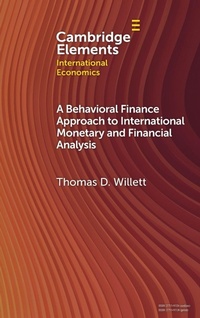
A Behavioral Finance Approach to International Monetary and Financial Analysis
Implications and Evidence
Published on 11. June 2026
Book
Hardback
76 pages
978-1-009-69401-8 (ISBN)
Description
Efficient market theory has made an important contribution to economic and financial analysis, but markets do not always behave according to the theory's predictions. The behavioral finance approach advocated in this Element is a complement to efficient market theory. The Element stresses the effects of perverse incentives, complexity, and uncertainty, as well as the roles of mental models or narrative and behavioral biases. It emphasizes limits to arbitrage, suggesting that international capital mobility is often far from perfect. It reviews popular models and considers alternatives in areas such as currency crises, exchange rates and the balance of payments, the international monetary trilemma, capital flow surges and sudden stops, and the discipline effects of international financial markets. The behavioral approach of the Element also helps to explain why governments often fail to undertake necessary policy adjustments in time to head off currency and financial crises.
More details
Series
Language
English
Place of publication
Cambridge
United Kingdom
Illustrations
Worked examples or Exercises
Weight
233 gr
ISBN-13
978-1-009-69401-8 (9781009694018)
Copyright in bibliographic data and cover images is held by Nielsen Book Services Limited or by the publishers or by their respective licensors: all rights reserved.
Schweitzer Classification
Other editions
Additional editions
Thomas D. Willett
A Behavioral Finance Approach to International Monetary and Financial Analysis
Implications and Evidence
Book
06/2026
Cambridge University Press
€22.50
Shipment within 15-20 days
Person
Content
1. Introduction; 2. Behavioral finance and efficient market theory; 3. Major impediments to financial sector efficiency; 4. Examples of faulty mental models contributing to major crises; 5. Some examples of the interactions among biases; 6. Some applications to international monetary and financial questions; 7. The Nature of the capital flow assumptions in the major open economy macro models; References.