

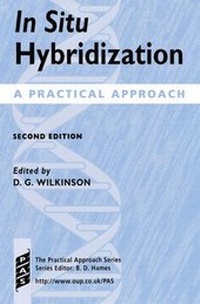
In Situ Hybridization
A Practical Approach
2nd Edition
Published on 26. November 1998
Book
Paperback/Softback
242 pages
978-0-19-963658-7 (ISBN)
Description
In situ hybridization is used to reveal the location of specific nucleic acids sequences on chromosomes or in tissues. Visualization of the location of genes on chromosomes or of specific mRNAs or viruses in tissues is crucial for understanding the organization, regulation, and function of genes. It is a therefore a core technique in all areas of biomedical research. In Situ Hybridization: A Practical Approach 2/e is the second edition of one of the
most successful Practical Approach books, published in 1992. Since the first edition was published, a number of important technical advances have been made. The new edition has been thoroughly updated to contain protocols detailing the major techniques of in situ hybridization currently in use: in situ hybridization
to mRNA with oligonucleotide and RNA probes (radiolabelled and hapten labelled); analysis using light and electron microscopes; whole mount in situ hybridization; double detection of RNAs, and RNA plus protein; and fluorescent in situ hybridization to detect chromosomal sequences. The protocols are complemented by advice on strategies for successful results, descriptions of the theoretical basis of in situ hybridization and important new developments in gene expression
databases. The procedures described are widely applicable to many systems. The use of in situ hybridization in PCR is covered in a separate volume: Herrington and O'Leary (Eds) PCR 3 - PCR in situ hybridization: A Practical Approach (OUP, 1997). All the authors have extensive practical experience of establishing reliable
techniques of in situ hybridization. This book will be useful to all researchers at all levels who use in situ hybridization.
most successful Practical Approach books, published in 1992. Since the first edition was published, a number of important technical advances have been made. The new edition has been thoroughly updated to contain protocols detailing the major techniques of in situ hybridization currently in use: in situ hybridization
to mRNA with oligonucleotide and RNA probes (radiolabelled and hapten labelled); analysis using light and electron microscopes; whole mount in situ hybridization; double detection of RNAs, and RNA plus protein; and fluorescent in situ hybridization to detect chromosomal sequences. The protocols are complemented by advice on strategies for successful results, descriptions of the theoretical basis of in situ hybridization and important new developments in gene expression
databases. The procedures described are widely applicable to many systems. The use of in situ hybridization in PCR is covered in a separate volume: Herrington and O'Leary (Eds) PCR 3 - PCR in situ hybridization: A Practical Approach (OUP, 1997). All the authors have extensive practical experience of establishing reliable
techniques of in situ hybridization. This book will be useful to all researchers at all levels who use in situ hybridization.
More details
Series
Edition
2nd Revised edition
Language
English
Place of publication
Oxford
United Kingdom
Target group
Professional and scholarly
Edition type
Revised edition
Illustrations
2 farbige Abbildungen, 8 Fotos bzw. Rasterbilder
2 colour illustrations, 8 halftones
Dimensions
Height: 236 mm
Width: 158 mm
Thickness: 13 mm
Weight
431 gr
ISBN-13
978-0-19-963658-7 (9780199636587)
Copyright in bibliographic data and cover images is held by Nielsen Book Services Limited or by the publishers or by their respective licensors: all rights reserved.
Schweitzer Classification
Other editions
Previous edition

D. G. Wilkinson
In Situ Hybridization
Book
10/1992
Oxford University Press
€37.14
Article exhausted; check for reprint