

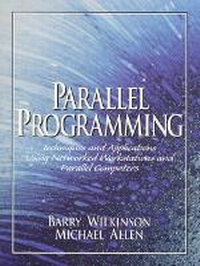
Parallel Programming
Techniques and Applications Using Networked Workstations and Parallel Computers
Published on 11. September 1998
Book
Hardback
431 pages
978-0-13-671710-2 (ISBN)
Description
Designed for undergraduate level parallel programming courses. This nontheoretical, highly accessible text-which is linked to real parallel programming software-covers the techniques of parallel programming in a practical manner that enables students to write and evaluate their parallel programs. Supported by the National Science Foundation and exhaustively class-tested, it is the first text of its kind that does not require access to a special multiprocessor system, concentrating instead only on parallel programs that can be executed on networked workstations using freely available parallel software tools.
More details
Language
English
Place of publication
United States
Publishing group
Pearson Education (US)
Target group
College/higher education
Dimensions
Height: 234 mm
Width: 178 mm
Thickness: 20 mm
Weight
641 gr
ISBN-13
978-0-13-671710-2 (9780136717102)
Copyright in bibliographic data and cover images is held by Nielsen Book Services Limited or by the publishers or by their respective licensors: all rights reserved.
Schweitzer Classification
Other editions
New editions
Barry Wilkinson | Michael Allen
Parallel Programming: Techniques and Applications Using Networked Workstations and Parallel Computers
Techniques and Applications Using Networked Workstations and Parallel Computers
Book
05/2004
2nd Edition
Pearson
€215.49
Shipment within 15-20 days
Persons
BARRY WILKINSON and MICHAEL ALLEN have created a comprehensive instructors support website, including examples, assignments, and instructional materials for using the MPI and PVM software. The materials include extensive web pages to help students learn how to compile and run parallel programs as well as sample programs.
Content
I. BASIC TECHNIQUES.
1. Parallel Computers.
2. Message-Passing Computing.
3. Embarrassingly Parallel Computations.
4. Partitioning and Divide-and-Conquer Strategies.
5. Pipelined Computations.
6. Synchronous Computations.
7. Load Balancing and Termination Detection.
8. Programming with Shared Memory.
II. ALGORITHMS AND APPLICATIONS.
9. Sorting Algorithms.
10. Numerical Algorithms.
11. Image Processing.
12. Searching and Optimization.
Appendix A: Basic PVM Routines.
Appendix B: Basic MPI Routines.
Appendix C: Basic Pthread Routines.
Appendix D: Parallel Computation Models.
Index.
1. Parallel Computers.
2. Message-Passing Computing.
3. Embarrassingly Parallel Computations.
4. Partitioning and Divide-and-Conquer Strategies.
5. Pipelined Computations.
6. Synchronous Computations.
7. Load Balancing and Termination Detection.
8. Programming with Shared Memory.
II. ALGORITHMS AND APPLICATIONS.
9. Sorting Algorithms.
10. Numerical Algorithms.
11. Image Processing.
12. Searching and Optimization.
Appendix A: Basic PVM Routines.
Appendix B: Basic MPI Routines.
Appendix C: Basic Pthread Routines.
Appendix D: Parallel Computation Models.
Index.