

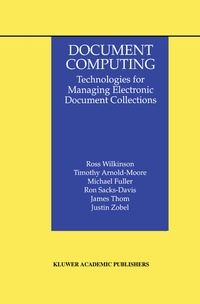
Document Computing
Technologies for Managing Electronic Document Collections
Published on 30. November 1998
Book
Hardback
X, 205 pages
978-0-7923-8357-4 (ISBN)
Description
Document Computing: Technologies for Managing Electronic Document
Collections
discusses the important aspects of document computing and recommends technologies and techniques for document management, with an emphasis on the processes that are appropriate when computers are used to create, access, and publish documents. This book includes descriptions of the nature of documents, their components and structure, and how they can be represented; examines how documents are used and controlled; explores the issues and factors affecting design and implementation of a document management strategy; and gives a detailed case study. The analysis and recommendations are grounded in the findings of the latest research.
Document Computing: Technologies for Managing Electronic Document Collections brings together concepts, research, and practice from diverse areas including document computing, information retrieval, librarianship, records management, and business process re-engineering. It will be of value to anyone working in these areas, whether as a researcher, a developer, or a user.
Document Computing: Technologies for Managing Electronic Document Collections can be used for graduate classes in document computing and related fields, by developers and integrators of document management systems and document management applications, and by anyone wishing to understand the processes of document management.
Document Computing: Technologies for Managing Electronic Document Collections brings together concepts, research, and practice from diverse areas including document computing, information retrieval, librarianship, records management, and business process re-engineering. It will be of value to anyone working in these areas, whether as a researcher, a developer, or a user.
Document Computing: Technologies for Managing Electronic Document Collections can be used for graduate classes in document computing and related fields, by developers and integrators of document management systems and document management applications, and by anyone wishing to understand the processes of document management.
More details
Series
Edition
1998 ed.
Language
English
Place of publication
New York
United States
Target group
College/higher education
Professional and scholarly
Research
Illustrations
X, 205 p.
Dimensions
Height: 241 mm
Width: 160 mm
Thickness: 17 mm
Weight
494 gr
ISBN-13
978-0-7923-8357-4 (9780792383574)
DOI
10.1007/978-1-4615-4957-4
Schweitzer Classification
Other editions
Additional editions
Ross Wilkinson | Timothy Arnold-Moore | Michael Fuller
Document Computing
Technologies for Managing Electronic Document Collections
Book
10/2012
Springer
€106.99
Shipment within 7-9 days
Content
1. Document Lifecycle.- 1.1 Introduction.- 1.2 What is a Document?.- 1.3 Using Documents.- 1.4 Why Document Management?.- 1.5 Document Management Solutions.- 1.6 An Example.- 2. Electronic Document Description.- 2.1 Introduction.- 2.2 Document Constituents.- 2.3 Document Description Requirements.- 2.4 Document Description Languages.- 2.5 Evaluation.- 3. Document Production.- 3.1 Introduction.- 3.2 Editing Structured Documents.- 3.3 Document Conversion.- 3.4 Metadata Assignment.- 3.5 Document Creation.- 3.6 Document Import.- 3.7 Document Modification.- 3.8 Document Integration.- 4. Document Delivery.- 4.1 Introduction.- 4.2 Delivery Units.- 4.3 Delivery Examples.- 4.4 Delivery Requirements and Answer Components.- 4.5 Answer Organization.- 4.6 Formatting Answers for Delivery.- 5. Document Publication.- 5.1 Introduction.- 5.2 Building Access Paths.- 5.3 Registration.- 5.4 Access Paths and Labels.- 5.5 Access by Content.- 5.6 Access by Metadata.- 5.7 Access by Structure.- 5.8 Access by Navigation.- 5.9 Versions.- 5.10 Storage.- 6. Document Discovery.- 6.1 Introduction.- 6.2 Access Methods.- 6.3 Query Language Requirements.- 6.4 Query Languages.- 6.5 Document Matching.- 6.6 Interactive Document Discovery.- 6.7 Document Filtering.- 6.8 Distributed Document Discovery.- 7. Document Removal.- 7.1 Introduction.- 7.2 What to Remove.- 7.3 Types of Removal.- 7.4 Approaches to Removal.- 7.5 Archiving.- 8. Document Flow.- 8.1 Introduction.- 8.2 Processes.- 8.3 People.- 8.4 Systems.- 8.5 Recommendations.- 9. Case Study: Managing Legislation.- 9.1 Introduction.- 9.2 Document Description.- 9.3 Document Production.- 9.4 Document Delivery.- 9.5 Document Publication.- 9.6 Document Discovery.- 9.7 Document Removal.- 9.8 Document Control.- References.