

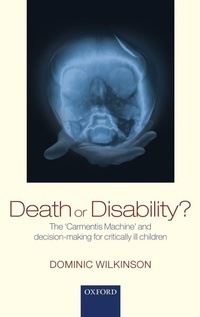
Death or Disability?
The 'Carmentis Machine' and decision-making for critically ill children
Published on 24. January 2013
Book
Hardback
320 pages
978-0-19-966943-1 (ISBN)
Description
In ancient Rome parents would consult the priestess Carmentis shortly after birth to obtain prophecies of the future of their newborn infant. Today, parents and doctors of critically ill children consult a different oracle. Neuroimaging provides a vision of the child's future, particularly of the nature and severity of any disability. Based on the results of brain scans and other tests doctors and parents face heart-breaking decisions about whether or not to continue intensive treatment or to allow the child to die.
Paediatrician and ethicist Dominic Wilkinson looks at the profound and contentious ethical issues facing those who work in intensive care caring for critically ill children and infants. When should infants or children be allowed to die? How accurate are predictions of future quality of life? How much say should parents have in these decisions? How should they deal with uncertainty about the future? He combines philosophy, medicine and science to shed light on current and future dilemmas.
Paediatrician and ethicist Dominic Wilkinson looks at the profound and contentious ethical issues facing those who work in intensive care caring for critically ill children and infants. When should infants or children be allowed to die? How accurate are predictions of future quality of life? How much say should parents have in these decisions? How should they deal with uncertainty about the future? He combines philosophy, medicine and science to shed light on current and future dilemmas.
Reviews / Votes
This book reflects a remarkable blend of philosophical sophistication and clinical expertise. ... Wilkinson's book will be mandatory reading for philosophers and clinical ethicists who are writing on, or working with, critically ill children and their parents. * J. Paul Kelleher, Mind * [T]his book does represent an interesting approach to the ethical decision problems faced in a neonatal intensive care unit. Wilkinson defends his threshold framework using not only medical protocols but also philosophical arguments, showing that reasons about how to treat a critically ill newborn are not only medical but also have a philosophical and anthropological base. * Fermin J. Gonzalez-Melado, Theoretical Medicine and Bioethics * this is a wonderful book: wise, clever, humane, realistic and humble. It will be, and richly deserves to be, the cornerstone of academic and practitioner debate about this terrible, and terribly important area of ethics and medicine. * Charles Foster, European Journal of Health Law * His style, clear and simple for a work on a subject of considerable complexity, and yet profound in its way of dealing with issues more related to philosophy and ethics, make this book a read of great interest not only for professionals pediatric medicine, but also for affected families and for anyone who wants to know the problems of bioethics from a multidisciplinary perspective. * Revista EspaA+/-ola de Discapacidad * This is a book that must be read by everybody who is seriously interested in the bioethical issues that arise in neonatal intensive care or, more generally, in decision making for children with chronic, debilitating or life-threatening conditions. Wilkinson critically summarizes the work in this field over the last two decades and adds his own insights to that work. * John D. Lantos, Notre Dame Philosophical Reviews * the best book of the decade in bioethics... Dominic Wilkinson is a philosopher and neonatologist... His research focuses on the thorny ethical dilemmas that arise in the care of critically ill newborns. Wilkinson has been working out an approach to these difficult problems for the last decade. He has gathered his thoughts together in a marvelous, engaging and challenging book... this is a book that must be read by everybody who is seriously interested in the bioethical issues that arise in neonatal intensive care or, more generally, in decision making for children with chronic, debilitating or life-threatening conditions. * John D. Lantos, Notre Dame Philosophical Reviews * this was an interesting read, comprehensive, analytical, and thought-provoking... Wilkinson does a good job of articulating and providing evidence to support his point of view. He successfully accomplishes what he sets out to do, while keeping the reader entertained with historical points, clinical examples, and philosophical theories and vignettes. * Marlyse F. Haward, The American Journal of Bioethics * The author skilfully draws on his training in philosophy, bioscience and clinical practice to offer an analysis that is original, not merely in content but also in form. Wilkinsons comparison of the Carmentis Machine with contemporary neuroimaging is inspired. * Deborah Bowman, Times Higher Education Supplement *More details
Language
English
Place of publication
Oxford
United Kingdom
Target group
College/higher education
Professional and scholarly
Medical professionals and practitioners; moral philosophers; anyone with an interest in medical ethics.
Dimensions
Height: 240 mm
Width: 161 mm
Thickness: 22 mm
Weight
646 gr
ISBN-13
978-0-19-966943-1 (9780199669431)
Copyright in bibliographic data and cover images is held by Nielsen Book Services Limited or by the publishers or by their respective licensors: all rights reserved.
Schweitzer Classification
Other editions
Additional editions
Dominic Wilkinson
Death or Disability?
The 'Carmentis Machine' and decision-making for critically ill children
Book
04/2017
Oxford University Press
€43.32
Shipment within 15-20 days
Dominic Wilkinson
Death or Disability?
The 'Carmentis Machine' and decision-making for critically ill children
E-Book
01/2013
1st Edition
OUP eBook
€21.99
Available for download
Person
Dominic Wilkinson is Associate Professor of Neonatal Medicine and Bioethics at the University of Adelaide, and a senior research associate of the Oxford Uehiro Centre for Practical Ethics. He has worked as a doctor in neonatal, paediatric and adult intensive care, and is currently consultant neonatologist at the Women's and Children's Hospital in Adelaide. He has a DPhil in medical ethics from the University of Oxford, and has written a large number of academic articles relating to ethical issues in intensive care.
Content
SECTION A; SECTION B