

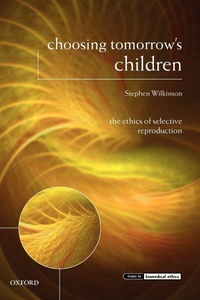
Choosing Tomorrow's Children
The Ethics of Selective Reproduction
1st Edition
Published on 1. March 2012
Book
Paperback/Softback
274 pages
978-0-19-964658-6 (ISBN)
Description
To what extent should parents be allowed to use reproductive technologies to determine the characteristics of their future children? And is there something morally wrong with parents who wish to do this? Choosing Tomorrow's Children provides answers to these (and related) questions. In particular, the book looks at issues raised by selective reproduction, the practice of choosing between different possible future persons by selecting or deselecting (for example) embryos, eggs, and sperm.
Wilkinson offers answers to questions including the following. Do children have a 'right to an open future' and, if they do, what moral constraints does this place upon selective reproduction? Should parents be allowed to choose their future children's sex? Should we 'screen out' as much disease and disability as possible before birth, or would that be an objectionable form of eugenics? Is it acceptable to create or select a future person in order to provide lifesaving tissue for an existing relative? Is there a moral difference between selecting to avoid disease and selecting to produce an 'enhanced' child? Should we allow deaf parents to use reproductive technologies to ensure that they have a deaf child?
Wilkinson offers answers to questions including the following. Do children have a 'right to an open future' and, if they do, what moral constraints does this place upon selective reproduction? Should parents be allowed to choose their future children's sex? Should we 'screen out' as much disease and disability as possible before birth, or would that be an objectionable form of eugenics? Is it acceptable to create or select a future person in order to provide lifesaving tissue for an existing relative? Is there a moral difference between selecting to avoid disease and selecting to produce an 'enhanced' child? Should we allow deaf parents to use reproductive technologies to ensure that they have a deaf child?
Reviews / Votes
All in all, this is a tremendously rich and well-argued book. It will be of great interest to philosophers working on the ethics of reproduction and in related areas, as well as an invaluable tool for policymakers on selective reproduction. * Ben Bramble, Mind * [an] interesting book with some very arresting insights and well worth reading, whether you are a graduate student, academic or just interested in the exciting new field of emerging reproductive technologies. * Oliver Feeney, Res Publica: A Journal of Moral, Legal and Social Philosophy *More details
Series
Language
English
Place of publication
Oxford
United Kingdom
Target group
Advanced students and scholars of ethics, health policy, and medical law
Dimensions
Height: 234 mm
Width: 156 mm
Thickness: 15 mm
Weight
421 gr
ISBN-13
978-0-19-964658-6 (9780199646586)
Copyright in bibliographic data and cover images is held by Nielsen Book Services Limited or by the publishers or by their respective licensors: all rights reserved.
Schweitzer Classification
Other editions
Additional editions
Book
02/2010
1st Edition
Oxford University Press
€129.90
Shipment within 15-20 days
Person
Stephen Wilkinson is Professor of Bioethics and Director of the Centre for Professional Ethics at Keele University.
Content
1. Introduction: the Ethics of Selective Reproduction ; 2. Parental Duties and Virtues ; 3. Selecting for Disability and the Welfare of the Child ; 4. Choosing One for the Sake of Another ; 5. Treating Children as Commodities ; 6. Eugenics and the Expressivist Argument ; 7. Enhancement ; 8. Sex Selection