

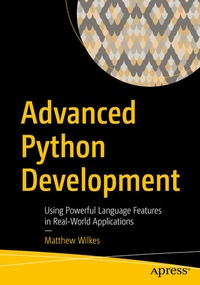
Advanced Python Development
Using Powerful Language Features in Real-World Applications
Published on 26. July 2020
Book
Paperback/Softback
XXII, 605 pages
978-1-4842-5792-0 (ISBN)
Description
This book builds on basic Python tutorials to explain various Python language features that aren't routinely covered: from reusable console scripts that play double duty as micro-services by leveraging entry points, to using asyncio efficiently to collate data from a large number of sources. Along the way, it covers type-hint based linting, low-overhead testing and other automated quality checking to demonstrate a robust real-world development process.
Some powerful aspects of Python are often documented with contrived examples that explain the feature as a standalone example only. By following the design and build of a real-world application example from prototype to production quality you'll see not only how the various pieces of functionality work but how they integrate as part of the larger system design process. In addition, you'll benefit from the kind of useful asides and library recommendations that are a staple of conference Q&A sessions at Python conferences as well as discussions of modern Python best practice and techniques to better produce clear code that is easily maintainable.
Advanced Python Development is intended for developers who can already write simple programs in Python and want to understand when it's appropriate to use new and advanced language features and to do so in a confident manner. It is especially of use to developers looking to progress to a more senior level and to very experienced developers who have thus far used older versions of Python.
What You'll Learn
Developers at the mid to seniorlevel who already have Python experience.
Some powerful aspects of Python are often documented with contrived examples that explain the feature as a standalone example only. By following the design and build of a real-world application example from prototype to production quality you'll see not only how the various pieces of functionality work but how they integrate as part of the larger system design process. In addition, you'll benefit from the kind of useful asides and library recommendations that are a staple of conference Q&A sessions at Python conferences as well as discussions of modern Python best practice and techniques to better produce clear code that is easily maintainable.
Advanced Python Development is intended for developers who can already write simple programs in Python and want to understand when it's appropriate to use new and advanced language features and to do so in a confident manner. It is especially of use to developers looking to progress to a more senior level and to very experienced developers who have thus far used older versions of Python.
What You'll Learn
-
Understand asynchronous programming
-
Examine developing plugin architectures
-
Work with type annotations
-
Review testing techniques
-
Explore packaging and dependency management
Developers at the mid to seniorlevel who already have Python experience.
More details
Edition
1st ed.
Language
English
Place of publication
Berkeley
United States
Target group
Professional and scholarly
Product notice
Paperback (trade)
Unsewn / adhesive bound
Illustrations
62 s/w Abbildungen
XXII, 605 p. 62 illus.
Dimensions
Height: 254 mm
Width: 178 mm
Thickness: 33 mm
Weight
1163 gr
ISBN-13
978-1-4842-5792-0 (9781484257920)
DOI
10.1007/978-1-4842-5793-7
Schweitzer Classification
Other editions
Additional editions
Matthew Wilkes
Advanced Python Development
Using Powerful Language Features in Real-World Applications
E-Book
07/2020
APress
€56.99
Available for download
Person
Matthew Wilkes is a European software developer who has worked with Python on web projects for the last fifteen years. As well as developing software, he has long experience in mentoring Python developers in a commercial setting.
He is also very involved in open source software, with commits to many popular
frameworks. His contributions in that space are focused on the details of database and security interactions of web frameworks.
Content
Chapter 1: Prototyping and Environments.- Chapter 2: Testing, Checking and Linting.- Chapter 3: Packaging Scripts.- Chapter 4: From Script to Library.- Chapter 5: Alternative Interfaces.- Chapter 6: Speeding Things Up.- Chapter 7: Aggregation Process.- Chapter 8: Asynchronous Programming.- Chapter 9: Asynchronous Databases.- Chapter 10: Viewing the Data.- Chapter 11: Fault Tolerance.- Chapter 12: Callbacks and Data Analysis.