

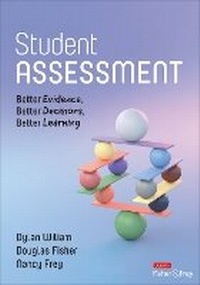
Student Assessment
Better Evidence, Better Decisions, Better Learning
1st Edition
Published on 6. September 2024
Book
Paperback/Softback
176 pages
978-1-0719-0936-2 (ISBN)
Description
Fuel student-driven success and enhance learning with better assessment
What if there was a better way to collect and interpret assessment data that could strengthen the link between teaching and learning? Student Assessment: Better Evidence, Better Decisions, Better Learning is the innovative guide to show you how it's done and done right. This unique book offers a new assessment model focused on decision-driven data collection and provides an arsenal of tools for collecting better evidence to increase student learning. You will learn:
the importance of assessment in the teaching and learning process
what a decision-driven data collection assessment model looks like and how it differs from a more traditional data-driven decision-making model
how to effectively establish learning intentions and success criteria within assessments to actively engage students in their own learning
how to implement an array of assessment tools that yield better evidence and improve decision-making
how to address the challenge of ensuring authenticity in students' responses when AI-generated content is becoming more common
With this guide in hand, you'll be ready for a better approach to assessment-armed with practical tools and strategies to ensure students can analyze, synthesize, adapt, critique, and most importantly, take charge of their own learning.
What if there was a better way to collect and interpret assessment data that could strengthen the link between teaching and learning? Student Assessment: Better Evidence, Better Decisions, Better Learning is the innovative guide to show you how it's done and done right. This unique book offers a new assessment model focused on decision-driven data collection and provides an arsenal of tools for collecting better evidence to increase student learning. You will learn:
the importance of assessment in the teaching and learning process
what a decision-driven data collection assessment model looks like and how it differs from a more traditional data-driven decision-making model
how to effectively establish learning intentions and success criteria within assessments to actively engage students in their own learning
how to implement an array of assessment tools that yield better evidence and improve decision-making
how to address the challenge of ensuring authenticity in students' responses when AI-generated content is becoming more common
With this guide in hand, you'll be ready for a better approach to assessment-armed with practical tools and strategies to ensure students can analyze, synthesize, adapt, critique, and most importantly, take charge of their own learning.
Reviews / Votes
Student Assessment is a text that is the definition of pioneering and leading the way for a better future for education with our students at the forefront. Innovative, restorative, and enriching, this text is one that will be utilized for many more decades to come. -- Daruis Phelps Frey, Fisher, and Wilam are the education research equivalent of the Marvel Avengers, righteously standing up for all that is good for student achievement and success. In Student Assessment: Better Evidence, Better Decision, Better Learning they have applied their many years of research into a logical and easily approachable book, so that any teacher can implement timely formative assessment to impact student achievement. -- Brian Deller Rarely does a book come along from authors who are renowned researchers and also practitioners deep in the work. The authors' collective insights provide the perfect balance for a book that thoughtfully illustrates assessment as the bridge between effective teaching and learning. This book provides practical, actionable examples for busy practitioners! -- Dr. Angela Lyon Hinton This book is a practical reminder of WHY we should use assessment in our classrooms and HOW we can quickly yet effectively assess our students using a variety of strategies. This refreshing read is applicable to any educator, in any classroom. -- Alisa Barrett Student Assessment: Better Evidence, Better Decision, Better Learning is an excellent resource that provides a comprehensive exploration of assessment practices. This book goes beyond the ordinary, offering valuable insights for dedicated teachers and forward-thinking administrators. It equips readers with additional knowledge and tools needed to enhance the quality of assessments, leading to better decisions and, ultimately, better learning outcomes for students. If you are committed to advancing education and seeing a transformative guide to assessment, this book is an absolute must-read. -- Kelly Jensen Wiliam, Fisher and Frey show how student assessment data should support decisions that help teachers teach and students learn-and they provide a variety of practical examples of assessment tools and procedures from real classrooms. It's the combination of the two that makes the book so compelling. -- Professor EmeritaMore details
Language
English
Place of publication
Thousand Oaks
United States
Publishing group
SAGE Publications Inc
Target group
Professional and scholarly
Dimensions
Height: 251 mm
Width: 173 mm
Thickness: 12 mm
Weight
378 gr
ISBN-13
978-1-0719-0936-2 (9781071909362)
Copyright in bibliographic data and cover images is held by Nielsen Book Services Limited or by the publishers or by their respective licensors: all rights reserved.
Schweitzer Classification
Persons
Dr. Dylan Wiliam is emeritus professor of educational assessment at the UCL Institute of Education. He started his career teaching in urban London schools before transitioning to educational research. He was dean of the School of Education at King's College London, senior research director at the Educational Testing Service in Princeton, US, and deputy director of the Institute of Education, University of London. His research has focused on the use of assessment to support learning (sometimes called formative assessment), and he now works with groups of teachers all over the world on developing formative assessment practices. Dylan's recent books include Creating the Schools Our Children Need and Embedded Formative Assessment. Douglas Fisher is a professor and chair of educational leadership at San Diego State University and a teacher leader at Health Sciences High and Middle College. Previously, Fisher was an early intervention teacher and elementary school educator. In 2022, he was inducted into the Reading Hall of Fame by the Literacy Research Association. He has published numerous articles on reading and literacy, leadership, and curriculum design, as well as books such as Your Introduction to PLC+, Welcome to Teaching, How Feedback Works, Teaching Reading, and RIGOR Unveiled. Fisher loves being an educator and hopes to share that passion with others.
Nancy Frey is a professor in educational leadership at San Diego State University and a teacher leader at Health Sciences High and Middle College. Her published titles include The Courage to Learn, The Art and Science of Coaching, How Scaffolding Works, and The Illustrated Guide to Visible Learning. Frey is a credentialed special educator, reading specialist, and administrator in California and learns from teachers and students every day.
Nancy Frey is a professor in educational leadership at San Diego State University and a teacher leader at Health Sciences High and Middle College. Her published titles include The Courage to Learn, The Art and Science of Coaching, How Scaffolding Works, and The Illustrated Guide to Visible Learning. Frey is a credentialed special educator, reading specialist, and administrator in California and learns from teachers and students every day.
Content
Praise Page
Publishers Acknowledgements
Table of Contents
Introduction
Chapter 1
Chapter 2
Chapter 3
Chapter 4
Chapter 5
Chapter 6
Chapter 7
Chapter 8
Chapter 9
Chapter 10
References
Index
Publishers Acknowledgements
Table of Contents
Introduction
Chapter 1
Chapter 2
Chapter 3
Chapter 4
Chapter 5
Chapter 6
Chapter 7
Chapter 8
Chapter 9
Chapter 10
References
Index