

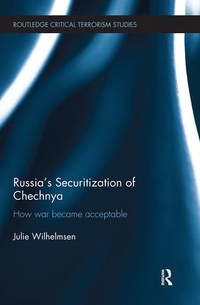
Russia's Securitization of Chechnya
How War Became Acceptable
1st Edition
Published on 14. March 2018
Book
Paperback/Softback
248 pages
978-1-138-54986-9 (ISBN)
Description
This book provides an in-depth analysis of how mobilization and legitimation for war are made possible, with a focus on Russia's conflict with Chechnya.
Through which processes do leaders and their publics come to define and accept certain conflicts as difficult to engage in, and others as logical, even necessary? Drawing on a detailed study of changes in Russia's approach to Chechnya, this book argues that 're-phrasing' Chechnya as a terrorist threat in 1999 was essential to making the use of violence acceptable to the Russian public. The book refutes popular explanations that see Russian war-making as determined and grounded in a sole, authoritarian leader. Close study of the statements and texts of Duma representatives, experts and journalists before and during the war demonstrates how the Second Chechen War was made a 'legitimate' undertaking through the efforts of many. A post-structuralist reinterpretation of securitization theory guides and structures the book, with discourse theory and method employed as a means to uncover the social processes that make war acceptable. More generally, the book provides a framework for understanding the broad social processes that underpin legitimized war-making.
This book will be of much interest to students of Russian politics, critical terrorism studies, security studies and international relations.
Through which processes do leaders and their publics come to define and accept certain conflicts as difficult to engage in, and others as logical, even necessary? Drawing on a detailed study of changes in Russia's approach to Chechnya, this book argues that 're-phrasing' Chechnya as a terrorist threat in 1999 was essential to making the use of violence acceptable to the Russian public. The book refutes popular explanations that see Russian war-making as determined and grounded in a sole, authoritarian leader. Close study of the statements and texts of Duma representatives, experts and journalists before and during the war demonstrates how the Second Chechen War was made a 'legitimate' undertaking through the efforts of many. A post-structuralist reinterpretation of securitization theory guides and structures the book, with discourse theory and method employed as a means to uncover the social processes that make war acceptable. More generally, the book provides a framework for understanding the broad social processes that underpin legitimized war-making.
This book will be of much interest to students of Russian politics, critical terrorism studies, security studies and international relations.
More details
Series
Language
English
Place of publication
London
United Kingdom
Publishing group
Taylor & Francis Ltd
Target group
College/higher education
Professional and scholarly
Dimensions
Height: 234 mm
Width: 156 mm
Weight
380 gr
ISBN-13
978-1-138-54986-9 (9781138549869)
Copyright in bibliographic data and cover images is held by Nielsen Book Services Limited or by the publishers or by their respective licensors: all rights reserved.
Schweitzer Classification
Other editions
Additional editions
E-Book
10/2016
Routledge
€67.49
Available for download
E-Book
10/2016
Routledge
€67.49
Available for download
Book
09/2016
1st Edition
Routledge
€243.40
Shipment within 10-20 days
Person
Julie Wilhelmsen is Senior Research Fellow at the Norwegian Institute of International Affairs (NUPI), Norway and has a PhD in political science from the University of Oslo. She is co-editor of Russia's Encounter with Globalization: Actors, Processes and Critical Moments (2011).
Content
1. Introduction
2. A theoretical framework for the study of acceptable war
3. Method and sources
4. The interwar period: a case of desecuritization
5. Russian official representations of Chechnya and Russia
6. Historical representations of Chechnya and Russia
7. Political elite representations of Chechnya and Russia
8. Expert representations of Chechnya and Russia
9. Journalistic representations of Chechnya and Russia
10. Sealing off Chechnya
11. Bombing Chechnya
12. Cleansing Chechnya
13. Conclusions and perspectives
2. A theoretical framework for the study of acceptable war
3. Method and sources
4. The interwar period: a case of desecuritization
5. Russian official representations of Chechnya and Russia
6. Historical representations of Chechnya and Russia
7. Political elite representations of Chechnya and Russia
8. Expert representations of Chechnya and Russia
9. Journalistic representations of Chechnya and Russia
10. Sealing off Chechnya
11. Bombing Chechnya
12. Cleansing Chechnya
13. Conclusions and perspectives