

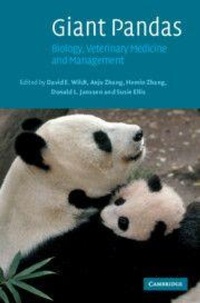
Giant Pandas
Biology, Veterinary Medicine and Management
Published on 27. July 2006
Book
Hardback
610 pages
978-0-521-83295-3 (ISBN)
Description
The giant panda is one of the world's most recognized animals. With the environment undergoing unprecedented change at a rapid and accelerating rate, can such a highly specialized species survive? This 2006 book summarizes panda biology and encompasses topics such as reproduction, behaviour, nutrition, genetics and veterinary medicine. It also provides information on veterinary management, advances in neonatal care, disease detection and prevention and the use of 'assisted breeding' to promote reproduction and preserve genetic diversity, as the females are sexually receptive for only 3 days per year and generally produce twins, but often lose one due to maternal neglect. This book provides the scholarly knowledge that will help conserve this treasured species in nature, while there is still time.
Reviews / Votes
Review of the hardback: 'Much of the information presented here is not easily available elsewhere and such this is a precious and scholarly resource for those working with these unique animals.' Biologist Review of the hardback: 'The purpose of this book is exactly that of the title, to bring together as much reliable information as possible on the biology, medical treatment, and management of Giant Panda.' BiologistMore details
Language
English
Place of publication
Cambridge
United Kingdom
Target group
Professional and scholarly
Product notice
Unsewn / adhesive bound
Paper over boards
Dimensions
Height: 231 mm
Width: 160 mm
Thickness: 34 mm
Weight
1098 gr
ISBN-13
978-0-521-83295-3 (9780521832953)
Copyright in bibliographic data and cover images is held by Nielsen Book Services Limited or by the publishers or by their respective licensors: all rights reserved.
Schweitzer Classification
Other editions
Additional editions
Book
11/2012
Cambridge University Press
€91.00
Shipment within 15-20 days

E-Book
09/2006
1st Edition
Cambridge University Press
€67.99
Available for download
Persons
DAVID WILDT is Senior Scientist and Chairman of the Department of Reproductive Sciences at Smithsonian's National Zoological Park. ANJU ZHANG is the former Director of the Giant Panda Technical Committee in China under the auspices of the Chinese Association of Zoological Gardens. HEMIN ZHANG is Director of Wolong Nature Reserve in Sichuan Province. Both Anju Zhang and Hemin Zhang are among China's leading authorities on giant panda reproduction and health. DONALD L. JANSSEN is Director of Veterinary Services at the Zoological Society of San Diego. SUSIE ELLIS is Vice President of the Indonesia and Philippines Program at Conservation International, based in Washington DC.
Content
1. The giant panda as a social, biological and conservation phenomenon; 2. The giant panda biomedical survey: how it began and the value of people working together across cultures and disciplines; 3. Factors limiting reproductive success in the giant panda as revealed by a biomedical survey; 4. Significant medical issues and biological reference values for giant pandas from the biomedical survey; 5. Life histories and behavioural traits as predictors of breeding status; 6. Nutrition and dietary husbandry; 7. Male reproductive biology in giant pandas in breeding programmes in China; 8. Endocrinology of the giant panda and application of hormone technology to species management; 9. The value and significance of vaginal cytology; 10. Parentage assessment among captive giant pandas in China; 11. The science of behavioural management: creating biologically relevant living environments in captivity; 12. Evaluating stress and well-being in the giant panda: a system for monitoring; 13. The neonatal giant panda: hand-rearing and medical management; 14. Consequences of early rearing on socialization and social competence of the giant panda; 15. Medical management of captive adult and geriatric giant pandas; 16. Diseases and pathology of giant pandas; 17. Ultrasonography to assess and enhance health and reproduction in the giant panda; 18. Gastrointestinal endoscopy in the giant panda; 19. Historical perspective of breeding giant pandas ex situ in China and high priorities for the future; 20. Role and efficiency of artificial insemination and genome resource banking; 21. Analysis of demographic and genetic trends for developing a captive breeding masterplan for the giant panda; 22. Partnerships and capacity building for securing giant pandas ex situ and in situ: how zoos are contributing to conservation.