


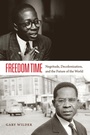
Freedom Time
Negritude, Decolonization, and the Future of the World
Published on 19. January 2015
Book
Hardback
400 pages
978-0-8223-5839-8 (ISBN)
Description
Freedom Time reconsiders decolonization from the perspectives of AimE CEsaire (Martinique) and LEopold SEdar Senghor (Senegal) who, beginning in 1945, promoted self-determination without state sovereignty. As politicians, public intellectuals, and poets they struggled to transform imperial France into a democratic federation, with former colonies as autonomous members of a transcontinental polity. In so doing, they revitalized past but unrealized political projects and anticipated impossible futures by acting as if they had already arrived. Refusing to reduce colonial emancipation to national independence, they regarded decolonization as an opportunity to remake the world, reconcile peoples, and realize humanity's potential. Emphasizing the link between politics and aesthetics, Gary Wilder reads CEsaire and Senghor as pragmatic utopians, situated humanists, and concrete cosmopolitans whose postwar insights can illuminate current debates about self-management, postnational politics, and planetary solidarity. Freedom Time invites scholars to decolonize intellectual history and globalize critical theory, to analyze the temporal dimensions of political life, and to question the territorialist assumptions of contemporary historiography.
Reviews / Votes
"Freedom Time is an important book. It is also exceptionally scholarly and extremely readable. Such qualities rarely inhere in a single text. And they are rarely bundled into an analysis so passionate and timely that excavates past attempts at human emancipation in order to reveal new pathways into modernization." - Massimiliano Tomba (Journal of Latin American and Caribbean Anthropology) "Rich, dense, and meticulously researched, Gary Wilder's book offers nuanced critical reflections on the alternative landscapes of freedom proposed by AimE CEsaire and LEopold SEdar Senghor." - Kaiama L. Glover (French Studies) "There is an important message here ... for a broad audience, and I sincerely hope that it reaches beyond French Studies, postcolonial, or colonial historical studies. Wilder observes that CEsaire, SEdar and their contemporaries in black Caribbean and African thought 'are rarely included in general considerations of interwar philosophy or postwar social theory' (9). What Freedom Time does most convincingly is to demonstrate that the social theory studied in European universities is weaker for this omission and that serious engagement with these thinkers is long overdue." - Lucy Mayblin (Ethnic and Racial Studies) "[A] thoughtful and challenging work on the often maligned Negritude thinkers, poets, and politicians AimE CEsaire and LEopold Senghor." - Brett A. Berliner (Callaloo) "[A] tremendous achievement in scope and originality. Readers who wish to think about the nation-state from a deeply historical and theoretically sophisticated perspective will be richly rewarded." - Anuja Bose (Africa Today) "Freedom Time is an engaging book that combines cultural anthropology, political theory and postcolonial theory and offers the reader a detailed intellectual history of Leopold Senghor and AimE CEsaire between 1945 and 1960." - Frank Gerits (European Review of History) "Gary Wilder's Freedom Time constitutes an exciting and significant contribution to the field of nation and nationalism study in that he challenges the claim that decolonisation and self-determination can, and should, only lead to one form of state sovereignty: the nation-state." - Kristin Hissong (Nations and Nationalism) "Wilder provides us with a provocative retelling of the intellectual and political vision of two luminaries of the 20th century, and he does a great service by recasting our attention to these two authors to provoke reflection on the condition of nationhood and sovereignty in the 21st century. The text is always engaging and at times possesses a lyricism that echoes the poetics of CEsaire and Senghor.... This book is a welcome addition, providing a substantial contribution to the field of francophone intellectual history." - Michael Lambert (Anthropological Quarterly) "Freedom Time is a dynamic treatise deftly upholding the Fanonian and Wynterian imperatives to navigate ongoing processes of decolonization and becoming Human betwixt and between the allure of emancipations masking as freedom." - Neil Roberts (Theory & Event) "Freedom Time is an impressive, inspiring, necessary work. . . . Wilder's lucid, sensitively textured and impressively well-researched book allows us to rethink the meaning of decolonisation and the conceptual nexus surrounding it." - Deborah Walker-Morrison (Cultural Studies Review) "Wilder's reading of Senghor and CEsaire is subtle and engaging, and challenges the idea that they were cynical - or naive." - Musab Younis (London Review of Books)More details
Language
English
Place of publication
North Carolina
United States
Product notice
Cloth over boards
Dimensions
Height: 234 mm
Width: 160 mm
Thickness: 25 mm
Weight
612 gr
ISBN-13
978-0-8223-5839-8 (9780822358398)
Copyright in bibliographic data and cover images is held by Nielsen Book Services Limited or by the publishers or by their respective licensors: all rights reserved.
Schweitzer Classification
Other editions
Additional editions
E-Book
02/2015
1st Edition
De Gruyter
€208.99
Available for download
Person
Gary Wilder is Associate Professor of Anthropology at The Graduate Center of the City University of New York. He is the author of The French Imperial Nation-State: Negritude and Colonial Humanism between the Two World Wars.
Content
Index 373
Preface ix
Acknowledgments xv
1. Unthinking France, Rethinking Decolonization 1
2. Situating CEsaire: Antillean Awakening and Global Redemption 17
3. Situating Senghor: African Hospitality and Human Solidarity 49
4. Freedom, Time, Territory 74
5. Departmentalization and the Spirit of Schoelcher 106
6. Federalism and the Future of France 133
7. Antillean Autonomy and the Legacy of Louverture 167
8. African Socialism and the Fate of the World 206
9. Decolonization and Postnational Democracy 241
Chronology 261
Notes 275
Works Cited 333
Preface ix
Acknowledgments xv
1. Unthinking France, Rethinking Decolonization 1
2. Situating CEsaire: Antillean Awakening and Global Redemption 17
3. Situating Senghor: African Hospitality and Human Solidarity 49
4. Freedom, Time, Territory 74
5. Departmentalization and the Spirit of Schoelcher 106
6. Federalism and the Future of France 133
7. Antillean Autonomy and the Legacy of Louverture 167
8. African Socialism and the Fate of the World 206
9. Decolonization and Postnational Democracy 241
Chronology 261
Notes 275
Works Cited 333