

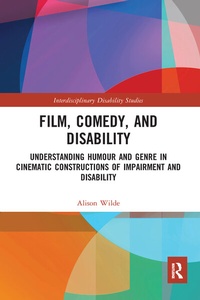
Film, Comedy, and Disability
Understanding Humour and Genre in Cinematic Constructions of Impairment and Disability
1st Edition
Published on 30. June 2020
Book
Paperback/Softback
196 pages
978-0-367-58768-0 (ISBN)
Description
Comedy and humour have frequently played a key role in disabled people's lives, for better or for worse. Comedy has also played a crucial part in constructing cultural representations of disability and impairments, contributing to the formation and maintenance of cultural attitudes towards disabled people, and potentially shaping disabled people's images of themselves. As a complex and often polysemic form of communication, there is a need for greater understanding of the way we make meanings from comedy.
This is the first book which explores the specific role of comedic film genres in representations of disability and impairment. Wilde argues that there is a need to explore different ways to synthesise Critical/Disability Studies with Film Studies approaches, and that a better understanding of genre conventions is necessary if we are to understand the conditions of possibility for new representational forms and challenges to ableism.
After a discussion of the possibilities of a 'fusion' between Disability Studies and Film Studies, and a consideration of the relationships of comedy to disability, Wilde undertakes analysis of contemporary films from the romantic comedy, satire, and gross-out genres. Analysis is focused upon the place of disabled and non-disabled people in particular films, considering visual, audio, and narrative dimensions of representation and the ways they might shape the expectations of film audiences.
This book is of particular value to those in Film and Media Studies, and Critical/Disability Studies, especially for those who are investigating more inclusive practices in cultural representation.
This is the first book which explores the specific role of comedic film genres in representations of disability and impairment. Wilde argues that there is a need to explore different ways to synthesise Critical/Disability Studies with Film Studies approaches, and that a better understanding of genre conventions is necessary if we are to understand the conditions of possibility for new representational forms and challenges to ableism.
After a discussion of the possibilities of a 'fusion' between Disability Studies and Film Studies, and a consideration of the relationships of comedy to disability, Wilde undertakes analysis of contemporary films from the romantic comedy, satire, and gross-out genres. Analysis is focused upon the place of disabled and non-disabled people in particular films, considering visual, audio, and narrative dimensions of representation and the ways they might shape the expectations of film audiences.
This book is of particular value to those in Film and Media Studies, and Critical/Disability Studies, especially for those who are investigating more inclusive practices in cultural representation.
More details
Series
Language
English
Place of publication
London
United Kingdom
Publishing group
Taylor & Francis Ltd
Target group
College/higher education
Dimensions
Height: 234 mm
Width: 156 mm
Weight
380 gr
ISBN-13
978-0-367-58768-0 (9780367587680)
Copyright in bibliographic data and cover images is held by Nielsen Book Services Limited or by the publishers or by their respective licensors: all rights reserved.
Schweitzer Classification
Other editions
Additional editions
Alison Wilde
Film, Comedy, and Disability
Understanding Humour and Genre in Cinematic Constructions of Impairment and Disability
E-Book
09/2018
1st Edition
Routledge
€59.49
Available for download
Alison Wilde
Film, Comedy, and Disability
Understanding Humour and Genre in Cinematic Constructions of Impairment and Disability
Book
08/2018
1st Edition
Routledge
€215.41
Shipment within 10-20 days
Person
Alison Wilde is Senior Lecturer at Leeds Beckett University. Alison has written mainly on topics of screen media, disability, gender, and audiences, in addition to researching and publishing on disability and educational inclusion, parenting, gender, social care, and health care. She co-founded the MeCCSA Disability Studies Network, and the BSA's Disability Studies group.
Content
Acknowledgments; Chapter 1: Introduction; Chapter 2: Comedy and Disability; Chapter 3: Contemporary Comedy: Subjectivity, Genre, and Impairment; Chapter 4: Romantic Comedy and Disability; Chapter 5: Romantic Comedy Meets Satire: Yorgos Lanthimos' The Lobster; Chapter 6: The Gross-Out Genre, the Farrelly Brothers, and Disability: Mapping Representational Change; Chapter 7: Conclusion, or When is an Ending not an Ending?; Bibliography; Index