

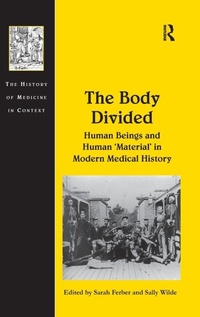
The Body Divided
Human Beings and Human 'Material' in Modern Medical History
1st Edition
Published on 28. January 2012
Book
Hardback
264 pages
978-0-7546-6834-3 (ISBN)
Description
Bodies and body parts of the dead have long been considered valuable material for use in medical science. Over time and in different places, they have been dissected, autopsied, investigated, harvested for research and therapeutic purposes, collected to turn into museum and other specimens, and then displayed, disposed of, and exchanged. This book examines the history of such activities, from the early nineteenth century through to the present, as they took place in hospitals, universities, workhouses, asylums and museums in England, Australia and elsewhere. Through a series of case studies, the volume reveals the changing scientific, economic and emotional value of corpses and their contested place in medical science.
Reviews / Votes
'... an absorbing study of the issues and attitudes surrounding medical uses of the human body... often disturbing or challenging, and invariably fascinating.' Historical Records of Australian Science 'This thought-provoking collection lives up to the promise of its title. The body is, divided, literally, into its constituent parts for medical purposes. We are divided on how to preserve its integrity for human beings while harvesting its material for, well, other human beings. We are conscious, in the modern world, of the need to reaffirm equally the dignity of all bodies, and we are equally conscious of how firmly inequality is embodied in past historical practices. This collection has excellent notes and bibliography for each article, making it a valuable resource for scholars. It will be of interest to any readers who dwell within, own, use and analyse bodies.' Social History of Medicine '...the collection will be of interest to analysts of the material culture of medicine, and to scholars who aim to develop historically grounded perspectives on the ethics and politics of modern medicine.' Reviews in Australian Studies '...this is a collection of interesting and thought-provoking reads.' ISISMore details
Series
Language
English
Place of publication
London
United Kingdom
Publishing group
Taylor & Francis Ltd
Target group
College/higher education
Dimensions
Height: 240 mm
Width: 161 mm
Thickness: 19 mm
Weight
567 gr
ISBN-13
978-0-7546-6834-3 (9780754668343)
Copyright in bibliographic data and cover images is held by Nielsen Book Services Limited or by the publishers or by their respective licensors: all rights reserved.
Schweitzer Classification
Other editions
Additional editions
Sally Wilde | Sarah Ferber
The Body Divided
Human Beings and Human 'Material' in Modern Medical History
Book
09/2016
1st Edition
Routledge
€80.10
Shipment within 10-20 days
Sally Wilde | Sarah Ferber
The Body Divided
Human Beings and Human 'Material' in Modern Medical History
E-Book
03/2016
Routledge
€73.99
Available for download
Sally Wilde | Sarah Ferber
The Body Divided
Human Beings and Human 'Material' in Modern Medical History
E-Book
03/2016
Routledge
€73.99
Available for download
Persons
Sarah Ferber is Associate Professor of History at the University of Wollongong, Australia, and Sally Wilde is Honorary Research Fellow at the University of Queensland, Australia.
Content
Contents: The body divided in time and place: an introductory essay, Sarah Ferber and Sally Wilde; A body buried is a body wasted: the spoils of human dissection, Helen MacDonald; Cadavers and the social dimension of dissection, Ross L. Jones; Dissection, Anatomy Acts, and the appropriation of bodies in 19th-century Australia: 'the government's brains' and the benevolent asylum, Susan K. Martin; Bodies of evidence: dissecting madness in colonial Victoria (Australia), Dolly MacKinnon; A judicious collector: Edward Charles Stirling and the procurement of Aboriginal bodily remains in South Australia, c.1880-1912, Paul Turnbull; The leprosy-affected body as a commodity: autonomy and compensation, Jo Robertson; Gifts, commodities and the demand for organ transplants, Sally Wilde; Science fiction, cultural knowledge and rationality: how stem cell researchers talk about reproductive cloning, Nicola J. Marks; Inventing the healthy body: the use of popular medical disclosures in public anatomical exhibitions, Elizabeth Stephens; Epilogue, Leo Brown; Index.