

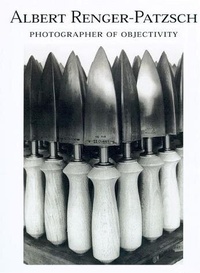
Albert Renger-Patzsch
Photographs of Objectivity
Published on 15. January 1998
Book
Hardback
176 pages
978-0-262-18189-1 (ISBN)
Description
with text by Thomas Janzon Albert Renger-Patzsch, together with August
Sander and Karl Blossfeldt, was one of the undisputed pioneers of twentieth-century
German photography. Indeed, what Sander achieved in portrait photography and
Blossfeldt in plant photography, Renger-Patzsch achieved in his renderings of
objects and the material world. As a protagonist of the movement that came to be
known as Neue Sachlichkeit (New Objectivity), he wanted to record,
phenomenologically as it were, the exact appearance of objects -- their form,
material, and surface. Thus he rejected any kind of artistic claim for himself.
Believing that the photographer should strive to capture the "essence of the
object," he called for documentation rather than art.Renger-Patzsch's most famous
work was the 1928 photo album Die Welt ist SchÃn (The World Is Beautiful), a
catalog of objects that became one of the most influential photography books ever
published. His cool and clinical photographs, with their details of technical
apparatus, industrial products, and natural organisms, were models of a new kind of
artistic vision.This book contains not only the canonical "Icons of New Objectivity"
series -- the famous still lifes of Jena glassware, rows of flatirons at a shoe
factory, industrial objects, and more -- but also Renger-Patzsch's lesser-known but
no less engaging photographs of landscapes, architecture, urban scenes, and studies
of trees and stones. The book also contains a biography, a bibliography, critical
commentary by Thomas Janzon, and selected writings of Renger-Patzsch appearing in
English for the first time.
Sander and Karl Blossfeldt, was one of the undisputed pioneers of twentieth-century
German photography. Indeed, what Sander achieved in portrait photography and
Blossfeldt in plant photography, Renger-Patzsch achieved in his renderings of
objects and the material world. As a protagonist of the movement that came to be
known as Neue Sachlichkeit (New Objectivity), he wanted to record,
phenomenologically as it were, the exact appearance of objects -- their form,
material, and surface. Thus he rejected any kind of artistic claim for himself.
Believing that the photographer should strive to capture the "essence of the
object," he called for documentation rather than art.Renger-Patzsch's most famous
work was the 1928 photo album Die Welt ist SchÃn (The World Is Beautiful), a
catalog of objects that became one of the most influential photography books ever
published. His cool and clinical photographs, with their details of technical
apparatus, industrial products, and natural organisms, were models of a new kind of
artistic vision.This book contains not only the canonical "Icons of New Objectivity"
series -- the famous still lifes of Jena glassware, rows of flatirons at a shoe
factory, industrial objects, and more -- but also Renger-Patzsch's lesser-known but
no less engaging photographs of landscapes, architecture, urban scenes, and studies
of trees and stones. The book also contains a biography, a bibliography, critical
commentary by Thomas Janzon, and selected writings of Renger-Patzsch appearing in
English for the first time.
More details
Language
English
Place of publication
Cambridge, Mass.
United States
Publishing group
MIT Press Ltd
Target group
College/higher education
Professional and scholarly
Illustrations
114 Duotone/Duplex-Fotos bzw. Rasterbilder
114 duotones
Dimensions
Height: 305 mm
Width: 229 mm
Thickness: 25 mm
Weight
1361 gr
ISBN-13
978-0-262-18189-1 (9780262181891)
Copyright in bibliographic data and cover images is held by Nielsen Book Services Limited or by the publishers or by their respective licensors: all rights reserved.
Schweitzer Classification
Persons
Jurgen Wilde is curator of the Karl Blossfeldt Archive.