


A Practical Guide to Finding Treatments That Work for People with Autism
Published on 5. January 2017
Book
Paperback/Softback
138 pages
978-0-12-809480-8 (ISBN)
Description
A Practical Guide to Finding Treatments That Work for People with Autism provides a logical, culturally sensitive, and values-based resource to aid practitioners in making informed decisions on the most effective treatment for any given client at any given time.
By providing multiple illustrative examples, practitioners will learn to use their professional judgment to integrate the best available evidence with client values and context. This will increase the efficacy of autism treatments, with the goal of producing meaningful gains across a range of skills.
By providing multiple illustrative examples, practitioners will learn to use their professional judgment to integrate the best available evidence with client values and context. This will increase the efficacy of autism treatments, with the goal of producing meaningful gains across a range of skills.
More details
Series
Language
English
Place of publication
San Diego
United States
Publishing group
Elsevier Science Publishing Co Inc
Target group
College/higher education
Dimensions
Height: 229 mm
Width: 152 mm
Weight
230 gr
ISBN-13
978-0-12-809480-8 (9780128094808)
Copyright in bibliographic data and cover images is held by Nielsen Book Services Limited or by the publishers or by their respective licensors: all rights reserved.
Schweitzer Classification
Other editions
New editions
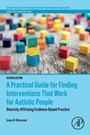
Susan M. Wilczynski
A Practical Guide for Finding Interventions That Work for Autistic People
Diversity-Affirming Evidence-Based Practice
Book
08/2024
2nd Edition
Academic Press
€76.00
Shipment within 15-20 days
Additional editions

Susan M. Wilczynski
A Practical Guide to Finding Treatments That Work for People with Autism
E-Book
01/2017
Academic Press
€28.95
Available for download
Person
Dr. Susan Wilczynski is the Plassman Family Distinguished Professor at Ball State University, a licensed psychologist, and a board-certified behavior analyst. She holds a Diversity, Equity, and Inclusion certificate from Cornell University. Susan conducts research on training practitioners to use the diversity affirming evidence-based practice decision-making model, which strongly emphasizes social validity, quality of life, and person-centered care. She serves on the nursing division of Wolters-Kluwer Publishing House's diversity advisory board. Susan is the former Coordinator for ABAI's Practice Board, served on their Task Force for the Promotion of Quality and Values-Based ABA, and on their Licensing Committee. As the former Executive Director of the National Autism Center, she chaired the first National Standards Project, the most comprehensive systematic review of behavioral and educational interventions supporting Autistic people of its time. She developed the first center-based intervention program at the University of Nebraska Medical Center. Susan has edited and/or written multiple books, including Postsecondary Transition for College- or Career-Bound Autistic Students. She has published in numerous journals such as Behavior Analysis in Practice, Journal of Applied Behavior Analysis, Focus on Autism and Other Developmental Disabilities, and Psychology in the Schools.
Content
Section I: Evidence-Based Practice: A Brief Overview
Section II: Best Available Evidence
1. Systematic Review
2. Other Sources of Evidence
Section III: Target, Stakeholder, and Leader Client Variables, Values, and Preferences
3. Client Health
4. Client Repertoire and Behavioral Cusps
5. Client Preferences
6. Quality of Life, Generalization, and Social Validity
7. Treatment Acceptability and Social Validity
8. Treatment Feasibility and Social Validity
9. Context Matters: Getting Systems to Adopt Treatments
Section IV: Professional Judgment
10. Initial Selection: Weighing and Integrating Information
11. Progress Monitoring
12. Determining the Next Step
Section V. Conclusions and Examples
Section II: Best Available Evidence
1. Systematic Review
2. Other Sources of Evidence
Section III: Target, Stakeholder, and Leader Client Variables, Values, and Preferences
3. Client Health
4. Client Repertoire and Behavioral Cusps
5. Client Preferences
6. Quality of Life, Generalization, and Social Validity
7. Treatment Acceptability and Social Validity
8. Treatment Feasibility and Social Validity
9. Context Matters: Getting Systems to Adopt Treatments
Section IV: Professional Judgment
10. Initial Selection: Weighing and Integrating Information
11. Progress Monitoring
12. Determining the Next Step
Section V. Conclusions and Examples