

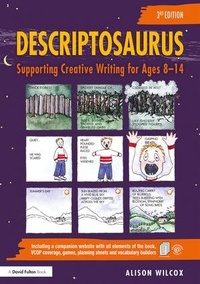
Descriptosaurus
Supporting Creative Writing for Ages 8-14
3rd Edition
Published on 16. November 2017
Book
Hardback
302 pages
978-1-138-09302-7 (ISBN)
Description
Now in a fully updated third edition, Descriptosaurus is the first book for creative writing that is a thematic expansion of a dictionary and a thesaurus; it provides children with a comprehensive resource with which to expand their descriptive vocabulary, experiment with language and sentence structure and build up narratives based around settings, characters and creatures.
Descriptosaurus positions the word, zooms in on it to examine the meaning, expands it into phrases, and then provides alternatives in words, phrases and sentences; the model was created and refined over a number of years as a result of feedback from children inside and outside the classroom as to the resources they required to inspire and assist them with their writing. For reluctant writers or those faced with blank page syndrome, it provides essential starting points to encourage putting pen to paper, not only inspiring children, but also building their confidence, encouraging them to use, apply and create using the correct grammatical structures, and adding colour to their writing through evaluation and experimentation.
New features for this updated third edition include:
Sample poems
Word banks and model sentences to provide a step-by-step process for development of vocabulary and understanding of phrase, clause and sentence structure
Contextualised grammar and punctuation instruction and guidance
Units of work where the models can be incorporated in a creative focus
A companion website containing all the features of the book, games, planning sheets and vocabulary builders
This is an ideal resource to dramatically improve children's creative writing for all KS2 primary and KS3 secondary English teachers, literacy coordinators and parents. It would also make an excellent classroom book for PGCE students, particularly Primary PGCE with English specialism.
Descriptosaurus positions the word, zooms in on it to examine the meaning, expands it into phrases, and then provides alternatives in words, phrases and sentences; the model was created and refined over a number of years as a result of feedback from children inside and outside the classroom as to the resources they required to inspire and assist them with their writing. For reluctant writers or those faced with blank page syndrome, it provides essential starting points to encourage putting pen to paper, not only inspiring children, but also building their confidence, encouraging them to use, apply and create using the correct grammatical structures, and adding colour to their writing through evaluation and experimentation.
New features for this updated third edition include:
Sample poems
Word banks and model sentences to provide a step-by-step process for development of vocabulary and understanding of phrase, clause and sentence structure
Contextualised grammar and punctuation instruction and guidance
Units of work where the models can be incorporated in a creative focus
A companion website containing all the features of the book, games, planning sheets and vocabulary builders
This is an ideal resource to dramatically improve children's creative writing for all KS2 primary and KS3 secondary English teachers, literacy coordinators and parents. It would also make an excellent classroom book for PGCE students, particularly Primary PGCE with English specialism.
More details
Edition
3rd edition
Language
English
Place of publication
London
United Kingdom
Publishing group
Taylor & Francis Ltd
Target group
College/higher education
Professional and scholarly
Further/Vocational Education, Parents, and Professional Practice & Development
Illustrations
227 s/w Abbildungen, 227 s/w Zeichnungen, 17 s/w Tabellen
17 Tables, black and white; 227 Line drawings, black and white; 227 Illustrations, black and white
Dimensions
Height: 297 mm
Width: 210 mm
Weight
1100 gr
ISBN-13
978-1-138-09302-7 (9781138093027)
Copyright in bibliographic data and cover images is held by Nielsen Book Services Limited or by the publishers or by their respective licensors: all rights reserved.
Schweitzer Classification
Other editions
New editions
Book
12/2023
4th Edition
Routledge
€44.00
Shipment within 10-20 days
Previous edition
Book
03/2013
2nd Edition
Routledge
€60.84
Article exhausted; check for reprint
Person
Alison Wilcox has extensive teaching experience in schools in England and Scotland. Colleagues describe her methods as 'innovative and inspirational to even the most reluctant of writers'.
Content
Part 1 - Settings Chapter 1: Forest and Woods Chapter 2: Mountains Chapter 3: Caves Chapter 4: Beaches, islands, volcanoes and deserts Chapter 5: Ground and Paths Chapter 6: Streams, Rivers, Lakes and Waterfalls Chapter 7: Sea and Waves Chapter 8: Cities, towns and villages Chapter 9: Roads Chapter 10: Gardens Chapter 11: Buildings Chapter 12: Doors, halls, corridors and stairs Chapter 13: Rooms Chapter 14: Time of day Chapter 15: Seasons Chapter 16: Rain, mist and fog Chapter 17: Wind, thunder and lightning Chapter 18: Smell and touch Chapter 19: Sound Part 2 - Characters Chapter 20: Age, height and shape Chapter 21: Face Chapter 22: Eyes Chapter 23: Mouth, teeth, nose and ears Chapter 24: Hands and fingers Chapter 25: Hair and facial hair Chapter 26: Clothes Chapter 27: Voice Chapter 28: Excited, happy Chapter 29: Concentrating, determined Chapter 30: Sympathetic, caring Chapter 31: Relieved Chapter 32: Angry, irritated, aggressive, impatient Chapter 33: Cold, evil, arrogant, sly Chapter 34: Frightened, timid Chapter 35: Nervous, embarrassed, shy Chapter 36: Sad, miserable Chapter 37: Tired Chapter 38: Pain Part 3 - Creatures Chapter 39: Parts, size, shape, colour and covering Chapter 40: Head Chapter 41: Eyes Chapter 42: Arms and legs Chapter 43: Wings and tails Chapter 44: Smell and sound Chapter 45: Movement Chapter 46: Habitat Chapter 47: Abilities and actions Chapter 48: Weapons and destruction Part 4 - Additional Vocabulary Chapter 49: Adverbs Chapter 50: Connectives Part 5 - Grammar in a Creative Context Chapter 51: Poetry Chapter 52: Modelled Sentences Chapter 53: Action Frames Chapter 54: Setting, interaction and reaction