

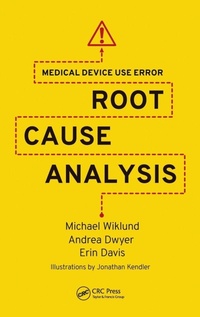
Medical Device Use Error
Root Cause Analysis
1st Edition
Published on 16. December 2015
Book
Hardback
245 pages
978-1-4987-0579-0 (ISBN)
Description
Medical Device Use Error: Root Cause Analysis offers practical guidance on how to methodically discover and explain the root cause of a use error-a mistake-that occurs when someone uses a medical device. Covering medical devices used in the home and those used in clinical environments, the book presents informative case studies about the use errors (mistakes) that people make when using a medical device, the potential consequences, and design-based preventions.
Using clear illustrations and simple narrative explanations, the text:
Covers the fundamentals and language of root cause analysis and regulators' expectations regarding the thorough analysis of use errors
Describes how to identify use errors, interview users about use errors, and fix user interface design flaws that could induce use errors
Reinforces the application of best practices in human factors engineering, including conducting both formative and summative usability tests
Medical Device Use Error: Root Cause Analysis delineates a systematic method of analyzing medical device use errors. The book provides a valuable reference to human factors specialists, product development professionals, and others committed to making medical devices as safe and effective as possible.
Using clear illustrations and simple narrative explanations, the text:
Covers the fundamentals and language of root cause analysis and regulators' expectations regarding the thorough analysis of use errors
Describes how to identify use errors, interview users about use errors, and fix user interface design flaws that could induce use errors
Reinforces the application of best practices in human factors engineering, including conducting both formative and summative usability tests
Medical Device Use Error: Root Cause Analysis delineates a systematic method of analyzing medical device use errors. The book provides a valuable reference to human factors specialists, product development professionals, and others committed to making medical devices as safe and effective as possible.
Reviews / Votes
"In a simple but lucid manner, this book addresses medical device use error, utilizing root cause analysis as a structured method to examine serious adverse events. It is an excellent resource for human factors practitioners, medical device manufacturers and designers, clinicians at the bedside, biomedical engineers, caregivers at home, and students interested in understanding effective and safe design aspects of typical medical devices."-Ergonomics in Design, October 2017
More details
Language
English
Place of publication
Bosa Roca
United States
Publishing group
Taylor & Francis Inc
Target group
College/higher education
Professional and scholarly
Illustrations
130 farbige Abbildungen, 6 farbige Tabellen
6 Tables, color; 130 Illustrations, color
Dimensions
Height: 240 mm
Width: 161 mm
Thickness: 19 mm
Weight
573 gr
ISBN-13
978-1-4987-0579-0 (9781498705790)
Copyright in bibliographic data and cover images is held by Nielsen Book Services Limited or by the publishers or by their respective licensors: all rights reserved.
Schweitzer Classification
Other editions
Additional editions
E-Book
01/2016
CRC Press
€211.99
Available for download
E-Book
01/2016
1st Edition
CRC Press
€211.99
Available for download
Persons
Michael E. Wiklund is general manager of the human factors engineering (HFE) practice at UL-Wiklund, as well as professor of the practice at Tufts University, where he teaches courses on HFE. He has more than 30 years of experience in HFE, much of which has focused on medical technology development. His work has involved optimizing the safety, effectiveness, usability, and appeal of various products. Widely published, he is a certified human factors professional and one of the primary contributors to today's most pertinent guidelines on the HFE of medical devices: AAMI HE75 and IEC 62366.
Andrea M. Dwyer is a managing human factors specialist at UL-Wiklund, where she leads some of the team's most challenging user research and usability testing projects. She has authored numerous usability test reports that involve root cause analysis of medical device use errors. She also frequently composes usability engineering (i.e., human factors engineering, or HFE) program plans, administers usability tests, and develops HFE reports. She earned her BS in human factors engineering from Tufts University, where she received two prizes that honor achievement and excellence in human factors studies. She is currently a part-time graduate student in engineering management at Tufts University.
Erin M. Davis is a managing human factors specialist at UL-Wiklund , where she develops and implements human factors engineering (HFE) programs and leads projects requiring expertise in user research, design, and usability testing of medical devices. She received her MS in HFE from Tufts University, and her BS in biomedical engineering from Marquette University. Erin is a published researcher and serves as the 2015 president of the Human Factors and Ergonomics Society's New England chapter.
Andrea M. Dwyer is a managing human factors specialist at UL-Wiklund, where she leads some of the team's most challenging user research and usability testing projects. She has authored numerous usability test reports that involve root cause analysis of medical device use errors. She also frequently composes usability engineering (i.e., human factors engineering, or HFE) program plans, administers usability tests, and develops HFE reports. She earned her BS in human factors engineering from Tufts University, where she received two prizes that honor achievement and excellence in human factors studies. She is currently a part-time graduate student in engineering management at Tufts University.
Erin M. Davis is a managing human factors specialist at UL-Wiklund , where she develops and implements human factors engineering (HFE) programs and leads projects requiring expertise in user research, design, and usability testing of medical devices. She received her MS in HFE from Tufts University, and her BS in biomedical engineering from Marquette University. Erin is a published researcher and serves as the 2015 president of the Human Factors and Ergonomics Society's New England chapter.
Content
Introduction. Our Root Cause Analysis Process. The Regulatory Imperative to Perform Root Cause Analysis. Applicable Standards and Guidelines. The Language of Risk and Root Cause Analysis. Types of Use Errors. Detecting Use Errors. Interviewing Users to Determine Root Causes. Perils of Blaming Users for Use Errors. User Interface Design Flaws That Can Lead to Use Error. Reporting Root Causes of Medical Device Use Error. Root Cause Analysis Examples. Guide to Designing an Error-Resistant User Interface. Other Root Cause Analysis Methods. Resources.