

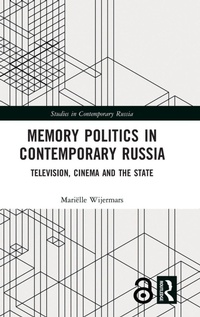
Memory Politics in Contemporary Russia
Television, Cinema and the State
1st Edition
Published on 26. July 2018
Book
Hardback
266 pages
978-1-138-54319-5 (ISBN)
Description
This book examines the societal dynamics of memory politics in Russia. Since Vladimir Putin became president, the Russian central government has increasingly actively employed cultural memory to claim political legitimacy and discredit all forms of political opposition. The rhetorical use of the past has become a defining characteristic of Russian politics, creating a historical foundation for the regime's emphasis on a strong state and centralised leadership.
Exploring memory politics, this book analyses a wide range of actors, from the central government and the Russian Orthodox Church, to filmmaker and cultural heavyweight Nikita Mikhalkov and radical thinkers such as Aleksandr Dugin. In addition, in view of the steady decline in media freedom since 2000, it critically examines the role of cinema and television in shaping and spreading these narratives. Thus, this book aims to gain a better understanding of the various means through which the Russian government practices its memory politics (e.g., the role of state media) and, on the other hand, to sufficiently value the existence of alternative and critical voices and criticism that existing studies tend to overlook.
Contributing to current debates in the field of memory studies and of current affairs in Russia and Eastern Europe, this book will be of interest to scholars working in the fields of Russian Studies, Cultural Memory Studies, Nationalism and National Identity, Political Communication, Film, Television and Media Studies.
Exploring memory politics, this book analyses a wide range of actors, from the central government and the Russian Orthodox Church, to filmmaker and cultural heavyweight Nikita Mikhalkov and radical thinkers such as Aleksandr Dugin. In addition, in view of the steady decline in media freedom since 2000, it critically examines the role of cinema and television in shaping and spreading these narratives. Thus, this book aims to gain a better understanding of the various means through which the Russian government practices its memory politics (e.g., the role of state media) and, on the other hand, to sufficiently value the existence of alternative and critical voices and criticism that existing studies tend to overlook.
Contributing to current debates in the field of memory studies and of current affairs in Russia and Eastern Europe, this book will be of interest to scholars working in the fields of Russian Studies, Cultural Memory Studies, Nationalism and National Identity, Political Communication, Film, Television and Media Studies.
More details
Series
Language
English
Place of publication
London
United Kingdom
Publishing group
Taylor & Francis Ltd
Target group
College/higher education
Dimensions
Height: 240 mm
Width: 161 mm
Thickness: 19 mm
Weight
570 gr
ISBN-13
978-1-138-54319-5 (9781138543195)
Copyright in bibliographic data and cover images is held by Nielsen Book Services Limited or by the publishers or by their respective licensors: all rights reserved.
Schweitzer Classification
Other editions
Additional editions
Book
12/2020
1st Edition
Routledge
€52.07
Shipment within 15-20 days
E-Book
07/2018
1st Edition
Routledge
€0.00
Available for download
E-Book
07/2018
1st Edition
Routledge
€0.00
Available for download
Person
Marielle Wijermars is a postdoctoral researcher at the Aleksanteri Institute, University of Helsinki.
Content
Chapter 1 - Introduction Chapter 2 - Memory Politics and the Remediation of Cultural Memory Case Studies Chapter 3 - Petr Stolypin Chapter 4 - Aleksandr Nevskii Chapter 5 - The Time of Troubles Chapter 6 - Ivan the Terrible and the Oprichnina Chapter 7 - The Trial of Time Chapter 8 - Conclusion