

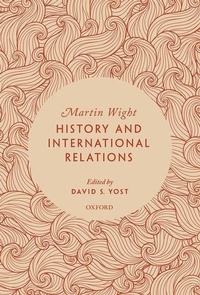
History and International Relations
Published on 18. July 2023
Book
Hardback
352 pages
978-0-19-286747-6 (ISBN)
Description
History and International Relations collects works by the late Professor Martin Wight (1913-1972), an historian and scholar of international relations. Wight conducted research on many topics, including British colonial history, European studies, international institutions, and the history of states-systems, and is nonetheless best known for his lectures about the political philosophy of international relations at the London School of Economics (1949-1961) and the University of Sussex (1961-1972). He is widely regarded as an intellectual ancestor and pathbreaker of the "English School" of international relations, even though this term only gained currency nine years after his death. The "English School" is usually construed as signifying an approach to the study of international relations more rooted in historical and humanistic learning than in the social sciences.
This volume encompasses works in four categories: (a) standards of excellence in scholarship about history and international relations; (b) European integration efforts since 1945; (c) British policy in the Middle East, notably in relation to the 1956 Suez crisis; and (d) European politics in the interwar period leading up to 1939. This last category features four chapters by Wight from the noteworthy Chatham House collection sponsored by the Royal Institute of International Affairs, The World in March 1939. These chapters on Germany and Eastern Europe stand out as exceptionally thorough and discerning, owing in part to their reliance on a wealth of primary and secondary sources. This collection also includes Wight's reviews of works by Geoffrey Barraclough, Marc Bloch, Herbert Butterfield, R. G. Collingwood, Denis Mack Smith, Sir Lewis Namier, A. J. P. Taylor, Arnold J. Toynbee, Veronica Wedgwood, and other historians.
This volume encompasses works in four categories: (a) standards of excellence in scholarship about history and international relations; (b) European integration efforts since 1945; (c) British policy in the Middle East, notably in relation to the 1956 Suez crisis; and (d) European politics in the interwar period leading up to 1939. This last category features four chapters by Wight from the noteworthy Chatham House collection sponsored by the Royal Institute of International Affairs, The World in March 1939. These chapters on Germany and Eastern Europe stand out as exceptionally thorough and discerning, owing in part to their reliance on a wealth of primary and secondary sources. This collection also includes Wight's reviews of works by Geoffrey Barraclough, Marc Bloch, Herbert Butterfield, R. G. Collingwood, Denis Mack Smith, Sir Lewis Namier, A. J. P. Taylor, Arnold J. Toynbee, Veronica Wedgwood, and other historians.
More details
Language
English
Place of publication
Oxford
United Kingdom
Target group
Professional and scholarly
Product notice
sewn/stitched
Cloth over boards
Dimensions
Height: 237 mm
Width: 159 mm
Thickness: 29 mm
Weight
788 gr
ISBN-13
978-0-19-286747-6 (9780192867476)
Copyright in bibliographic data and cover images is held by Nielsen Book Services Limited or by the publishers or by their respective licensors: all rights reserved.
Schweitzer Classification
Other editions
Additional editions
Martin Wight | David S. Yost
History and International Relations
E-Book
07/2023
1st Edition
OUP eBook
€81.99
Available for download
Martin Wight | David S. Yost
History and International Relations
E-Book
06/2023
1st Edition
OUP eBook
€81.99
Available for download
Persons
David S. Yost is a Distinguished Professor Emeritus at the U.S. Naval Postgraduate School, Monterey, California. His books have been published by Harvard University Press, the United States Institute of Peace, and the International Institute for Strategic Studies. He has held fellowships from Fulbright, NATO, the Council on Foreign Relations, the Woodrow Wilson International Center for Scholars, and the United States Institute of Peace, and he was a senior research fellow at the NATO Defense College in Rome in 2004-2007. He earned a Ph.D. in international relations from the University of Southern California.
Martin Wight was one of the most important twentieth century British scholars of International Relations. He taught at the London School of Economics (1949-1961) and the University of Sussex (1961-1972), where he served as the founding Dean of the School of European Studies. Wight is often associated with the British Committee on the Theory of International Politics and the so-called English School of International Relations.
Martin Wight was one of the most important twentieth century British scholars of International Relations. He taught at the London School of Economics (1949-1961) and the University of Sussex (1961-1972), where he served as the founding Dean of the School of European Studies. Wight is often associated with the British Committee on the Theory of International Politics and the so-called English School of International Relations.
Content
1: What Is International Relations?
2: History and the Study of International Relations
3: What Makes a Good Historian?
4: The Principles of Historiographical Criticism
5: The Concept of Europe
6: United Europe: The Historical Background
7: Europe After 1945
8: British Policy in the Middle East
9: Brutus in Foreign Policy: The Memoirs of Sir Anthony Eden
10: Germany in The World in March 1939
11: Eastern Europe in The World in March 1939
12: Spain and Portugal in The World in March 1939
13: Switzerland, the Low Countries, and Scandinavia in The World in March 1939
14: Note on Partition
15: Arnold Toynbee: An Appreciation
16: Review of Arnold J. Toynbee, A Study of History, abridgment of Volumes I-VI by D.C. Somervell
17: Review of Arnold J. Toynbee, Civilisation on Trial
18: Dame Veronica Wedgwood, O.M.
19: Review of Charles Petrie, Diplomatic History 1713-1933
20: Review of A.L. Rowse, The Use of History, and R. G. Collingwood, The Idea of History
21: Review of Jacob Bronowski and Bruce Mazlish, The Western Intellectual Tradition
22: Review of Marc Bloch, The Historian's Craft
23: Review of Homer Carey Hockett, The Critical Method in Historical Research and Writing, and Geoffrey Barraclough, History in a Changing World
24: Review of Denis Mack Smith, Cavour and Garibaldi
25: Review of A. J. P. Taylor, Rumours of Wars
26: Review of A. J. P. Taylor, The Struggle for Mastery in Europe, 1848-1918
27: Review of A.J.P. Taylor, Bismarck: The Man and the Statesman
28: Review of A.J.P. Taylor, The Habsburg Monarchy, 1809-1918: A History of the Austrian Empire and Austria-Hungary in International Affairs
29: Review of Herbert Butterfield, History and Human Relations
30: Review of Edouard Perroy, The Hundred Years' War
31: Review of L. B. Namier, Avenues of History
32: Review of Sir Lewis Namier, In the Nazi Era
2: History and the Study of International Relations
3: What Makes a Good Historian?
4: The Principles of Historiographical Criticism
5: The Concept of Europe
6: United Europe: The Historical Background
7: Europe After 1945
8: British Policy in the Middle East
9: Brutus in Foreign Policy: The Memoirs of Sir Anthony Eden
10: Germany in The World in March 1939
11: Eastern Europe in The World in March 1939
12: Spain and Portugal in The World in March 1939
13: Switzerland, the Low Countries, and Scandinavia in The World in March 1939
14: Note on Partition
15: Arnold Toynbee: An Appreciation
16: Review of Arnold J. Toynbee, A Study of History, abridgment of Volumes I-VI by D.C. Somervell
17: Review of Arnold J. Toynbee, Civilisation on Trial
18: Dame Veronica Wedgwood, O.M.
19: Review of Charles Petrie, Diplomatic History 1713-1933
20: Review of A.L. Rowse, The Use of History, and R. G. Collingwood, The Idea of History
21: Review of Jacob Bronowski and Bruce Mazlish, The Western Intellectual Tradition
22: Review of Marc Bloch, The Historian's Craft
23: Review of Homer Carey Hockett, The Critical Method in Historical Research and Writing, and Geoffrey Barraclough, History in a Changing World
24: Review of Denis Mack Smith, Cavour and Garibaldi
25: Review of A. J. P. Taylor, Rumours of Wars
26: Review of A. J. P. Taylor, The Struggle for Mastery in Europe, 1848-1918
27: Review of A.J.P. Taylor, Bismarck: The Man and the Statesman
28: Review of A.J.P. Taylor, The Habsburg Monarchy, 1809-1918: A History of the Austrian Empire and Austria-Hungary in International Affairs
29: Review of Herbert Butterfield, History and Human Relations
30: Review of Edouard Perroy, The Hundred Years' War
31: Review of L. B. Namier, Avenues of History
32: Review of Sir Lewis Namier, In the Nazi Era