

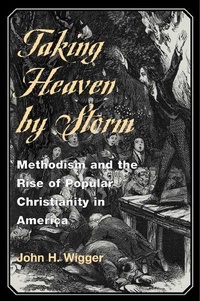
Taking Heaven by Storm
Methodism and the Rise of Popular Christianity in America
Will be published approx. on 25. July 2001
Book
Paperback/Softback
288 pages
978-0-252-06994-9 (ISBN)
Description
In 1770 there were fewer than 1,000 Methodists in America. Fifty years later, the church counted more than 250,000 adherents. Identifying Methodism as America's most significant large-scale popular religious movement of the antebellum period, John H. Wigger reveals what made Methodism so attractive to post-revolutionary America.
Taking Heaven by Storm shows how Methodism fed into popular religious enthusiasm as well as the social and economic ambitions of the "middling people on the make"--skilled artisans, shopkeepers, small planters, petty merchants--who constituted its core. Wigger describes how the movement expanded its reach and fostered communal intimacy and "intemperate zeal" by means of an efficient system of itinerant and local preachers, class meetings, love feasts, quarterly meetings, and camp meetings. He also examines the important role of African Americans and women in early American Methodism and explains how the movement's willingness to accept impressions, dreams, and visions as evidence of the work and call of God circumvented conventional assumptions about education, social standing, gender, and race.
A pivotal text on the role of religion in American life, Taking Heaven by Storm shows how the enthusiastic, egalitarian, entrepreneurial, lay-oriented spirit of early American Methodism continues to shape popular religion today.
Taking Heaven by Storm shows how Methodism fed into popular religious enthusiasm as well as the social and economic ambitions of the "middling people on the make"--skilled artisans, shopkeepers, small planters, petty merchants--who constituted its core. Wigger describes how the movement expanded its reach and fostered communal intimacy and "intemperate zeal" by means of an efficient system of itinerant and local preachers, class meetings, love feasts, quarterly meetings, and camp meetings. He also examines the important role of African Americans and women in early American Methodism and explains how the movement's willingness to accept impressions, dreams, and visions as evidence of the work and call of God circumvented conventional assumptions about education, social standing, gender, and race.
A pivotal text on the role of religion in American life, Taking Heaven by Storm shows how the enthusiastic, egalitarian, entrepreneurial, lay-oriented spirit of early American Methodism continues to shape popular religion today.
Reviews / Votes
"The story of [Methodism's] rise and growth has been told before, but in this new book an attempt is made to account for the movement's remarkable success, a success which in part ... was the result of Methodism's adaptability in the context of the prevailing popular religious culture in which Methodism took root." -- Kenneth Newport, Theological Book Review "Stunning, magnificent, pungent, well-crafted, beautifully written, painstakingly researched, lavishly documented, careful, comprehensive, insightful, compelling... It provides the best treatment of early American Methodism (to 1820) that we have and are likely to get any time soon." - Russell E. Richey, Wesleyan/Holiness Studies Center Bulletin "John Wigger has at last provided us with the wide-ranging, contextualized study of expansionary, early Methodism that we have long needed... This is a lucidly written work of scrupulous and unostentatious historical scholarship." - Richard J. Carwardine, Journal of Southern Religion "Exhaustively researched, beautifully written, broad and sweeping in conception and interpretation... By far the best account of early Methodism in America." -- David Edwin Harrell, Jr., Labour History ReviewMore details
Language
English
Place of publication
Baltimore
United States
Target group
Professional and scholarly
Interest Age: From 12 to 17 years
Product notice
Paperback (trade)
Unsewn / adhesive bound
Dimensions
Height: 230 mm
Width: 154 mm
Thickness: 22 mm
Weight
467 gr
ISBN-13
978-0-252-06994-9 (9780252069949)
Copyright in bibliographic data and cover images is held by Nielsen Book Services Limited or by the publishers or by their respective licensors: all rights reserved.
Schweitzer Classification
Person
John Wigger is an associate professor of history at the University of Missouri.