

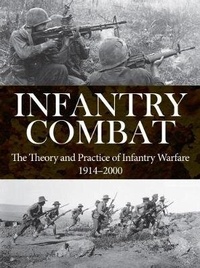
Infantry Combat
The Theory and Practice of Infantry Warfare 1914-2000
Published on 14. July 2017
Book
Paperback/Softback
176 pages
978-1-78274-536-5 (ISBN)
Description
From the trenches of the Somme to the ruins of Stalingrad to the deserts of Iraq, the role of the infantry soldier developed dramatically throughout the twentieth century. Infantry Combat examines the changing roles that took place for infantry from 1900 to the year 2000.
With the introduction of tanks during World War I, infantry were no longer the shock arm in battle but became responsible for securing objectives that tanks had taken. But this wasn't to be the case all around the world, as in areas inaccessible to tanks, such as the jungles of the Pacific islands or Vietnam, the infantry were once again the primary means of waging war. And while the Cold War and nuclear weapons threatened to reduce the infantry to a secondary role, the increase in limited operations, often against less well-equipped opponents, saw the common soldier once again in the forefront. And what future the combat soldier? The book concludes with an examination of robotics and new mechanisation on the battlefield. Illustrated with action photographs and battle maps, Infantry Combat uses examples from an immense range of twentieth century combat situations to provide a definitive guide to modern infantry warfare.
With the introduction of tanks during World War I, infantry were no longer the shock arm in battle but became responsible for securing objectives that tanks had taken. But this wasn't to be the case all around the world, as in areas inaccessible to tanks, such as the jungles of the Pacific islands or Vietnam, the infantry were once again the primary means of waging war. And while the Cold War and nuclear weapons threatened to reduce the infantry to a secondary role, the increase in limited operations, often against less well-equipped opponents, saw the common soldier once again in the forefront. And what future the combat soldier? The book concludes with an examination of robotics and new mechanisation on the battlefield. Illustrated with action photographs and battle maps, Infantry Combat uses examples from an immense range of twentieth century combat situations to provide a definitive guide to modern infantry warfare.
More details
Series
Language
English
Place of publication
United Kingdom
Publishing group
Amber Books Ltd
Target group
Interest Age: From 16 to 99 years
Product notice
Unsewn / adhesive bound
Illustrations
Index; Maps; Halftones, black and white
Dimensions
Height: 245 mm
Width: 183 mm
Thickness: 10 mm
Weight
500 gr
ISBN-13
978-1-78274-536-5 (9781782745365)
Copyright in bibliographic data and cover images is held by Nielsen Book Services Limited or by the publishers or by their respective licensors: all rights reserved.
Schweitzer Classification
Persons
Andrew Wiest is University Distinguished Professor of History at the University of Southern Mississippi and Founding Director of the university's Dale Center for the Study of War and Society. He is author of many books including The Illustrated History of World War I and The Boys of '67, and co-author of Campaigns of World War II: The Pacific War, The Illustrated History of the Vietnam War and Strategy and Tactics: Infantry Warfare. M.K. Barbier is an Associate Professor at Mississippi State University, and a former Olin Postdoctoral Fellow at the department of International Security Studies at Yale University. With Andrew Wiest she is co-author of Infantry Combat.
Content
Introduction
Industrial War
New Thinking
Blitzkrieg
Eastern Front
Pacific
After D-Day
Infantry after 1945
Proxy Wars
Limited Conflicts
Peacekeeping
Index
Industrial War
New Thinking
Blitzkrieg
Eastern Front
Pacific
After D-Day
Infantry after 1945
Proxy Wars
Limited Conflicts
Peacekeeping
Index