

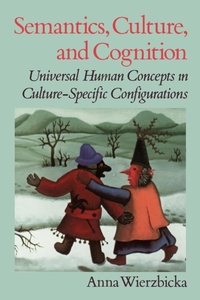
Semantics, Culture, and Cognition
Universal Human Concepts in Culture-specific Configurations
Published on 10. December 1992
Book
Paperback/Softback
496 pages
978-0-19-507326-3 (ISBN)
Description
To what extent are languages 'essentially the same'? Is every word in our language translatable into every other language, or are some of our words and concepts 'culture specific'? In this innovative study, Wierzbicka ranges across a wide variety of languages and cultures, attempting to identify concepts which are truly universal, while at the same time arguing that every language constitutes a different 'guide to reality'. The lexicons of different languages, she shows, do indeed suggest different conceptual universes. Not everything that can be said in one language can be said in another, and this is not just a matter of certain things being easier to say in one language than in another.
Wierzbicka focuses on a few specific classes of words. One chapter looks at the language of emotion across cultures, and finds that there are numerous culture-specific words for feelings and emotions which have no analogues in other cultures. Another chapter considers moral concepts across cultures. A third examines names and titles. In her concluding chapter, Wierzbicka analyses the ways in which the Russian language and Australian English serve as mirrors of their respective cultures and 'national characters'.
Clearly and accessibly written, this important new study will be of great interest to scholars working in a wide range of disciplines, including linguistics, anthropology, philosophy, psychology and literary studies.
Wierzbicka focuses on a few specific classes of words. One chapter looks at the language of emotion across cultures, and finds that there are numerous culture-specific words for feelings and emotions which have no analogues in other cultures. Another chapter considers moral concepts across cultures. A third examines names and titles. In her concluding chapter, Wierzbicka analyses the ways in which the Russian language and Australian English serve as mirrors of their respective cultures and 'national characters'.
Clearly and accessibly written, this important new study will be of great interest to scholars working in a wide range of disciplines, including linguistics, anthropology, philosophy, psychology and literary studies.
Reviews / Votes
Excellent cross-linguistic, cross-cultural penetration into how the mind works. Fascinating analysis of language as a mirror into the workings of the human soul. Richard L. Wright, Howard UniversityMore details
Language
English
Place of publication
New York
United States
Target group
Professional and scholarly
Illustrations
1 Zeichnung
1 line drawing
Dimensions
Height: 229 mm
Width: 152 mm
Thickness: 29 mm
Weight
798 gr
ISBN-13
978-0-19-507326-3 (9780195073263)
Copyright in bibliographic data and cover images is held by Nielsen Book Services Limited or by the publishers or by their respective licensors: all rights reserved.
Schweitzer Classification
Other editions
Additional editions
Anna Wierzbicka
Semantics, Culture, and Cognition
Universal Human Concepts in Culture-Specific Configurations
E-Book
10/1992
1st Edition
OUP USA
€82.99
Available for download