

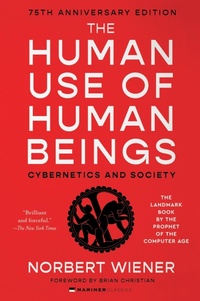
The Human Use of Human Beings
Cybernetics and Society
Published on 25. September 2025
Book
Paperback/Softback
240 pages
978-0-06-342319-0 (ISBN)
Description
For the 75th anniversary, a new edition of The Human Use of Human Beings-the landmark book that delves into the relationship between humans and computers, and presciently anticipates many contemporary dilemmas surrounding AI technology. With a new introduction by Brian Christian, author of the bestselling Algorithms to Live By and The Alignment Problem.
In 1950, mathematician-philosopher Norbert Wiener ended this classic book on the place of machines in society with a warning: "We shall never receive the right answers to our questions unless we ask the right questions.... The hour is very late, and the choice of good and evil knocks at our door."
Wiener, the founder of the science of cybernetics-the study of the relationship between computers and the human nervous system-was widely mislabeled as an advocate for the automation of human life. As The Human Use for Human Beings reveals, his vision was much more complex and interesting, and is more relevant in today's world of AI than anyone could have anticipated.
In his new introduction, Brian Christian aptly calls Wiener the "progenitor of contemporary AI-safety discourse." Wiener hoped that machines would release people from relentless and repetitive drudgery to achieve more creative pursuits, yet he anticipated the danger of dehumanizing and displacement. His pioneering views on the human-machine relationship as a "communicative process" are only more crucial now, as we carry in our pockets AI devices that we can literally speak to. His prescient warnings illuminate our contemporary relationships with language, art, and even social media.
The Human Use of Human Beings examines the implications of cybernetics for education, law, language, science, technology, as Wiener anticipates the enormous impact-in effect, a third industrial revolution-that the computer has had on our lives.
In 1950, mathematician-philosopher Norbert Wiener ended this classic book on the place of machines in society with a warning: "We shall never receive the right answers to our questions unless we ask the right questions.... The hour is very late, and the choice of good and evil knocks at our door."
Wiener, the founder of the science of cybernetics-the study of the relationship between computers and the human nervous system-was widely mislabeled as an advocate for the automation of human life. As The Human Use for Human Beings reveals, his vision was much more complex and interesting, and is more relevant in today's world of AI than anyone could have anticipated.
In his new introduction, Brian Christian aptly calls Wiener the "progenitor of contemporary AI-safety discourse." Wiener hoped that machines would release people from relentless and repetitive drudgery to achieve more creative pursuits, yet he anticipated the danger of dehumanizing and displacement. His pioneering views on the human-machine relationship as a "communicative process" are only more crucial now, as we carry in our pockets AI devices that we can literally speak to. His prescient warnings illuminate our contemporary relationships with language, art, and even social media.
The Human Use of Human Beings examines the implications of cybernetics for education, law, language, science, technology, as Wiener anticipates the enormous impact-in effect, a third industrial revolution-that the computer has had on our lives.
Reviews / Votes
"It presents cybernetics as a scientific theory and a social philosophy. From the latter standpoint, the writing is often brilliant and forceful." - New York Times"It is hardly possible to read him without being startled to furious and fruitful thinking, moved to deep and reverberating emotion. He is a Jeremiah with the taste and learning of a Renaissance humanist, the free-ranging intellectual gusto of a William James." - Christian Science Monitor
"Norbert Weiner's seminal 1950 book . . . investigates the interplay between human beings and machines in a world in which machines are becoming ever more computationally capable and powerful. It is a remarkably prescient book." - Seth Lloyd, Slate
"Immensely insightful and increasingly relevant." - Maria Popova
More details
Language
English
Place of publication
New York
United States
Publishing group
HarperCollins Publishers Inc
Dimensions
Height: 201 mm
Width: 132 mm
Thickness: 18 mm
Weight
206 gr
ISBN-13
978-0-06-342319-0 (9780063423190)
Copyright in bibliographic data and cover images is held by Nielsen Book Services Limited or by the publishers or by their respective licensors: all rights reserved.
Schweitzer Classification
Other editions
Additional editions
E-Book
08/2025
HarperCollins
€12.93
Available for download
Persons
Norbert Wiener received his Ph.D. from Harvard at the age of eighteen and joined the mathematics department at M.I.T. when he was twenty-five. Honored throughout his life with numerous scientific awards, he was the author of two autobiographies, Ex-Prodogy and I Am a Mathematician, as well as several important books and basic papers on the theory and practice of cybernetics.
Brian Christian is the bestselling author of the acclaimed books The Most Human Human, Algorithms to Live By, and The Alignment Problem, which have been translated into nineteen languages. A researcher at the University of Oxford, he lives in San Francisco.
Brian Christian is the bestselling author of the acclaimed books The Most Human Human, Algorithms to Live By, and The Alignment Problem, which have been translated into nineteen languages. A researcher at the University of Oxford, he lives in San Francisco.