

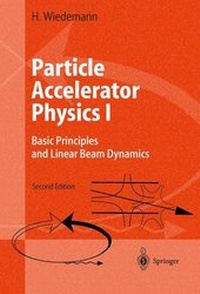
Particle Accelerator Physics I
Basic Principles and Linear Beam Dynamics
2nd Edition
Published on 12. March 1999
Book
Hardback
XVIII, 449 pages
978-3-540-64671-6 (ISBN)
Description
In this second edition of Particle Accelerator Physics, Vol. 1, is mainly a reprint of the first edition without significant changes in content. The bibliography has been updated to include more recent progress in the field of particle accelerators. With the help of many observant readers a number of misprints and errors could be eliminated. The author would like to express his sincere appreciation to all those who have pointed out such shortcomings and wel comes such information and any other relevant information in the future. The author would also like to express his special thanks to the editor Dr. Helmut Lotsch and his staff for editorial as well as technical advice and support which contributed greatly to the broad acceptance of this text and made a second edition of both volumes necessary. Palo Alto, California Helmut Wiedemann November 1998 VII Preface to the First Edition The purpose of this textbook is to provide a comprehensive introduction into the physics of particle accelerators and particle beam dynamics. Parti cle accelerators have become important research tools in high energy physics as well as sources of incoherent and coherent radiation from the far infra red to hard x-rays for basic and applied research. During years of teaching accelerator physics it became clear that the single most annoying obstacle to get introduced into the field is the absence of a suitable textbook.
More details
Series
Edition
2nd ed.
Language
English
Place of publication
Heidelberg
Germany
Publishing group
Springer Berlin
Target group
College/higher education
Professional and scholarly
Edition type
Revised edition
Illustrations
37
37 s/w Abbildungen
160 figures
Dimensions
Height: 23.5 cm
Width: 15.5 cm
Weight
800 gr
ISBN-13
978-3-540-64671-6 (9783540646716)
DOI
10.1007/978-3-662-03827-7
Schweitzer Classification
Other editions
New editions

Helmut Wiedemann
Particle Accelerator Physics
Book
08/2015
4th Edition
Springer
€85.59
Shipment within 10-15 days
Additional editions
E-Book
12/2012
2nd Edition
Springer
€72.99
Available for download
Previous edition

Book
09/1993
Springer
€85.59
Article exhausted; check for reprint
Content
1. Introduction.- 1.1 Short Historical Overview.- 1.2 Particle Accelerator Systems.- 1.2.1 Basic Components of Accelerator Facilities.- 1.2.2 Applications of Particle Accelerators.- 1.3 Basic Definitions and Formulas.- 1.3.1 Units and Dimensions.- 1.3.2 Basic Relativistic Formalism.- 1.3.3 Particle Collisions at High Energies.- 1.4 Basic Principles of Particle-Beam Dynamics.- 1.4.1 Stability of a Charged-Particle Beam.- Problems.- 2. Linear Accelerators.- 2.1 Principles of Linear Accelerators.- 2.1.1 Charged Particles in Electric Fields.- 2.1.2 Electrostatic Accelerators.- 2.1.3 Induction Linear Accelerator.- 2.2 Acceleration by rf Fields.- 2.2.1 Basic Principle of Linear Accelerators.- 2.2.2 Waveguides for High Frequency EM Waves.- 2.3 Preinjector Beam Preparation.- 2.3.1 Prebuncher.- 2.3.2 Beam Chopper.- Problems.- 3. Circular Accelerators.- 3.1 Betatron.- 3.2 Weak Focusing.- 3.3 Adiabatic Damping.- 3.4 Acceleration by rf Fields.- 3.4.1 Microtron.- 3.4.2 Cyclotron.- 3.4.3 Synchro Cyclotron.- 3.4.4 Isochron Cyclotron.- 3.5 Synchrotron.- 3.5.1 Storage Ring.- 3.6 Summary of Characteristic Parameters.- Problems.- 4. Charged Particles in Electromagnetic Fields.- 4.1 The Lorentz Force.- 4.2 Coordinate System.- 4.3 Fundamentals of Charged Particle Beam Optics.- 4.3.1 Particle Beam Guidance.- 4.3.2 Particle Beam Focusing.- 4.4 Multipole Field Expansion.- 4.4.1 Laplace Equation.- 4.4.2 Magnetic Field Equations.- 4.5 Multipole Fields for Beam Transport Systems.- 4.6 Multipole Field Patterns and Pole Profiles.- 4.7 Equations of Motion in Charged Particle Beam Dynamics.- 4.8 General Solution of the Equations of Motion.- 4.8.1 Linear Unperturbed Equation of Motion.- 4.8.2 Wronskian.- 4.8.3 Perturbation Terms.- 4.8.4 Dispersion Function.- 4.9 Building Blocks for Beam Transport Lines.- 4.9.1 General Focusing Properties.- 4.9.2 Chromatic Properties.- 4.9.3 Achromatic Lattices.- 4.9.4 Isochronous Systems.- Problems.- 5. Linear Beam Dynamics.- 5.1 Linear Beam Transport Systems.- 5.1.1 Nomenclature.- 5.2 Matrix Formalism in Linear Beam Dynamics.- 5.2.1 Driftspace.- 5.2.2 Quadrupole Magnet.- 5.2.3 Thin Lens Approximation.- 5.2.4 Quadrupole End Field Effects.- 5.2.5 Quadrupole Design Concepts.- 5.3 Focusing in Bending Magnets.- 5.3.1 Sector Magnets.- 5.3.2 Wedge Magnets.- 5.3.3 Rectangular Magnet.- 5.4 Particle Beams and Phase Space.- 5.4.1 Beam Emittance.- 5.4.2 Liouville's Theorem.- 5.4.3 Transformation in Phase Space.- 5.4.4 Measurement of the Beam Emittance.- 5.5 Betatron Functions.- 5.5.1 Beam Envelope.- 5.5.2 Beam Dynamics in Terms of Betatron Functions.- 5.5.3 Beam Dynamics in Normalized Coordinates.- 5.6 Dispersive Systems.- 5.6.1 Analytical Solution.- 5.6.2 (3 × 3)-Transformation Matrices.- 5.6.3 Linear Achromat.- 5.6.4 Spectrometer.- 5.7 Path Length and Momentum Compaction.- Problems.- 6. Periodic Focusing Systems.- 6.1 FODO Lattice.- 6.1.1 Scaling of FODO Parameters.- 6.2 Betatron Motion in Periodic Structures.- 6.2.1 Stability Criterion.- 6.2.2 General FODO Lattice.- 6.3 Beam Dynamics in Periodic Closed Lattices.- 6.3.1 Hill's Equation.- 6.3.2 Periodic Betatron Functions.- 6.4 Periodic Dispersion Function.- 6.4.1 Scaling of the Dispersion in a FODO Lattice.- 6.4.2 General Solution for the Periodic Dispersion.- 6.5 Periodic Lattices in Circular Accelerators.- 6.5.1 Synchrotron Lattice.- 6.5.2 Phase Space Matching.- 6.5.3 Dispersion Matching.- 6.5.4 Magnet Free Insertions.- 6.5.5 Low Beta Insertions.- 6.5.6 Example of a Colliding Beam Storage Ring.- Problems.- 7. Perturbations in Beam Dynamics.- 7.1 Magnet Alignment Errors.- 7.2 Dipole Field Perturbations.- 7.2.1 Existence of Equilibrium Orbits.- 7.2.2 Closed Orbit Distortion.- 7.2.3 Closed Orbit Correction.- 7.3 Quadrupole Field Perturbations.- 7.3.1 Betatron Tune Shift.- 7.3.2 Resonances and Stop Band Width.- 7.3.3 Perturbation of Betatron Functions.- 7.4 Resonance Theory.- 7.4.1 Resonance Conditions.- 7.4.2 Coupling Resonances.- 7.4.3 Resonance Diagram.- 7.5 Chromatic Effects in a Circular Accelerator.- 7.5.1 Chromaticity.- 7.5.2 Chromaticity Correction.- Problems.- 8. Charged Particle Acceleration.- 8.1 Longitudinal Particle Motion.- 8.1.1 Longitudinal Phase Space Dynamics.- 8.1.2 Equation of Motion in Phase Space.- 8.1.3 Phase Stability.- 8.1.4 Acceleration of Charged Particles.- 8.2 Longitudinal Phase Space Parameters.- 8.2.1 Separatrix Parameters.- 8.2.2 Momentum Acceptance.- 8.2.3 Bunch Length.- 8.2.4 Longitudinal Beam Emittance.- 8.2.5 Phase Space Matching.- Problems.- 9. Synchrotron Radiation.- 9.1 Physics of Synchrotron Radiation.- 9.1.1 Coulomb Regime.- 9.1.2 Radiation Regime.- 9.1.3 Spatial Distribution of Synchrotron Radiation.- 9.1.4 Radiation Power.- 9.1.5 Synchrotron Radiation Spectrum.- 9.1.6 Photon Beam Divergence.- 9.2 Coherent Radiation.- 9.2.1 Temporal Coherent Synchrotron Radiation.- 9.2.2 Spatially Coherent Synchrotron Radiation.- 9.2.3 Spectral Brightness.- 9.2.4 Matching.- 9.3 Insertion Devices.- 9.3.1 Bending Magnet Radiation.- 9.3.2 Wave Length Shifter.- 9.3.3 Wiggler Magnet Radiation.- 9.3.4 Undulator Radiation.- 9.4 Back Scattered Photons.- 9.4.1 Radiation Intensity.- Problems.- 10. Particle Beam Parameters.- 10.1 Definition of Beam Parameters.- 10.1.1 Beam Energy.- 10.1.2 Time Structure.- 10.1.3 Beam Current.- 10.1.4 Beam Dimensions.- 10.2 Damping.- 10.2.1 Robinson Criterion.- 10.3 Particle Distribution in Phase Space.- 10.3.1 Equilibrium Phase Space.- 10.3.2 Transverse Beam Parameters.- 10.4 Variation of the Equilibrium Beam Emittance.- 10.4.1 Beam Emittance and Wiggler Magnets.- 10.4.2 Damping Wigglers.- 10.5 Variation of the Damping Distribution.- 10.5.1 Damping Partition and rf Frequency.- 10.5.2 Robinson Wiggler.- 10.5.3 Damping Partition and Synchrotron Oscillation.- 10.5.4 Can We Eliminate the Beam Energy Spread?.- Problems.- 11. Beam Life Time.- 11.1 Beam Lifetime and Vacuum.- 11.1.1 Elastic Scattering.- 11.1.2 Inelastic Scattering.- 11.2 Ultra High Vacuum System.- 11.2.1 Thermal Gas Desorption.- 11.2.2 Synchrotron Radiation Induced Desorption.- Problems.- 12. Collective Phenomena.- 12.1 Linear Space-Charge Effects.- 12.1.1 Self Field for Particle Beams.- 12.1.2 Forces from Space-Charge Fields.- 12.2 Beam-Beam Effect.- 12.3 Wake Fields.- 12.3.1 Parasitic Mode Losses and Impedances.- 12.4 Beam Instabilities.- Problems.- 13. Beam Emittance and Lattice Design.- 13.1 Equilibrium Beam Emittance in Storage Rings.- 13.2 Beam Emittance in Periodic Lattices.- 13.2.1 The Double Bend Achromat Lattice (DBA)..- 13.2.2 The Triple Bend Achromat Lattice (TBA).- 13.2.3 The Triplet Achromat Lattice (TAL).- 13.2.4 The FODO Lattice.- 13.3 Optimum Emittance for Colliding Beam Storage Rings.- Problems.- Appendices.- A. Suggested Reading.- B. Bibliography.- References.- Author Index.