

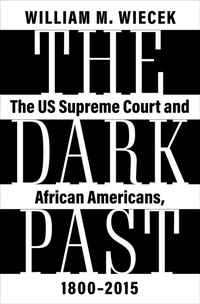
The Dark Past
The US Supreme Court and African Americans, 1800-2015
Published on 18. December 2024
Book
Hardback
552 pages
978-0-19-765443-9 (ISBN)
Description
For most of its existence, the US Supreme Court has sustained slavery, racial discrimination, segregation, racial inequality, and white preference through constitutional interpretation and legal doctrine. During America's first two centuries, slavery was the law of the land. The Court initially avoided challenging it, and in 1857, it seemed that the justices were committed to defending it with the disastrous Dred Scott decision, which denied that Black Americans could claim any rights under the Constitution. The Court also failed to sustain Congress's effort to accord rights and status to Black Americans during Reconstruction, and it accepted white supremacy in the 1896 decision in Plessy v. Ferguson, which ratified the doctrine of "separate but equal." It did better in the Civil Rights Era, 1954-1972, but then again retreated in the face of political backlash.
The Dark Past offers a historical overview and interpretive guide to all the major cases decided by US Supreme Court that have affected the freedom and rights of Black Americans since 1800. It lends coherence to what could otherwise be a disjointed chronicle of cases and connects the events of the past to the current era of racial inequality-most recently exhibited in the Shelby County v. Holder (2015) decision, which hobbled the Voting Rights Act. Throughout the six hundred volumes of the United States Reports the justices have almost never alluded to the reality of racism or used words that denote it. Only once has the phrase "white supremacy" appeared in an opinion of the Court, and only thirty or so times has a member of the Court referred to "racism." The Dark Past, on the other hand, incorporates structural racism as a principal definition of inequality in the contemporary Black legal experience as it updates and enlarges our understanding of how the legal foundations of inequality structure American society.
The Dark Past offers a historical overview and interpretive guide to all the major cases decided by US Supreme Court that have affected the freedom and rights of Black Americans since 1800. It lends coherence to what could otherwise be a disjointed chronicle of cases and connects the events of the past to the current era of racial inequality-most recently exhibited in the Shelby County v. Holder (2015) decision, which hobbled the Voting Rights Act. Throughout the six hundred volumes of the United States Reports the justices have almost never alluded to the reality of racism or used words that denote it. Only once has the phrase "white supremacy" appeared in an opinion of the Court, and only thirty or so times has a member of the Court referred to "racism." The Dark Past, on the other hand, incorporates structural racism as a principal definition of inequality in the contemporary Black legal experience as it updates and enlarges our understanding of how the legal foundations of inequality structure American society.
Reviews / Votes
We need this book. The Dark Past brilliantly exposes the US Supreme Court's historic role in sustaining slavery, segregation, racial discrimination and inequality, and white supremacy. It is depressing-and indispensable. * Laura Kalman, Distinguished Research Professor of History, University of California, Santa Barbara * William M. Wiecek's coverage of the US Supreme Court's rulings involving African Americans is comprehensive, and he displays a command over vast swaths of Supreme Court and constitutional history. His ability to synthesize massive amounts of scholarship is astounding. This book is an important scholarly contribution and a valuable resource. * Christopher W. Schmidt, Professor of Law and Co-Director of the Institute on the Supreme Court of the United States, Chicago-Kent College of Law * The Dark Past deftly documents how the US Supreme Court has surreptitiously transformed the Constitution's promise of racial equality into a tool that preserves white supremacy by denying the legal relevance of structural discrimination against non-whites. I was surprised by how many new facts and insights I discovered in this engaging narrative, which illuminates the personalities, alliances, and strategies of the Justices in their infamous past decisions and identifies the contemporary echoes of those decisions in the current Court's efforts to ensure that genuine racial equality remains hopelessly out of reach. * Girardeau A Spann, James and Catherine Denny Professor of Law, Georgetown University Law Center * The Dark Past is a dense and often passionate analysis of the impact of the Supreme Court's decisions on Black Americans. An important book. * P. Watkins, Choice *More details
Language
English
Place of publication
New York
United States
Target group
College/higher education
Product notice
sewn/stitched
Cloth over boards
Dimensions
Height: 224 mm
Width: 142 mm
Thickness: 51 mm
Weight
862 gr
ISBN-13
978-0-19-765443-9 (9780197654439)
Copyright in bibliographic data and cover images is held by Nielsen Book Services Limited or by the publishers or by their respective licensors: all rights reserved.
Schweitzer Classification
Other editions
Additional editions
E-Book
10/2024
OUP eBook
€35.99
Available for download
E-Book
10/2024
OUP eBook
€35.99
Available for download
Person
William M. Wiecek is Professor Emeritus at Syracuse University, where he was appointed the Congdon Professor of Public Law, with a joint appointment in the history department of the Maxwell School. He is the author of The Birth of the Modern Constitution: The United States Supreme Court, 1941-1953 and The Lost World of Classical Legal Thought: Law and Ideology in America, 1886-1937, among other titles.
Content
Prologue Chapter 1: The Antebellum Court, 1800-1861 Chapter 2: Reconstruction and the Supreme Court, 1861-1880 Chapter 3: Redemption, 1880-1900 Chapter 4: The Nadir and the Blue Hour, 1900-1920 Chapter 5: Civil Rights and Civil Liberties Between the Wars, 1920-1940 Chapter 6: War and Cold War, 1941-1953 Chapter 7: The Second Reconstruction, 1954-1971 Chapter 8: Right Turn, 1960-1980 Chapter 9: The Resegregation of America's Schools Chapter 10: Affirmative Action Chapter 11: Redemption Redux, 1972-2015 Epilogue