

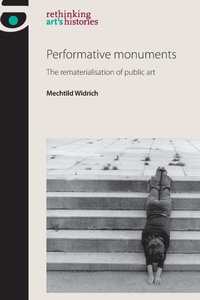
Performative Monuments
The Rematerialisation of Public Art
Published on 31. May 2014
Book
Paperback/Softback
240 pages
978-0-7190-9591-7 (ISBN)
Description
This book answers one of the most puzzling questions in contemporary art: how did performance artists of the '60s and '70s, famous for their opposition both to lasting art and the political establishment, become the foremost monument builders of the '80s, '90s and today? Not by selling out, nor by making self-undermining monuments. This book argues that the centrality of performance to monuments and indeed public art in general rests not on its ephemerality or anti-authoritarian rhetoric, but on its power to build interpersonal bonds both personal and social. Specifically, the survival of body art in photographs that cross time and space to meet new audiences makes it literally into a monument.
The argument of the book spans art in Austria, the former Yugoslavia, and Germany: Valie Export, Peter Weibel and the Viennese Actionists (working in Austria and abroad), Marina Abramovic, Sanja Ivecovic and Braco Dimitrijevic (working in Yugoslavia and abroad), and Joseph Beuys and Jochen Gerz (working in Germany and abroad). These artists began by critiquing monumentality in authoritarian public space, and expanded the models developed on the streets of Vienna, Munich, Rome, Belgrade and Zagreb to participatory monuments that delegate political authority to the audience.
Readers interested in contemporary art, politics, photography and performance will find in this book new facts and arguments for their interconnection. -- .
The argument of the book spans art in Austria, the former Yugoslavia, and Germany: Valie Export, Peter Weibel and the Viennese Actionists (working in Austria and abroad), Marina Abramovic, Sanja Ivecovic and Braco Dimitrijevic (working in Yugoslavia and abroad), and Joseph Beuys and Jochen Gerz (working in Germany and abroad). These artists began by critiquing monumentality in authoritarian public space, and expanded the models developed on the streets of Vienna, Munich, Rome, Belgrade and Zagreb to participatory monuments that delegate political authority to the audience.
Readers interested in contemporary art, politics, photography and performance will find in this book new facts and arguments for their interconnection. -- .
Reviews / Votes
'Mechtild Widrich's astonishing and original book connects performance histories, feminist theory and speech act theory to elucidate the "event character" of public art by contemporary artists. Widrich advances a powerful argument about the stakes of spectatorship, temporality and collective memory.'Julia Bryan-Wilson, Associate Professor of Contemporary Art, University of California, Berkeley
'Rigorously researched and argued, this important book will become required reading not only on the history and theory of performance art but also on the history of the "performative" itself as it has transformed public art and commemoration.'
Kirk Savage, Professor, History of Art & Architecture, University of Pittsburgh -- .
More details
Series
Language
English
Place of publication
Manchester
United Kingdom
Target group
College/higher education
Illustrations
Illustrations, black & white
Dimensions
Height: 234 mm
Width: 156 mm
Thickness: 16 mm
Weight
551 gr
ISBN-13
978-0-7190-9591-7 (9780719095917)
Copyright in bibliographic data and cover images is held by Nielsen Book Services Limited or by the publishers or by their respective licensors: all rights reserved.
Schweitzer Classification
Other editions
Additional editions
E-Book
07/2024
1st Edition
Manchester University Press
from
€44.99
Available for download
Person
Mechtild Widrich is Professor in Art History, Theory and Criticism at the School of the Art Institute of Chicago -- .
Content
Introduction: what is a performative monument?
1. Documents
2. Audiences
3. Sites
4. Monuments
Conclusion: relations
Bibliography
Index -- .
1. Documents
2. Audiences
3. Sites
4. Monuments
Conclusion: relations
Bibliography
Index -- .