

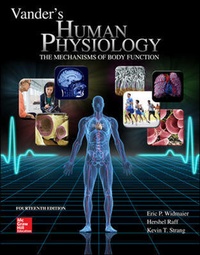
Vander's Human Physiology
14th Edition
Published on 16. January 2016
Book
Hardback
784 pages
978-1-259-29409-9 (ISBN)
Description
Eric Widmaier (Boston University), Hershel Raff (Medical College of Wisconsin), and Kevin Strang (University of Wisconsin) have taken on the challenge of maintaining the strengths and reputation of Vander's Human Physiology: The Mechanisms of Body Function. Moving beyond the listing of mere facts, it stresses the causal chains of events that constitute the mechanisms of body function. The fundamental purpose of this textbook is to present the principles and facts of human physiology in a format that is suitable for undergraduates regardless of academic background or field of study. Vander's Human Physiology, fourteenth edition, carries on the tradition of clarity and accuracy, while refining and updating the content to meet the needs of today's instructors and students. The fourteenth edition features a streamlined, clinically oriented focus to the study of human body systems. It has also responded to reviewer requests for more clinical applications. Physiology Inquiries are maintained throughout the chapters. These critical-thinking questions associated with figures are just one more opportunity to add to the student's learning experience.
More details
Edition
14th edition
Language
English
Place of publication
OH
United States
Target group
US School Grade: From College Freshman to College Graduate Student
Illustrations
595 Illustrations
Dimensions
Height: 282 mm
Width: 234 mm
Thickness: 33 mm
Weight
1733 gr
ISBN-13
978-1-259-29409-9 (9781259294099)
Schweitzer Classification
Other editions
Previous edition
Hershel Raff | Eric Widmaier | Kevin Strang
Vander's Human Physiology
The Mechanisms of Body Function
Book
04/2014
13th Edition
McGraw-Hill Professional
€252.54
Article exhausted; check for reprint
Persons
Eric P. Widmaier received his Ph.D. in 1984 in Endocrinology from the University of California at San Francisco. His postdoctoral training was in endocrinology and physiology at the Worcester Foundation for Experimental Biology, and The Salk Institute in La Jolla, CA. He is currently Professor of Biology at Boston University.
Content
Chapter 1 Homeostasis: A Framework for Human Physiology
Chapter 2 Chemical Composition of the Body
Chapter 3 Cellular structure, proteins, and Metabolism
Chapter 4 Movement of Molecules Across Cell Membranes
Chapter 5 Control of Cells by Chemical Messengers
Chapter 6 Neuronal Signaling and the Structure of the Nervous System
Chapter 7 Sensory Physiology
Chapter 8 Consciousness, the Brain, and Behavior
Chapter 9 Muscle
Chapter 10 Control of Body Movement
Chapter 11 The Endocrine System
Chapter 12 Cardiovascular Physiology
Chapter 13 Respiratory Physiology
Chapter 14 The Kidneys and Regulation of Water and Inorganic Ions
Chapter 15 The Digestion and Absorption of Food
Chapter 16 Regulation of Organic Metabolism and Energy Balance
Chapter 17 Reproduction
Chapter 18 Defense Mechanisms of the Body
Chapter 19 Medical Physiology: Integration Using Clinical Cases
Chapter 2 Chemical Composition of the Body
Chapter 3 Cellular structure, proteins, and Metabolism
Chapter 4 Movement of Molecules Across Cell Membranes
Chapter 5 Control of Cells by Chemical Messengers
Chapter 6 Neuronal Signaling and the Structure of the Nervous System
Chapter 7 Sensory Physiology
Chapter 8 Consciousness, the Brain, and Behavior
Chapter 9 Muscle
Chapter 10 Control of Body Movement
Chapter 11 The Endocrine System
Chapter 12 Cardiovascular Physiology
Chapter 13 Respiratory Physiology
Chapter 14 The Kidneys and Regulation of Water and Inorganic Ions
Chapter 15 The Digestion and Absorption of Food
Chapter 16 Regulation of Organic Metabolism and Energy Balance
Chapter 17 Reproduction
Chapter 18 Defense Mechanisms of the Body
Chapter 19 Medical Physiology: Integration Using Clinical Cases