

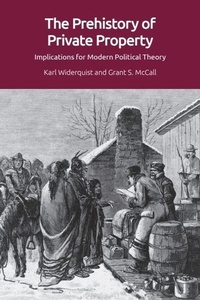
The Prehistory of Private Property
Implications for Modern Political Theory
Published on 5. December 2022
Book
Paperback/Softback
288 pages
978-1-4744-4743-0 (ISBN)
Description
This book debunks three false claims commonly accepted by contemporary political philosophers regarding property systems: that inequality is natural, inevitable, or incompatible with freedom; that capitalism is more consistent with negative freedom than any other conceivable economic system; and that the normative principles of appropriation and voluntary transfer applied in the world in which we live support a capitalist system with strong, individualist and unequal private property rights. The authors review the history of the use and importance of these claims in philosophy, and use thorough anthropological and historical evidence to refute them. They show that societies with common-property systems maintaining strong equality and extensive freedom were initially nearly ubiquitous around the world, and that the private property rights system was established through a long series of violent state-sponsored aggressions.
Reviews / Votes
This book fills an important interdisciplinary need in joining anthropology to philosophy. It continues the argument Widenquist and McCall started in their earlier book, Prehistoric Myths in Modern Political Philosophy. Both books debunk out-of-date and incorrect assumptions about human society that somehow remain foundational in political philosophy. The prior book focused on the ideas of Thomas Hobbes, and The Prehistory of Private Property develops and expands this line of thought. The authors do a real service by opening up comparative scholarship to new perspectives about the inevitability of inequality, capitalist markets, and private property. Anyone interested in how human societies operate-and how western scholars have portrayed them-will find this a compelling read. * Michael E. Smith, Arizona State University *More details
Language
English
Place of publication
Edinburgh
United Kingdom
Target group
Professional and scholarly
Dimensions
Height: 231 mm
Width: 153 mm
Thickness: 20 mm
Weight
474 gr
ISBN-13
978-1-4744-4743-0 (9781474447430)
Copyright in bibliographic data and cover images is held by Nielsen Book Services Limited or by the publishers or by their respective licensors: all rights reserved.
Schweitzer Classification
Other editions
Additional editions
Karl Widerquist | Grant S. McCall
Prehistory of Private Property
Implications for Modern Political Theory
E-Book
02/2021
1st Edition
Edinburgh University Press
€26.49
Available for download
Karl Widerquist | Grant S. McCall
Prehistory of Private Property
Implications for Modern Political Theory
E-Book
02/2021
1st Edition
Edinburgh University Press
€26.49
Available for download
Persons
Karl Widerquist is Professor of Political Philosophy at SFS-Qatar, Georgetown University. He is co-editor of Prehistoric Myths in Modern Political Philosophy(with Grant S. McCall, Edinburgh University Press, 2017), Basic Income: An Anthology of Contemporary Research (with Yannick Vanderborght, Jose Noguera, and Jurgen De Wispelaere, Wiley-Blackwell, 2013), Exporting the Alaska Model: Adapting the Permanent Fund Dividend for Reform around the World (with Michael W. Howard, Palgrave-MacMillan, 2012), The Ethics and Economics of the Basic Income Guarantee (with Michael Anthony Lewis and Steven Pressman, Ashgate, 2005) and co-author of Economics for Social Workers: The Application of Economic Theory to Social Policy and the Human Services (with Michael Anthony Lewis, Columbia University Press, 2002). He was a founding editor of the journal Basic Income Studies, and he has published dozens of scholarly articles. Grant S. McCall is Associate Professor in Anthropology at Tulane University, as well as the director of the Center for Human-Environmental Research, a New Orleans-based nonprofit research institute aimed at exploring and improving human responses to environmental change. His publications include Prehistoric Myth and Modern Political Philosophy (co-editor with Karl Widequist, Edinburgh University Press, 2017), Strategies for Quantitative Research: Archaeology by Numbers (Routledge, 2018) and Global Perspectives on Lithic Technologies in Complex Societies (co-editor with Rachel Horowitz, University of Colorado Press, 2019).
Content
PrefaceAcknowledgements
Introduction
Part I: The inequality hypothesis
2. Hierarchy's Apologists, Part One: 5,000 years of clever and contradictory arguments that inequality is natural and inevitable
3. Hierarchy's Apologists, Part Two: Natural inequality in contemporary political philosophy and social science
4. How small-scale societies maintain political, social, and economic equality
Part II: the market freedom hypothesis
5. The Negative Freedom Argument for the Market Economy
6. The Negative Freedom Argument for the Hunter-Gatherer Band Economy
Part III: The individual appropriation hypothesis
7. Contemporary Property Theory: A story, a myth, a principle, and a hypothesis
8. The History of a Hypothesis
9. The impossibility of a purely a-priori justification of private property
10. Evidence Provided by Propertarians to Support the Appropriation Hypothesis
11. Property Systems in Hunter-Gatherer Societies
12. Property Systems in Stateless Farming Communities
13. Property Systems in Ancient, Medieval, and Early Modern States
14. The Privatization the Earth, circa 1500-2000
15. The individual appropriation hypothesis assessed
16. Conclusion
Index
Introduction
Part I: The inequality hypothesis
2. Hierarchy's Apologists, Part One: 5,000 years of clever and contradictory arguments that inequality is natural and inevitable
3. Hierarchy's Apologists, Part Two: Natural inequality in contemporary political philosophy and social science
4. How small-scale societies maintain political, social, and economic equality
Part II: the market freedom hypothesis
5. The Negative Freedom Argument for the Market Economy
6. The Negative Freedom Argument for the Hunter-Gatherer Band Economy
Part III: The individual appropriation hypothesis
7. Contemporary Property Theory: A story, a myth, a principle, and a hypothesis
8. The History of a Hypothesis
9. The impossibility of a purely a-priori justification of private property
10. Evidence Provided by Propertarians to Support the Appropriation Hypothesis
11. Property Systems in Hunter-Gatherer Societies
12. Property Systems in Stateless Farming Communities
13. Property Systems in Ancient, Medieval, and Early Modern States
14. The Privatization the Earth, circa 1500-2000
15. The individual appropriation hypothesis assessed
16. Conclusion
Index