

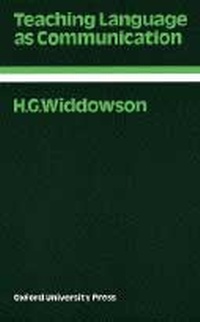
Teaching Language as Communication
Published on 22. June 1978
Book
Paperback/Softback
192 pages
978-0-19-437077-6 (ISBN)
Description
This book develops a rational approach to the teaching of language as communication, based on a careful consideration of the nature of language and of the language user's activities. It will stimulate all language teachers to investigate the ideas that inform their own practice.
More details
Other editions
Additional editions
E-Book
06/2017
1st Edition
Oxford University Press, USA
€80.79
Available for download
Content
Introduction ; 1. Usage and Use ; 1.1 Correctness and appropriacy ; 1.2 Usage and use as aspects of performance ; 1.3 Usage and use in classroom presentation ; 1.4 Aspects of meaning: signification and value ; 1.5 Usage and use in the design of language teaching materials ; 1.6 Selecting areas of use for teaching language ; 1.7 Summary and conclusion ; Notes and references ; 2. Discourse ; 2.1 Sentence, proposition and illocutionary act ; 2.2 Cohesion and propositional development ; 2.3 Coherence and illocutionary development ; 2.4 The relationship between propositional and illocutionary development ; 2.5 Procedures of interpretation ; 2.6 Deriving discourse from sentences: an example ; 2.6.1 Propositional development: achieving cohesion ; 2.6.2 Illocutionary development: achieving coherence ; 2.7 Conventions of coherence ; 2.8 Deriving discourse by arrangement: another example ; 2.9 Summary and conclusion ; Notes and references ; 3. Linguistic skills and communicative abilities ; 3.1 The four skills ; 3.2 Activities associated with spoken language ; 3.3 Activities associated with written language ; 3.4 Reciprocal and non-reciprocal activities ; 3.5 Linguistic skills and communicative abilities ; 3.6 Retrospective and prospective interpretation ; 3.7 Assimilation and discrimination ; 3.8 Non-verbal communication ; 3.9 Summary and conclusion ; Notes and references ; 4. Comprehending and reading ; 4.1 Preview ; 4.2 The reading passage as dependent exemplification ; 4.3 The reading passage as independent 'comprehension piece' ; 4.3.1 Extracts: the problem of authenticity ; 4.3.2 Extracts: the comprehending problem ; 4.3.2.1 Priming glossaries ; 4.3.2.2 Prompting glossaries ; 4.3.3 Simplified versions ; 4.3.4 Simple accounts ; 4.4 Gradual approximation ; 4.5 Comprehension questions: forms and functions ; 4.5.1 Types of question by reference to form ; 4.5.2 Types of question by reference to function ; 4.5.2.1 Usage reference ; 4.5.2.2 Use inference ; 4.6 Other reading exercises ; Notes and references ; 5. Composing and writing ; 5.1 Preview ; 5.2 Types of grammar exercise ; 5.3 Exercises in usage and use ; 5.3.1 Composing sentences in passages ; 5.3.2 Using the contexts of the reading passage ; 5.4 Preparation exercises ; 5.5 Exploitation exercises ; 5.5.1 Gradual approximation: sentence to discourse units ; 5.5.2 Gradual approximation: act to discourse units ; 5.5.2.1 Focus on single illocutionary acts ; 5.5.2.2 Relationships between pairs of acts ; 5.5.2.3 Extension to larger discourse units ; 5.5.3 Rhetorical transformation of discourse units ; 5.5.4 Information transfer ; 5.6 Summary and conclusion ; Notes and references ; 6. Towards an integrated approach ; 6.1 Preview: the need for integration ; 6.2 The discourse to discourse scheme ; 6.3 Types of procedure ; 6.3.1 Demonstration: rhetorical transformation by gradual approximation ; 6.3.2 Demonstration: rhetorical transformation by illocutionary change ; 6.3.3 Demonstration: information transfer ; 6.4 Principles of approach ; 6.4.1 Rational appeal: the use of translation ; 6.4.2 Integration and control ; 6.5 Summary and conclusion ; Notes and references ; Index