

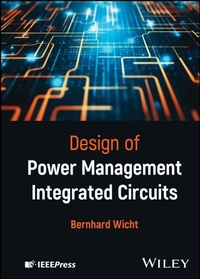
Design of Power Management Integrated Circuits
1st Edition
Published on 13. June 2024
Book
Hardback
480 pages
978-1-119-12306-4 (ISBN)
Description
Comprehensive resource on power management ICs affording new levels of functionality and applications with cost reduction in various fields
Design of Power Management Integrated Circuits is a comprehensive reference for power management IC design, covering the circuit design of main power management circuits like linear and switched-mode voltage regulators, along with sub-circuits such as power switches, gate drivers and their supply, level shifters, the error amplifier, current sensing, and control loop design. Circuits for protection and diagnostics, as well as aspects of the physical design like lateral and vertical power delivery, pin-out, floor planning, grounding/supply guidelines, and packaging, are also addressed. A full chapter is dedicated to the design of integrated passives. The text illustrates the application of power management integrated circuits (PMIC) to growth areas like computing, the internet of Things, mobility, and renewable energy.
Includes numerous real-world examples, case studies, and exercises illustrating key design concepts and techniques.
Offering a unique insight into this rapidly evolving technology through the author's experience developing PMICs in both the industrial and academic environment, Design of Power Management Integrated Circuits includes information on:
Capacitive, inductive and hybrid DC-DC converters and their essential circuit blocks, covering error amplifiers, comparators, and ramp generators
Sensing, protection, and diagnostics, covering thermal protection, inductive loads and clamping structures, under-voltage, reference and power-on reset generation
Integrated MOS, MOM and MIM capacitors, integrated inductors
Control loop design and PWM generation ensuring stability and fast transient response; subharmonic oscillations in current mode control (analysis and circuit design for slope compensation)
DC behavior and DC-related circuit design, covering power efficiency, line and load regulation, error amplifier, dropout, and power transistor sizing
Commonly used level shifters (including sizing rules) and cascaded (tapered) driver sizing and optimization guidelines
Optimizing the physical design considering packaging, floor planning, EMI, pinout, PCB design and thermal design
Design of Power Management Integrated Circuits is an essential resource on the subject for circuit designers/IC designers, system engineers, and application engineers, along with advanced undergraduate students and graduate students in related programs of study.
Design of Power Management Integrated Circuits is a comprehensive reference for power management IC design, covering the circuit design of main power management circuits like linear and switched-mode voltage regulators, along with sub-circuits such as power switches, gate drivers and their supply, level shifters, the error amplifier, current sensing, and control loop design. Circuits for protection and diagnostics, as well as aspects of the physical design like lateral and vertical power delivery, pin-out, floor planning, grounding/supply guidelines, and packaging, are also addressed. A full chapter is dedicated to the design of integrated passives. The text illustrates the application of power management integrated circuits (PMIC) to growth areas like computing, the internet of Things, mobility, and renewable energy.
Includes numerous real-world examples, case studies, and exercises illustrating key design concepts and techniques.
Offering a unique insight into this rapidly evolving technology through the author's experience developing PMICs in both the industrial and academic environment, Design of Power Management Integrated Circuits includes information on:
Capacitive, inductive and hybrid DC-DC converters and their essential circuit blocks, covering error amplifiers, comparators, and ramp generators
Sensing, protection, and diagnostics, covering thermal protection, inductive loads and clamping structures, under-voltage, reference and power-on reset generation
Integrated MOS, MOM and MIM capacitors, integrated inductors
Control loop design and PWM generation ensuring stability and fast transient response; subharmonic oscillations in current mode control (analysis and circuit design for slope compensation)
DC behavior and DC-related circuit design, covering power efficiency, line and load regulation, error amplifier, dropout, and power transistor sizing
Commonly used level shifters (including sizing rules) and cascaded (tapered) driver sizing and optimization guidelines
Optimizing the physical design considering packaging, floor planning, EMI, pinout, PCB design and thermal design
Design of Power Management Integrated Circuits is an essential resource on the subject for circuit designers/IC designers, system engineers, and application engineers, along with advanced undergraduate students and graduate students in related programs of study.
More details
Series
Language
English
Place of publication
United States
Publishing group
John Wiley & Sons Inc
Target group
Professional and scholarly
Dimensions
Height: 259 mm
Width: 184 mm
Thickness: 31 mm
Weight
1088 gr
ISBN-13
978-1-119-12306-4 (9781119123064)
Copyright in bibliographic data and cover images is held by Nielsen Book Services Limited or by the publishers or by their respective licensors: all rights reserved.
Schweitzer Classification
Other editions
Additional editions
Bernhard Wicht
Design of Power Management Integrated Circuits
E-Book
05/2024
1st Edition
Wiley-ISTE
€82.99
Available for download
Bernhard Wicht
Design of Power Management Integrated Circuits
E-Book
05/2024
1st Edition
Wiley-ISTE
€82.99
Available for download
Person
Bernhard Wicht, Leibniz University Hannover, Germany.
Bernhard Wicht is a Full Professor of mixed-signal integrated circuit design at Leibniz University Hannover. Between 2003 and 2010, he was with Texas Instruments in Freising, Germany, responsible for the design of automotive power management ICs. He has been a member of the Technical Program Committee of the International Solid-State Circuits Conference (ISSCC) since 2018, serving as the chair of the Power Management subcommittee since 2023. He was a Distinguished Lecturer of the IEEE Solid-State Circuits Society in 2020-2021.
Bernhard Wicht is a Full Professor of mixed-signal integrated circuit design at Leibniz University Hannover. Between 2003 and 2010, he was with Texas Instruments in Freising, Germany, responsible for the design of automotive power management ICs. He has been a member of the Technical Program Committee of the International Solid-State Circuits Conference (ISSCC) since 2018, serving as the chair of the Power Management subcommittee since 2023. He was a Distinguished Lecturer of the IEEE Solid-State Circuits Society in 2020-2021.
Content
Preface vii
1 Introduction 1
1.1 What Is a Power Management IC and What Are the Key
Requirements? 2
1.2 The Smartphone as a Typical Example 3
1.3 Fundamental Concepts 4
1.4 Power Management Systems 8
1.5 Applications 10
1.6 IC Supply Voltages 21
1.7 Power Delivery 22
1.8 Technology, Components and Co-Integration 28
1.9 A Look at the Market 34
2 The Power Stage 37
2.1 Introduction 37
2.2 On-Resistance and Dropout 39
2.3 Parasitic Capacitances 41
2.4 The Body Diode 42
2.5 Switching Behavior 44
2.6 Gate Current and Gate Charge 56
2.7 Losses 59
2.8 Dead Time Generation 69
2.9 Soft-Switching 73
2.10 Switch Stacking 75
2.11 Back-to-Back Configuration 78
3 Semiconductor Devices 81
3.1 Discrete Power Transistors 82
3.2 Power Transistors in Integrated Circuits 90
3.3 Parasitic Effects 98
3.4 Safe Operating Area (SOA) 104
3.5 Integrated Diodes 107
4 Integrated Passives 113
4.1 Capacitors 113
4.2 Inductors 118
5 Gate Drivers and Level Shifters 135
5.1 Introduction 135
5.2 Gate Driver Configurations 136
5.3 Driver Circuits 139
5.4 DC Characteristics 140
5.5 Driving Strength 142
5.6 The CMOS Inverter as a Gate Driver 144
5.7 Gate Driver with Single-Stage Inverter 151
5.8 Cascaded Gate Drivers 158
5.9 External Gate Resistor 170
5.10 dv/dt Triggered Turn-on 171
5.11 Bootstrap Gate Supply 175
5.12 Level Shifters 178
6 Protection and Sensing 201
6.1 Over-voltage Protection 202
6.2 Over-voltage Protection for Inductive Loads 203
6.3 Temperature Sensing and Thermal Protection 206
6.4 Bandgap Voltage and Current Reference 209
6.5 Short Circuits and Open Load 215
6.6 Current Sensing 217
6.7 Zero-Crossing Detection 234
6.8 Under-voltage Lockout 237
6.9 Power-on Reset 239
7 Linear Voltage Regulators 245
7.1 Fundamental Circuit and Control Concept 245
7.2 Dropout Voltage 248
7.3 DC Parameters 250
7.4 The Error Amplifier 255
7.5 Frequency Behavior and Stability 257
7.6 Transient Behavior 264
7.7 Noise in Linear Regulators 269
7.8 Power Supply Rejection 272
7.9 Soft-Start 273
7.10 Capacitor-Less LDO 274
7.11 Flipped Voltage Follower LDO 276
7.12 The Shunt Regulator 279
7.13 Digital LDOs 281
8 Charge Pumps 289
8.1 Introduction 289
8.2 Analysis of the Fundamental Charge Pump 291
8.3 Influence of Parasitics 295
8.4 Charge Pump Implementation 297
8.5 Power Efficiency 302
8.6 Cascading of Pumping Stages 306
8.7 Other Charge Pump Configurations 307
8.8 Current-Source Charge Pumps 308
8.9 Charge Pumps Suitable as a Floating Gate Supply 309
8.10 Closed-loop Control 312
9 Capacitive DC-DC Converters 315
9.1 Introduction 315
9.2 Realizable Ratios 319
9.3 Switched-Capacitor Topologies 321
9.4 Gate Drive Techniques 324
9.5 Charge Flow Analysis 325
9.6 Output Voltage Ripple 337
9.7 Topology Selection 339
9.8 Capacitor and Switch Sizing 340
9.9 Loss Analysis and Efficiency 345
9.10 Multi-Phase SC Converters 352
9.11 Multi-Ratio SC Converters 357
9.12 Multi-Phase Interleaving 367
9.13 Control Methods 368
10 Inductive DC-DC Converters 375
10.1 The Fundamental Buck Converter 375
10.2 Losses and Power Conversion Efficiency 383
10.3 Closing the Loop 385
10.4 Hysteretic Control 386
10.5 Voltage-Mode Control (VMC) 387
10.6 Current-Mode Control (CMC) 397
10.7 Constant On-time Control 407
10.8 Frequency Compensation 411
10.9 Discontinuous Conduction Mode (DCM) 424
10.10 The Boost Converter 432
10.11 The Buck-Boost Converter 445
10.12 The Flyback Converter 452
10.13 Rectifier Circuits 458
10.14 Multi-Phase Converters 461
10.15 Single-Inductor Multiple-Output Converters (SIMO) 472
11 Hybrid DC-DC Converters 483
11.1 Hybridization of Capacitive and Inductive Concepts 484
11.2 The Benefit of Soft-Charging 486
11.3 Basic Resonant SC Converter Stages 491
11.4 Frequency Generation and Tuning 493
11.5 Equivalent Output Resistance 495
11.6 Control of Hybrid Converters 502
11.7 From SC to Hybrid Converters 507
11.8 Multi-Phase Converters 516
11.9 Multi-Ratio Converters 517
11.10 The Three-Level Buck Converter 517
11.11 The Flying-Capacitor Multi-Level Converter (FCML) 525
11.12 The Double Step-Down (DSD) Converter 528
11.13 Inductor-First Topologies 531
12 Physical Implementation 539
12.1 Layout Floor Planning 540
12.2 Packaging 540
12.3 Electromagnetic Interference (EMI) 546
12.4 Interconnections 548
12.5 Pinout 552
12.6 IC-Level Wiring 554
12.7 PCB Layout Design 558
12.8 Power Delivery 560
12.9 Thermal Design 565
1 Introduction 1
1.1 What Is a Power Management IC and What Are the Key
Requirements? 2
1.2 The Smartphone as a Typical Example 3
1.3 Fundamental Concepts 4
1.4 Power Management Systems 8
1.5 Applications 10
1.6 IC Supply Voltages 21
1.7 Power Delivery 22
1.8 Technology, Components and Co-Integration 28
1.9 A Look at the Market 34
2 The Power Stage 37
2.1 Introduction 37
2.2 On-Resistance and Dropout 39
2.3 Parasitic Capacitances 41
2.4 The Body Diode 42
2.5 Switching Behavior 44
2.6 Gate Current and Gate Charge 56
2.7 Losses 59
2.8 Dead Time Generation 69
2.9 Soft-Switching 73
2.10 Switch Stacking 75
2.11 Back-to-Back Configuration 78
3 Semiconductor Devices 81
3.1 Discrete Power Transistors 82
3.2 Power Transistors in Integrated Circuits 90
3.3 Parasitic Effects 98
3.4 Safe Operating Area (SOA) 104
3.5 Integrated Diodes 107
4 Integrated Passives 113
4.1 Capacitors 113
4.2 Inductors 118
5 Gate Drivers and Level Shifters 135
5.1 Introduction 135
5.2 Gate Driver Configurations 136
5.3 Driver Circuits 139
5.4 DC Characteristics 140
5.5 Driving Strength 142
5.6 The CMOS Inverter as a Gate Driver 144
5.7 Gate Driver with Single-Stage Inverter 151
5.8 Cascaded Gate Drivers 158
5.9 External Gate Resistor 170
5.10 dv/dt Triggered Turn-on 171
5.11 Bootstrap Gate Supply 175
5.12 Level Shifters 178
6 Protection and Sensing 201
6.1 Over-voltage Protection 202
6.2 Over-voltage Protection for Inductive Loads 203
6.3 Temperature Sensing and Thermal Protection 206
6.4 Bandgap Voltage and Current Reference 209
6.5 Short Circuits and Open Load 215
6.6 Current Sensing 217
6.7 Zero-Crossing Detection 234
6.8 Under-voltage Lockout 237
6.9 Power-on Reset 239
7 Linear Voltage Regulators 245
7.1 Fundamental Circuit and Control Concept 245
7.2 Dropout Voltage 248
7.3 DC Parameters 250
7.4 The Error Amplifier 255
7.5 Frequency Behavior and Stability 257
7.6 Transient Behavior 264
7.7 Noise in Linear Regulators 269
7.8 Power Supply Rejection 272
7.9 Soft-Start 273
7.10 Capacitor-Less LDO 274
7.11 Flipped Voltage Follower LDO 276
7.12 The Shunt Regulator 279
7.13 Digital LDOs 281
8 Charge Pumps 289
8.1 Introduction 289
8.2 Analysis of the Fundamental Charge Pump 291
8.3 Influence of Parasitics 295
8.4 Charge Pump Implementation 297
8.5 Power Efficiency 302
8.6 Cascading of Pumping Stages 306
8.7 Other Charge Pump Configurations 307
8.8 Current-Source Charge Pumps 308
8.9 Charge Pumps Suitable as a Floating Gate Supply 309
8.10 Closed-loop Control 312
9 Capacitive DC-DC Converters 315
9.1 Introduction 315
9.2 Realizable Ratios 319
9.3 Switched-Capacitor Topologies 321
9.4 Gate Drive Techniques 324
9.5 Charge Flow Analysis 325
9.6 Output Voltage Ripple 337
9.7 Topology Selection 339
9.8 Capacitor and Switch Sizing 340
9.9 Loss Analysis and Efficiency 345
9.10 Multi-Phase SC Converters 352
9.11 Multi-Ratio SC Converters 357
9.12 Multi-Phase Interleaving 367
9.13 Control Methods 368
10 Inductive DC-DC Converters 375
10.1 The Fundamental Buck Converter 375
10.2 Losses and Power Conversion Efficiency 383
10.3 Closing the Loop 385
10.4 Hysteretic Control 386
10.5 Voltage-Mode Control (VMC) 387
10.6 Current-Mode Control (CMC) 397
10.7 Constant On-time Control 407
10.8 Frequency Compensation 411
10.9 Discontinuous Conduction Mode (DCM) 424
10.10 The Boost Converter 432
10.11 The Buck-Boost Converter 445
10.12 The Flyback Converter 452
10.13 Rectifier Circuits 458
10.14 Multi-Phase Converters 461
10.15 Single-Inductor Multiple-Output Converters (SIMO) 472
11 Hybrid DC-DC Converters 483
11.1 Hybridization of Capacitive and Inductive Concepts 484
11.2 The Benefit of Soft-Charging 486
11.3 Basic Resonant SC Converter Stages 491
11.4 Frequency Generation and Tuning 493
11.5 Equivalent Output Resistance 495
11.6 Control of Hybrid Converters 502
11.7 From SC to Hybrid Converters 507
11.8 Multi-Phase Converters 516
11.9 Multi-Ratio Converters 517
11.10 The Three-Level Buck Converter 517
11.11 The Flying-Capacitor Multi-Level Converter (FCML) 525
11.12 The Double Step-Down (DSD) Converter 528
11.13 Inductor-First Topologies 531
12 Physical Implementation 539
12.1 Layout Floor Planning 540
12.2 Packaging 540
12.3 Electromagnetic Interference (EMI) 546
12.4 Interconnections 548
12.5 Pinout 552
12.6 IC-Level Wiring 554
12.7 PCB Layout Design 558
12.8 Power Delivery 560
12.9 Thermal Design 565