

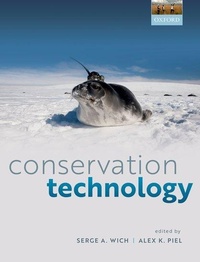
Conservation Technology
Published on 31. August 2021
Book
Paperback/Softback
320 pages
978-0-19-885025-0 (ISBN)
Description
The global loss of biodiversity is occurring at an unprecedented pace. Despite the considerable effort devoted to conservation science and management, we still lack even the most basic data on the distribution and density of the majority of plant and animal species, which in turn hampers our efforts to study changes over time. In addition, we often lack behavioural data from the very animals most influenced by environmental changes; this is largely due to the financial and logistical limitations associated with gathering scientific data on species that are cryptic, widely distributed, range over large areas, or negatively influenced by human presence.
To overcome these limitations, conservationists are increasingly employing technology to facilitate such data collection. Innovative solutions have been driven by dramatic advances in the conservation-technology interface. The use of camera traps, acoustic sensors, satellite data, drones, and computer algorithms to analyse the large datasets collected are all becoming increasingly widespread. Although specialist books are available on some of these individual technologies, this is the first comprehensive text to describe the breadth of available technology for conservation and to evaluate its varied applications, bringing together a team of international experts using a diverse range of approaches.
Conservation Technology is suitable for graduate level students, professional researchers, practitioners and field managers in the fields of ecology and conservation biology.
To overcome these limitations, conservationists are increasingly employing technology to facilitate such data collection. Innovative solutions have been driven by dramatic advances in the conservation-technology interface. The use of camera traps, acoustic sensors, satellite data, drones, and computer algorithms to analyse the large datasets collected are all becoming increasingly widespread. Although specialist books are available on some of these individual technologies, this is the first comprehensive text to describe the breadth of available technology for conservation and to evaluate its varied applications, bringing together a team of international experts using a diverse range of approaches.
Conservation Technology is suitable for graduate level students, professional researchers, practitioners and field managers in the fields of ecology and conservation biology.
Reviews / Votes
This is an excellent volume to have on the shelf for anyone interested in conservation science in the 21st century... Its breadth exceeds that of the expertise of many practitioners and I trust it will, in its coverage, provide a conduit to new technologies and applications where it can be of most use. * Rob Harcourt, The Quarterly Review of Biology * Conservation Technology selects some of the most commonly used and important tools in conservation and describes their diverse use in the field. This volume is recommended not only for conservation students, but also for researchers, conservationists, and practitioners who would like to become familiar with the increasing variety of conservation technologies. * Conservation Biology *More details
Language
English
Place of publication
Oxford
United Kingdom
Target group
College/higher education
Product notice
Paperback (trade)
Unsewn / adhesive bound
Illustrations
37 colour line figures and illustrations
Dimensions
Height: 245 mm
Width: 187 mm
Thickness: 17 mm
Weight
704 gr
ISBN-13
978-0-19-885025-0 (9780198850250)
Copyright in bibliographic data and cover images is held by Nielsen Book Services Limited or by the publishers or by their respective licensors: all rights reserved.
Schweitzer Classification
Other editions
Additional editions
Serge A. Wich | Alex K. Piel
Conservation Technology
Book
08/2021
Oxford University Press
€116.50
Shipment within 15-20 days
Serge A. Wich | Alex K. Piel
Conservation Technology
E-Book
08/2021
1st Edition
OUP eBook
€43.49
Available for download
Persons
Serge A. Wich is a Professor in Primate Biology at Liverpool John Moores University, Liverpool, UK and a honorary professor for the conservation of the great apes at the University of Amsterdam, Netherlands. Serge is also a co-Founding Director of the non-profit, ConservationDrones.org. Updates on his work can also be found on www.sergewich.com His research focuses on on primate behavioral ecology, tropical rain forest ecology and conservation of primates and their habitats. Research is strongly focused on the Indonesian island of Sumatra and Borneo and uses a mixture of observational and experimental fieldwork. He also uses emerging technologies such as drones for his work.
Alex K. Piel is Assistant Professor of Anthropology at University College London, UK and Director of the Greater Mahale Ecosystem Research and Conservation Project in Tanzania. More on his work can be found at www.gmerc.org. Alex's research foci are twofold: (1) primate adaption to dry habitats and the implications for human evolution and (2) chimpanzee conservation in East Africa, Tanzania especially. He is primarily interested in how primate behaviour reflects the various environmental challenges posed to populations that live in open, mosaic landscapes.
Alex K. Piel is Assistant Professor of Anthropology at University College London, UK and Director of the Greater Mahale Ecosystem Research and Conservation Project in Tanzania. More on his work can be found at www.gmerc.org. Alex's research foci are twofold: (1) primate adaption to dry habitats and the implications for human evolution and (2) chimpanzee conservation in East Africa, Tanzania especially. He is primarily interested in how primate behaviour reflects the various environmental challenges posed to populations that live in open, mosaic landscapes.
Content
Preface
1: Alex K. Piel and Serge A. Wich: Conservation and Technology: An Introduction
2: Lilian Pintea, Samuel M. Jantz, and Serge Wich: From the Cloud to the Ground: Converting Satellite Data into Conservation Decisions
3: Serge A. Wich, Mike Hudson, Herizo Andrianandrasana, and Steven N. Longmore: Drones for Conservation
4: Anne-Sophie Crunchant, Chanakya Dev Nakka, Jason T. Isaacs, and Alex K. Piel: Acoustic Sensors
5: Francesco Rovero and Roland Kays: Camera Trapping for Conservation
6: Kasim Rafiq, Pitcher, Ben J. Pitcher, Kate Cornelsen, K. Whitney Hansen, Andrew J. King, Rob. G. Appleby, Briana Abrahms and Neil R. Jordan: Animal-borne Technologies in Wildlife Research and Conservation
7: Cheryl D. Knott, Amy M. Scott, Caitlin A. O'Connell, Tri Wahyu Susanto and Erin E. Kane: Field and Laboratory Analysis for Non-Invasive Wildlife and Habitat Health Assessment and Conservation
8: Antoinette J. Piaggio: Environmental DNA for Conservation
9: Edward McLester and Alex K. Piel: Mobile Data Collection Apps
10: Drew T. Cronin, Anthony Dancer, Barney Long, Antony J. Lynam, Jeff Muntifering, Jonathan Palmer and Richard A. Bergl: Application of SMART Software for Conservation Area Management
11: Dan Morris and Lucas Joppa: Challenges for the Computer Vision Community
12: Trishant Simlai and Chris Sandbrook: Digital Surveillance Technologies in Conservation and their Social Implications
13: Margarita Mulero-Pazmany: The Future of Technology in Conservation
1: Alex K. Piel and Serge A. Wich: Conservation and Technology: An Introduction
2: Lilian Pintea, Samuel M. Jantz, and Serge Wich: From the Cloud to the Ground: Converting Satellite Data into Conservation Decisions
3: Serge A. Wich, Mike Hudson, Herizo Andrianandrasana, and Steven N. Longmore: Drones for Conservation
4: Anne-Sophie Crunchant, Chanakya Dev Nakka, Jason T. Isaacs, and Alex K. Piel: Acoustic Sensors
5: Francesco Rovero and Roland Kays: Camera Trapping for Conservation
6: Kasim Rafiq, Pitcher, Ben J. Pitcher, Kate Cornelsen, K. Whitney Hansen, Andrew J. King, Rob. G. Appleby, Briana Abrahms and Neil R. Jordan: Animal-borne Technologies in Wildlife Research and Conservation
7: Cheryl D. Knott, Amy M. Scott, Caitlin A. O'Connell, Tri Wahyu Susanto and Erin E. Kane: Field and Laboratory Analysis for Non-Invasive Wildlife and Habitat Health Assessment and Conservation
8: Antoinette J. Piaggio: Environmental DNA for Conservation
9: Edward McLester and Alex K. Piel: Mobile Data Collection Apps
10: Drew T. Cronin, Anthony Dancer, Barney Long, Antony J. Lynam, Jeff Muntifering, Jonathan Palmer and Richard A. Bergl: Application of SMART Software for Conservation Area Management
11: Dan Morris and Lucas Joppa: Challenges for the Computer Vision Community
12: Trishant Simlai and Chris Sandbrook: Digital Surveillance Technologies in Conservation and their Social Implications
13: Margarita Mulero-Pazmany: The Future of Technology in Conservation