

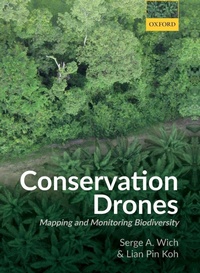
Conservation Drones
Mapping and Monitoring Biodiversity
Published on 21. June 2018
Book
Hardback
132 pages
978-0-19-878761-7 (ISBN)
Description
Increasing numbers of ecologists and conservation biologists have begun to explore the use of drone technology to obtain accurate and up-to-date data on the distribution and density of species, as well as the threats to their habitats, in their ongoing attempts to conserve and monitor biodiversity. Conservation drones are low-cost, autonomous, and operator-friendly unmanned aerial vehicles that can be used for surveying, mapping, and monitoring both habitat and biodiversity. They are fast becoming a valuable complement to ground-based surveys and satellite imagery for a wide range of ecological and conservation applications. The authors pioneered the use of conservation drones for the purpose of monitoring orangutan populations in Southeast Asia. They subsequently founded ConservationDrones.org to share their knowledge of building and using drones with colleagues in the wider environmental community. This website has proved highly popular and this book aims to further build capacity to use drones and inspire others to adapt emerging technologies for practical conservation.
Reviews / Votes
Overall, Conservation Drones is a great introduction to the world of drone use for conservation. This book provides a wealth of foundational knowledge, making it an excellent starting point for those who are new to the subject, but at the same time, it is a handy resource to keep on the shelf for those who have plenty of drone pilot hours under their belt. Conservation Drones will be useful to ecologists, managers, and researchers alike, and will help them capitalize on the expanding potential drones have for use in conservation. * Jesse Exum, Journal of Wildlife Management * Conservation Drones is a well-structured book that in just over 100 pages presents an exhaustive account of the technical aspects of drones and their applications in conservation. * Conservation Biology *More details
Language
English
Place of publication
Oxford
United Kingdom
Target group
Professional and scholarly
Illustrations
Over 45 Illustrations
Dimensions
Height: 252 mm
Width: 194 mm
Thickness: 12 mm
Weight
471 gr
ISBN-13
978-0-19-878761-7 (9780198787617)
Copyright in bibliographic data and cover images is held by Nielsen Book Services Limited or by the publishers or by their respective licensors: all rights reserved.
Schweitzer Classification
Other editions
Additional editions
Book
06/2019
Oxford University Press
€64.20
Shipment within 15-20 days
E-Book
05/2018
1st Edition
OUP eBook
€43.49
Available for download
Persons
Serge Wich is a professor at Liverpool John Moores University (Liverpool, UK) and an honorary professor for the conservation of the great apes at the University of Amsterdam (Netherlands). Serge is also a co-Founding Director of the non-profit, ConservationDrones.org. Updates on his work can also be found on www.sergewich.com. Professor Wich's research focuses on primate behavioral ecology, tropical rain forest ecology, and conservation of primates and their habitats. His research is strongly focused on the Indonesian island of Sumatra and Borneo and he uses a mixture of observational and experimental fieldwork. He also uses emerging technologies such as drones for his work.
Lian Pin Koh is Professor and Chair of Applied Ecology and Conservation at the University of Adelaide, and co-Founding Director of ConservationDrones.org. Koh is an applied ecologist whose notable scientific contributions include the study of species co-extinctions and modeling the environmental impacts of industrial agriculture across the tropics. His research focuses on developing the Science and Science-based decision support tools to help reconcile society's growing consumptive needs with environmental protection. He addresses this challenge through field studies and experiments, computer simulations and modelling, as well as by co-opting emerging technologies for use in environmental research and applications.
Lian Pin Koh is Professor and Chair of Applied Ecology and Conservation at the University of Adelaide, and co-Founding Director of ConservationDrones.org. Koh is an applied ecologist whose notable scientific contributions include the study of species co-extinctions and modeling the environmental impacts of industrial agriculture across the tropics. His research focuses on developing the Science and Science-based decision support tools to help reconcile society's growing consumptive needs with environmental protection. He addresses this challenge through field studies and experiments, computer simulations and modelling, as well as by co-opting emerging technologies for use in environmental research and applications.
Content
1: Deciding to use a drone
2: Typology and anatomy of drones
3: Sensors
4: Surveillance
5: Mapping
6: Animal detection
7: Data post processing
8: Future casting
2: Typology and anatomy of drones
3: Sensors
4: Surveillance
5: Mapping
6: Animal detection
7: Data post processing
8: Future casting