

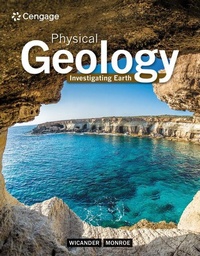
Physical Geology: Investigating Earth
Published on 9. May 2022
Book
Paperback/Softback
528 pages
978-0-357-73069-0 (ISBN)
Description
The overarching goal of Physical Geology: Investigating Earth is to provide students with a basic understanding of geology and its processes and, most importantly, with an understanding of how geology relates to the human experience-that is, how geology affects individuals, society, and nation-states.
More details
Language
English
Place of publication
CA
United States
Publishing group
Cengage Learning, Inc
Target group
College/higher education
Product notice
Paperback (trade)
Unsewn / adhesive bound
Dimensions
Height: 274 mm
Width: 213 mm
Thickness: 20 mm
Weight
1134 gr
ISBN-13
978-0-357-73069-0 (9780357730690)
Copyright in bibliographic data and cover images is held by Nielsen Book Services Limited or by the publishers or by their respective licensors: all rights reserved.
Schweitzer Classification
Persons
Reed Wicander is Professor Emeritus of Geology at Central Michigan University, where he taught Physical Geology, Historical Geology, Prehistoric Life, and Invertebrate Paleontology. Currently, he is an Adjunct Professor in the School of Earth and Environmental Sciences at The University of Queensland, Brisbane, Australia. Dr. Wicander earned his B.S. degree in geology from San Diego State University and his Ph.D. from UCLA. His main research focuses on various aspects of Paleozoic palynology, specifically the study of acritarchs, a group of organic-walled microphytoplankton, on which he has published many papers. In addition, he has co-authored numerous geology textbooks with James S. Monroe. He is a past president of the American Association of Stratigraphic Palynologists - The Palynological Society and the Commission Internationale de la Microflore du Paleozoique, as well as a former councilor of the International Federation of Palynological Societies. James S. Monroe is Professor Emeritus of Geology at Central Michigan University, where he taught Physical Geology, Historical Geology, Prehistoric Life, and Stratigraphy and Sedimentology, and served as chair of the Geology Department. Dr. Monroe earned his Ph.D. from the University of Montana. He has coauthored numerous geology textbooks with Reed Wicander and has interests in Cenozoic geology and geologic education. He now lives in Chico, California where he remains active in geology by teaching courses to large groups of retirees.
Content
1. Understanding Earth: A Dynamic and Evolving Planet
2. Plate Tectonics: A Unifying Theory
3. Minerals: The Building Blocks of Rocks
4. Igneous Rocks and Intrusive Igneous Activity
5. Volcanoes and Volcanism
6. Weathering, Erosion, and Soil
7. Sediment and Sedimentary Rocks
8. Metamorphism and Metamorphic Rocks
9. Earthquakes
10. Earth's Interior
11. Deformation, Mountain Building, and the Continents
12. Mass Wasting
13. Running Water
14. Groundwater
15. Glaciers and Glaciation
16. The Work of Wind and Deserts
17. Oceans, Shorelines, and Shoreline Processes
18. Geologic Time: Concepts and Principles
2. Plate Tectonics: A Unifying Theory
3. Minerals: The Building Blocks of Rocks
4. Igneous Rocks and Intrusive Igneous Activity
5. Volcanoes and Volcanism
6. Weathering, Erosion, and Soil
7. Sediment and Sedimentary Rocks
8. Metamorphism and Metamorphic Rocks
9. Earthquakes
10. Earth's Interior
11. Deformation, Mountain Building, and the Continents
12. Mass Wasting
13. Running Water
14. Groundwater
15. Glaciers and Glaciation
16. The Work of Wind and Deserts
17. Oceans, Shorelines, and Shoreline Processes
18. Geologic Time: Concepts and Principles