

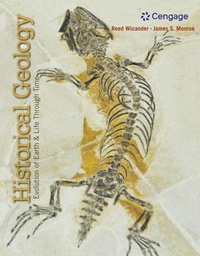
Historical Geology
8th Edition
Published on 1. January 2015
Book
Paperback/Softback
448 pages
978-1-305-11956-7 (ISBN)
Description
Offering comprehensive content for the historical geology course, HISTORICAL GEOLOGY provides students with an understanding of the principles of historical geology and how these principles are applied in unraveling Earth's history. Students will learn and understand the underlying causes of why things happened and the way they did, and how all of Earth's systems and subsystems are interrelated. Students will understand the relevancy of Earth's history as part of a dynamic and complex integrated system, not as a series of isolated and unrelated events
More details
Edition
8th edition
Language
English
Place of publication
CA
United States
Publishing group
Cengage Learning, Inc
Target group
College/higher education
Product notice
Paperback (trade)
Unsewn / adhesive bound
Dimensions
Height: 289 mm
Width: 220 mm
Thickness: 4 mm
Weight
920 gr
ISBN-13
978-1-305-11956-7 (9781305119567)
Copyright in bibliographic data and cover images is held by Nielsen Book Services Limited or by the publishers or by their respective licensors: all rights reserved.
Schweitzer Classification
Persons
Reed Wicander is Professor Emeritus of Geology at Central Michigan University, where he taught Physical Geology, Historical Geology, Prehistoric Life, and Invertebrate Paleontology. Currently, he is an Adjunct Professor in the School of Earth and Environmental Sciences at The University of Queensland, Brisbane, Australia. Dr. Wicander earned his B.S. degree in geology from San Diego State University and his Ph.D. from UCLA. His main research focuses on various aspects of Paleozoic palynology, specifically the study of acritarchs, a group of organic-walled microphytoplankton, on which he has published many papers. In addition, he has co-authored numerous geology textbooks with James S. Monroe. He is a past president of the American Association of Stratigraphic Palynologists - The Palynological Society and the Commission Internationale de la Microflore du Paleozoique, as well as a former councilor of the International Federation of Palynological Societies. James S. Monroe is Professor Emeritus of Geology at Central Michigan University, where he taught Physical Geology, Historical Geology, Prehistoric Life, and Stratigraphy and Sedimentology, and served as chair of the Geology Department. Dr. Monroe earned his Ph.D. from the University of Montana. He has coauthored numerous geology textbooks with Reed Wicander and has interests in Cenozoic geology and geologic education. He now lives in Chico, California where he remains active in geology by teaching courses to large groups of retirees.
Content
1. THE DYNAMIC AND EVOLVING EARTH.
Introduction. What Is Geology? Historical Geology and the Formulation of Theories. Origin of the Universe and Solar System, and Earth's Place in Them. Origin of the Universe-Did It Begin with a Big Bang? Our Solar System-Its Origin and Evolution. Earth-Its Place in Our Solar System. Perspective: Exoplanets. Why Is Earth a Dynamic and Evolving Planet? Plate Tectonic Theory. Organic Evolution and the History of Life. Geologic Time and Uniformitarianism. How Does the Study of Historical Geology Benefit Us? Summary.
2. MINERALS AND ROCKS.
Introduction. Matter and Its Composition. Elements and Atoms. Bonding and Compounds. Minerals-The Building Blocks of Rocks. How Many Minerals Are There? Rock-Forming Minerals and the Rock Cycle. Igneous Rocks. Texture and Composition. Classifying Igneous Rocks. Sedimentary Rocks. Sediment Transport, Deposition, and Lithification. Classification of Sedimentary Rocks. Metamorphic Rocks. What Causes Metamorphism? Metamorphic Rock Classification. Plate Tectonics and the Rock Cycle. Summary.
3. PLATE TECTONICS: A UNIFYING THEORY.
Introduction. Early Ideas About Continental Drift. Alfred Wegener and the Continental Drift Hypothesis . What Is the Evidence for Continental Drift? Continental Fit. Similarity of Rock Sequences and Mountain Ranges. Glacial Evidence. Fossil Evidence. Earth's Magnetic Field. Magnetic Reversals and Seafloor Spreading. Plate Tectonics: A Unifying Theory. The Three Types of Plate Boundaries. Divergent Boundaries. Perspective Plate Boundaries, Earthquakes, and Tsunami. An Example of Ancient Rifting. Convergent Boundaries . Recognizing Ancient Convergent Plate Boundaries. Transform Boundaries. Hot Spots and Mantle Plumes. How Are Plate Movement and Motion Determined? The Driving Mechanism of Plate Tectonics. Plate Tectonics and Mountain Building. Plate Tectonics and the Distribution of Life. Plate Tectonics and the Distribution of Natural Resources. Petroleum. Mineral Deposits. Summary.
4. GEOLOGIC TIME: CONCEPTS AND PRINCIPLES.
Introduction. How Is Geologic Time Measured? Early Concepts of Geologic Time and Earth's Age. Perspective-The Anthropocene: A New Geologic Epoch? James Hutton and the Recognition of Geologic Time. Lord Kelvin and a Crisis in Geology. Modern View of Uniformitarianism. Relative Dating Methods. Fundamental Principles of Relative Dating. Numerical Dating Methods. Atoms, Elements, and Isotopes. Radioactive Decay and Half-Lives. Sources of Uncertainty. Long-Lived Radioactive Isotope Pairs. Other Radioactive Isotope Pairs. Fission-Track Dating. Radiocarbon and Tree-Ring Dating Methods. Geologic Time and Climate Change. Summary.
5. ROCKS, FOSSILS, AND TIME: MAKING SENSE OF THE GEOLOGIC RECORD.
Introduction. Stratigraphy. Vertical Stratigraphic Relationships. Lateral Relationships-Facies. Marine Transgressions and Regressions. Extent, Rates, and Causes of Marine Transgressions and Regressions. Fossils and Fossilization. How Do Fossils Form? Fossils and Telling Time. The Relative Geologic Time Scale. Stratigraphic Terminology. Stratigraphic Units Defined by Their Content. Stratigraphic Units Expressing or Related to Geologic Time. Correlation. Perspective: The Goblins of Goblin Valley State Park, Utah. Absolute Dates and the Relative Geologic Time Scale. Summary.
6. SEDIMENTARY ROCKS: THE ARCHIVES OF EARTH HISTORY.
Introduction. Sedimentary Rock Properties. Composition and Texture. Sedimentary Structures. Geometry of Sedimentary Rocks. Fossils-The Biologic Content of Sedimentary Rocks. Depositional Environments. Continental Environments. Transitional Environments. Perspective: The Mississippi River Delta-Past and Present. Marine Environments. Interpreting Depositional Environments. Paleogeography. Summary.
7. EVOLUTION: THE THEORY AND ITS SUPPORTING EVIDENCE.
Introduction. Evolution: What Does It Mean? Jean-Baptiste de Lamarck's Ideas About Evolution. Charles Darwin and Alfred Wallace on Evolution. What Is the Significance of Natu
Introduction. What Is Geology? Historical Geology and the Formulation of Theories. Origin of the Universe and Solar System, and Earth's Place in Them. Origin of the Universe-Did It Begin with a Big Bang? Our Solar System-Its Origin and Evolution. Earth-Its Place in Our Solar System. Perspective: Exoplanets. Why Is Earth a Dynamic and Evolving Planet? Plate Tectonic Theory. Organic Evolution and the History of Life. Geologic Time and Uniformitarianism. How Does the Study of Historical Geology Benefit Us? Summary.
2. MINERALS AND ROCKS.
Introduction. Matter and Its Composition. Elements and Atoms. Bonding and Compounds. Minerals-The Building Blocks of Rocks. How Many Minerals Are There? Rock-Forming Minerals and the Rock Cycle. Igneous Rocks. Texture and Composition. Classifying Igneous Rocks. Sedimentary Rocks. Sediment Transport, Deposition, and Lithification. Classification of Sedimentary Rocks. Metamorphic Rocks. What Causes Metamorphism? Metamorphic Rock Classification. Plate Tectonics and the Rock Cycle. Summary.
3. PLATE TECTONICS: A UNIFYING THEORY.
Introduction. Early Ideas About Continental Drift. Alfred Wegener and the Continental Drift Hypothesis . What Is the Evidence for Continental Drift? Continental Fit. Similarity of Rock Sequences and Mountain Ranges. Glacial Evidence. Fossil Evidence. Earth's Magnetic Field. Magnetic Reversals and Seafloor Spreading. Plate Tectonics: A Unifying Theory. The Three Types of Plate Boundaries. Divergent Boundaries. Perspective Plate Boundaries, Earthquakes, and Tsunami. An Example of Ancient Rifting. Convergent Boundaries . Recognizing Ancient Convergent Plate Boundaries. Transform Boundaries. Hot Spots and Mantle Plumes. How Are Plate Movement and Motion Determined? The Driving Mechanism of Plate Tectonics. Plate Tectonics and Mountain Building. Plate Tectonics and the Distribution of Life. Plate Tectonics and the Distribution of Natural Resources. Petroleum. Mineral Deposits. Summary.
4. GEOLOGIC TIME: CONCEPTS AND PRINCIPLES.
Introduction. How Is Geologic Time Measured? Early Concepts of Geologic Time and Earth's Age. Perspective-The Anthropocene: A New Geologic Epoch? James Hutton and the Recognition of Geologic Time. Lord Kelvin and a Crisis in Geology. Modern View of Uniformitarianism. Relative Dating Methods. Fundamental Principles of Relative Dating. Numerical Dating Methods. Atoms, Elements, and Isotopes. Radioactive Decay and Half-Lives. Sources of Uncertainty. Long-Lived Radioactive Isotope Pairs. Other Radioactive Isotope Pairs. Fission-Track Dating. Radiocarbon and Tree-Ring Dating Methods. Geologic Time and Climate Change. Summary.
5. ROCKS, FOSSILS, AND TIME: MAKING SENSE OF THE GEOLOGIC RECORD.
Introduction. Stratigraphy. Vertical Stratigraphic Relationships. Lateral Relationships-Facies. Marine Transgressions and Regressions. Extent, Rates, and Causes of Marine Transgressions and Regressions. Fossils and Fossilization. How Do Fossils Form? Fossils and Telling Time. The Relative Geologic Time Scale. Stratigraphic Terminology. Stratigraphic Units Defined by Their Content. Stratigraphic Units Expressing or Related to Geologic Time. Correlation. Perspective: The Goblins of Goblin Valley State Park, Utah. Absolute Dates and the Relative Geologic Time Scale. Summary.
6. SEDIMENTARY ROCKS: THE ARCHIVES OF EARTH HISTORY.
Introduction. Sedimentary Rock Properties. Composition and Texture. Sedimentary Structures. Geometry of Sedimentary Rocks. Fossils-The Biologic Content of Sedimentary Rocks. Depositional Environments. Continental Environments. Transitional Environments. Perspective: The Mississippi River Delta-Past and Present. Marine Environments. Interpreting Depositional Environments. Paleogeography. Summary.
7. EVOLUTION: THE THEORY AND ITS SUPPORTING EVIDENCE.
Introduction. Evolution: What Does It Mean? Jean-Baptiste de Lamarck's Ideas About Evolution. Charles Darwin and Alfred Wallace on Evolution. What Is the Significance of Natu