

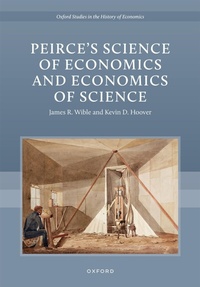
Peirceâs Science of Economics and Economics of Science
Will be published approx. on 16. September 2026
Book
Paperback/Softback
392 pages
978-0-19-783953-9 (ISBN)
Description
Charles S. Peirce (1839-1914) is most famous today as a philosopher, the founder of the philosophical school of Pragmatism, and as a logician. In his own day, he was better known as a bench scientist, astronomer, and metrologist, renowned in the international scientific community for his measurements of gravity. Peirce was, in fact, one of history's great polymaths: mathematician, a founder of semiotics and one of the earliest experimental psychologists, as well as a contributor to a number of other disciplines, lexicography, and for decades a scientific contributor to The Nation. Perhaps the least understood of Peirce's many contributions are his forays into economics. In the 1870s, no one in the world had a better understanding of mathematical economics or its applications to real-world problems.
Peirce's Science of Economics and Economics of Science is a careful examination of his engagement with economics. It takes an interdisciplinary approach. As history of economics, it reconstructs how Peirce came to possess a cutting-edge knowledge of mathematical economics at the dawn of the so-called "marginalist revolution," how he used that knowledge in concrete applications, and how he understood the nature of economics as a science. As a wider history of science, it shows how Peirce created the economics of science out of a whole cloth as part of resolving methodological problems that arose in his work of measuring gravity. The book explores applications of Peirce's ideas about economics to some long-standing problems in the philosophy of science and shows how these ideas have implications for real-world science.
Peirce's Science of Economics and Economics of Science is a careful examination of his engagement with economics. It takes an interdisciplinary approach. As history of economics, it reconstructs how Peirce came to possess a cutting-edge knowledge of mathematical economics at the dawn of the so-called "marginalist revolution," how he used that knowledge in concrete applications, and how he understood the nature of economics as a science. As a wider history of science, it shows how Peirce created the economics of science out of a whole cloth as part of resolving methodological problems that arose in his work of measuring gravity. The book explores applications of Peirce's ideas about economics to some long-standing problems in the philosophy of science and shows how these ideas have implications for real-world science.
More details
Other editions
Additional editions
James R. Wible | Kevin D. Hoover
Peirceas Science of Economics and Economics of Science
Book
approx. 09/2026
Oxford University Press Inc
€142.50
Not yet published
Persons
James R. Wible is Professor of Economics at the University of New Hampshire.
Kevin D. Hoover is Professor of Economics and Philosophy at Duke University.
Kevin D. Hoover is Professor of Economics and Philosophy at Duke University.
Content
- Prologue
- 1: The Economics of an American Aristotle
- Part I. The Science of Economics
- 2: "This is all in Cournot"
- 3: The Spanish Treaty: A Case Study of Economic Analysis
- 4: The Place of Economics Among the Sciences
- 5: On the Road to Modern Economics
- Part II. The Economics of Science
- 6: The Economy of Research
- 7: Pebbles on a Beach
- 8: Ricardian Inference: Mathematics, Models, and Analogy
- 9: The Economical Conduct of Scientific Inquiry