

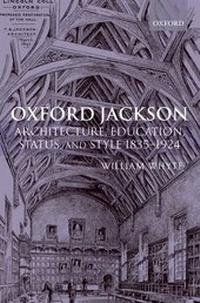
Oxford Jackson
Architecture, Education, Status, and Style 1835-1924
Published on 31. August 2006
Book
Hardback
284 pages
978-0-19-929658-3 (ISBN)
Description
In the late nineteenth century one man changed Oxford forever. T. G. Jackson built the Examination Schools, the Bridge of Sighs, worked at a dozen colleges, and restored a score of other Oxford icons. He also built for many of the major public schools, for the University of Cambridge, and at the Inns of Court. A friend of William Morris, he was a pioneering member of the arts and crafts moment. A distinguished historian, he also restored dozens of houses and churches - and ensured the survival of Winchester Cathedral. As an architectural theorist he was a leader of the generation that rejected the Gothic Revival and sought to develop a new and modern style of building.
Drawing on extensive archival work, and illustrated with a hundred images, this is the first in-depth analysis of Jackson's career ever written. It sheds light on a little-known architect and reveals that his buildings, his books, and his work as an arts and craftsman were not just important in their own right, they were also part of a wider social change. Jackson was the architect of choice for a particular group of people, for the 'intellectual aristocracy' of late Victorian England. His buildings were a means by which they could articulate their identity and demonstrate their distinctiveness. They reformed the universities and the schools whilst he refashioned their image.
Essential reading for anyone interested in Victorian architecture and nineteenth-century society, this book will also be of interest to all those who know and love Oxford or Cambridge.
Drawing on extensive archival work, and illustrated with a hundred images, this is the first in-depth analysis of Jackson's career ever written. It sheds light on a little-known architect and reveals that his buildings, his books, and his work as an arts and craftsman were not just important in their own right, they were also part of a wider social change. Jackson was the architect of choice for a particular group of people, for the 'intellectual aristocracy' of late Victorian England. His buildings were a means by which they could articulate their identity and demonstrate their distinctiveness. They reformed the universities and the schools whilst he refashioned their image.
Essential reading for anyone interested in Victorian architecture and nineteenth-century society, this book will also be of interest to all those who know and love Oxford or Cambridge.
Reviews / Votes
In this attractive book, William Whyte has wisely and ably brought Sir Thomas Graham Jackson out of the peculiar obscurity to which much of the twentieth century consigned him. * Simona Langella * Dr William Whyte s research has made a highly original contribution by integrating architecture and the built environment into cultural and intellectual history...a work of profound scholarship * Board of the Leverhulme Prize 2008 * An exploration of the career of the successful architect, Sir Thomas Graham Jackson, leads outwards into Victorian and Edwardian society in a multitude of ways. It opens up questions of taste, style, aesthetic ideals and ambitions, as well as of patronage, resources and social structure. William Whyte has seized all these oppurtunities triumphantly. * Gillian Sutherland, The English Historical Review * ...well written, based on the most extensive research and highly intelligent. * Apollo Magazine * In this attractive book, William Whyte has wisely and ably brought Sir Thomas Graham Jackson out of the peculiar obscurity to which much of the twentieth century consigned him. * Sheldon Rothblatt, History of Universities * Whyte has provided us with a highly-informed account of an architectural career and, for those unaware of how much of Oxford is Anglo-Jaxon, an eye-opening book, a pleasure to read and greatly enhanced by numerous plates and illustrations. * Sheldon Rothblatt, History of Universities * this informative and elegant study will attract all those interested in Victorian and Edwardian cultural history, and adds substantially to our knowledge of university and public-school architecture. * R. D. Anderson, History Journal * An exploration of the career of the successful architect, Sir Thomas Graham Jackson, leads outwards into Victorian and Edwardian society in a multitude of ways. It opens up questions of taste, style, aesthetic ideals and ambitions, as well as of patronage, resources and social structure. William Whyte has seized all these opportunities triumphantly. * Gillian Sutherland, English Historical Review *More details
Series
Language
English
Place of publication
Oxford
United Kingdom
Target group
Professional and scholarly
Illustrations
100 in-text half-tones
Dimensions
Height: 242 mm
Width: 164 mm
Thickness: 23 mm
Weight
585 gr
ISBN-13
978-0-19-929658-3 (9780199296583)
Copyright in bibliographic data and cover images is held by Nielsen Book Services Limited or by the publishers or by their respective licensors: all rights reserved.
Schweitzer Classification
Other editions
Additional editions

Book
02/2025
Oxford University Press
€30.95
Shipment within 15-20 days
Person
Content
Introduction ; 1. 'Recording our Eclectic Age': Jackson and the Dilemma of Style ; 2. 'The Unity of Art': Jackson and the Arts and Crafts ; 3. 'The Maker of Modern Oxford': Jackson and the Architecture of Progress ; 4. 'In the Shadow of Anglo-Jackson': Jackson and the Public Schools ; 5. 'Cambridge at Last!': Jackson and the Architecture of Science ; 6. 'An Intellectual Aristocracy': Jackson, his Clients, and their World ; Conclusion ; Bibliography ; Index