

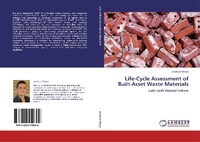
Life-Cycle Assessment of Built-Asset Waste Materials
Sustainable Disposal Options
Published on 31. January 2012
Book
Paperback/Softback
208 pages
978-3-8465-5960-4 (ISBN)
Description
Life-cycle assessment (LCA) of built-asset waste materials and respective sustainable waste-disposal options are increasingly important for an industry that generates a significant proportion of all matter sent to landfill. Legislation-push from the aggregates levy and landfill restrictions, together with technology-pull from modern re-use and recycling techniques, will continue to exert pressure on recycling rates for construction waste and demolition materials. To recognise the potential of construction and demolition waste as a resource, guidance is needed. This book presents a guide to determining sustainable options for the reduction, re-use, recycling and disposal of demolition waste, and provides essential information related to: the background variables influencing the waste management of construction demolition waste; an assessment procedure setting-out a method for determining sustainable disposal options; and, an examination of the sub-divisions of demolition waste and respective waste management routes in terms a Triple-Bottom-Line (TBL) analysis of environmental impact, financial cost and social safeguard legislation.
More details
Language
English
Place of publication
Germany
Product notice
Paperback (trade)
Unsewn / adhesive bound
Dimensions
Height: 220 mm
Width: 150 mm
Thickness: 14 mm
Weight
328 gr
ISBN-13
978-3-8465-5960-4 (9783846559604)
Copyright in bibliographic data and cover images is held by Nielsen Book Services Limited or by the publishers or by their respective licensors: all rights reserved.
Schweitzer Classification
Person
Having worked in both industrial and academic environments in Europe and Asia-Pacific, Dr Andrew Whyte has gained a wide-ranging knowledge of: construction management; design team integration; whole-life assessment of building; and, asset development through viable local technologies, environmentally sustainable methods and low-cost means.