

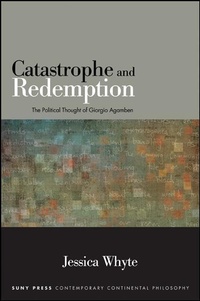
Catastrophe and Redemption
The Political Thought of Giorgio Agamben
Published on 1. December 2013
Book
Hardback
223 pages
978-1-4384-4853-4 (ISBN)
Description
Offers a striking new reading of Agamben's political thought and its implications for political action in the present.
Challenging the prevalent account of Agamben as a pessimistic thinker, Catastrophe and Redemption proposes a reading of his political thought in which the redemptive element of his work is not a curious aside but instead is fundamental to his project. Jessica Whyte considers his critical account of contemporary politics-his argument that Western politics has been "biopolitics" since its inception, his critique of human rights, his argument that the state of exception is now the norm, and the paradigmatic significance he attributes to the concentration camp-and shows that it is in the midst of these catastrophes of the present that Agamben sees the possibility of a form of profane redemption. Whyte outlines the importance of potentiality in his attempt to formulate a new politics, examines his relation to Jewish and Christian strands of messianism, and interrogates the new forms of praxis that he situates within contemporary commodity culture, taking Agamben's thought as a call for the creation of new political forms.
Challenging the prevalent account of Agamben as a pessimistic thinker, Catastrophe and Redemption proposes a reading of his political thought in which the redemptive element of his work is not a curious aside but instead is fundamental to his project. Jessica Whyte considers his critical account of contemporary politics-his argument that Western politics has been "biopolitics" since its inception, his critique of human rights, his argument that the state of exception is now the norm, and the paradigmatic significance he attributes to the concentration camp-and shows that it is in the midst of these catastrophes of the present that Agamben sees the possibility of a form of profane redemption. Whyte outlines the importance of potentiality in his attempt to formulate a new politics, examines his relation to Jewish and Christian strands of messianism, and interrogates the new forms of praxis that he situates within contemporary commodity culture, taking Agamben's thought as a call for the creation of new political forms.
Reviews / Votes
"Scholars of Agamben have long pondered about the coming community, and laboured to defend their Agambenian inspired work against accusations of negativity and esotericism. Now, thanks to Jessica Whyte ... that task will become a little easier." - ephemera"One of the book's strengths is to reveal the essential bond between sovereign power and political, social, and cultural identities ... [a] fascinating book." - Comparative and Continental Philosophy
"...Catastrophe and Redemption offers a good critical overview of Agamben's work." - Contemporary Political Theory
"...successfully break[s] through the crust of an interpretative machine around Agamben that has grown torpid by repetition ... Whyte's reading of Agamben is nuanced, and her attention to the dynamics of capitalism and the history of political struggle provide an important corrective to some of his philosophical tendencies, without jettisoning insights." - Law and Critique
"...Whyte identifies key questions which will need to be asked in order to transform this world. Such questions relate to challenging inequality, challenging capitalism's colonialism of the future, and creating new forms of solidarity. To address these issues, Whyte draws us to her conclusion that it is not enough to accede to teleological formations of capitalism. We must begin to develop ways to contest it. This slim volume can be seen as such a call to arms." - Symposium
More details
Series
Language
English
Place of publication
Albany, NY
United States
Target group
College/higher education
Professional and scholarly
US School Grade: College Graduate Student and over
Product notice
sewn/stitched
Cloth over boards
Dimensions
Height: 236 mm
Width: 163 mm
Thickness: 20 mm
Weight
522 gr
ISBN-13
978-1-4384-4853-4 (9781438448534)
Copyright in bibliographic data and cover images is held by Nielsen Book Services Limited or by the publishers or by their respective licensors: all rights reserved.
Schweitzer Classification
Other editions
Additional editions
E-Book
10/2013
1st Edition
De Gruyter
from
€84.99
Available for download
Person
Jessica Whyte is Lecturer in Cultural and Social Analysis at the University of Western Sydney, Australia. She is the coeditor (with Alex Murray) of The Agamben Dictionary.
Content
Acknowledgments
Introduction: On Catastrophe and Redemption
Katechon, Antichrist, Messiah
Flowers and Chains
Chapter Outline
1. The Politics of Life
Agamben and Foucault: On Biopolitics, Ancient and Modern
Biopolitics and Sovereignty
Biopolitical Being
The Rights of Bare Life
Hoping Merely Out of Stupidity
2. Politics at the Limits of the Law: On the State of Exception
The State of Exception
Carl Schmitt: The Paradox of Sovereignty
Presupposition and the Problem of Application
The State of "Nature"
Challenging the Normalization of the Exception?
3. If This Is a Man: Life after Auschwitz
The Remnant Shall Be Saved
The Danger
Where Danger Is, Grows the Saving Power Also
4. "I Would Prefer Not To": Bartleby, Messianism, and the Potentiality of the Law
The Law Is a Dry Canal
Aristotle and the Origins of Sovereignty
Past Contingent
Bartleby as Messiah?
5. A New Use: On Society of the Spectacle and the Coming Politics
Paying Pilgrimage to the Commodity Fetish
The Eclipse of Use and the "Dialectical Salvation of the Commodity"
A New Use for the Self: The Global Petty Bourgeoisie and the Coming Community
We Are Saved When We No Longer Want to Be
Conclusion: Unemployment and the Ungovernable
Notes
Bibliography
Index
Introduction: On Catastrophe and Redemption
Katechon, Antichrist, Messiah
Flowers and Chains
Chapter Outline
1. The Politics of Life
Agamben and Foucault: On Biopolitics, Ancient and Modern
Biopolitics and Sovereignty
Biopolitical Being
The Rights of Bare Life
Hoping Merely Out of Stupidity
2. Politics at the Limits of the Law: On the State of Exception
The State of Exception
Carl Schmitt: The Paradox of Sovereignty
Presupposition and the Problem of Application
The State of "Nature"
Challenging the Normalization of the Exception?
3. If This Is a Man: Life after Auschwitz
The Remnant Shall Be Saved
The Danger
Where Danger Is, Grows the Saving Power Also
4. "I Would Prefer Not To": Bartleby, Messianism, and the Potentiality of the Law
The Law Is a Dry Canal
Aristotle and the Origins of Sovereignty
Past Contingent
Bartleby as Messiah?
5. A New Use: On Society of the Spectacle and the Coming Politics
Paying Pilgrimage to the Commodity Fetish
The Eclipse of Use and the "Dialectical Salvation of the Commodity"
A New Use for the Self: The Global Petty Bourgeoisie and the Coming Community
We Are Saved When We No Longer Want to Be
Conclusion: Unemployment and the Ungovernable
Notes
Bibliography
Index