

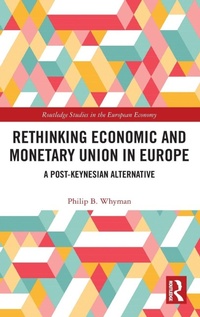
Rethinking Economic and Monetary Union in Europe
A Post-Keynesian Alternative
1st Edition
Published on 23. January 2018
Book
Hardback
116 pages
978-1-138-20334-1 (ISBN)
Description
In the wake of the Greek crisis, the future of the EU is the subject of a great deal of debate. This book critically evaluates the current new monetarist model of Economic and Monetary Union in Europe, presenting an alternative post-Keynesian (progressive) model, aimed at addressing the current problems of trade imbalance and asymmetric macroeconomic policy infrastructure that are augmenting tensions within the Eurozone.
The book's approach is based upon the development of a common, rather than a single, currency approach, and utilises post-Keynesian policy solutions in order to create a form of EMU which will promote full employment rather than austerity.
The book's approach is based upon the development of a common, rather than a single, currency approach, and utilises post-Keynesian policy solutions in order to create a form of EMU which will promote full employment rather than austerity.
More details
Series
Language
English
Place of publication
London
United Kingdom
Publishing group
Taylor & Francis Ltd
Target group
College/higher education
Illustrations
1 s/w Tabelle, 10 s/w Abbildungen, 10 s/w Zeichnungen
1 Tables, black and white; 10 Line drawings, black and white; 10 Illustrations, black and white
Dimensions
Height: 240 mm
Width: 161 mm
Thickness: 12 mm
Weight
367 gr
ISBN-13
978-1-138-20334-1 (9781138203341)
Copyright in bibliographic data and cover images is held by Nielsen Book Services Limited or by the publishers or by their respective licensors: all rights reserved.
Schweitzer Classification
Other editions
Additional editions
Book
09/2020
1st Edition
Routledge
€64.50
Shipment within 15-20 days
E-Book
01/2018
1st Edition
Routledge
€59.49
Available for download
Person
Philip B. Whyman is Professor of Economics at the University of Central Lancashire, UK.
Content
Introduction 1. Why is the Current Model of EMU Not Working? 2. Single Currency or Common Currency? 3. Monetary Policy in the Keynesian EMU 4. Rediscovering Fiscal Policy 5. Breathing Life into the European Social Model 6. Conclusion Bibliography